

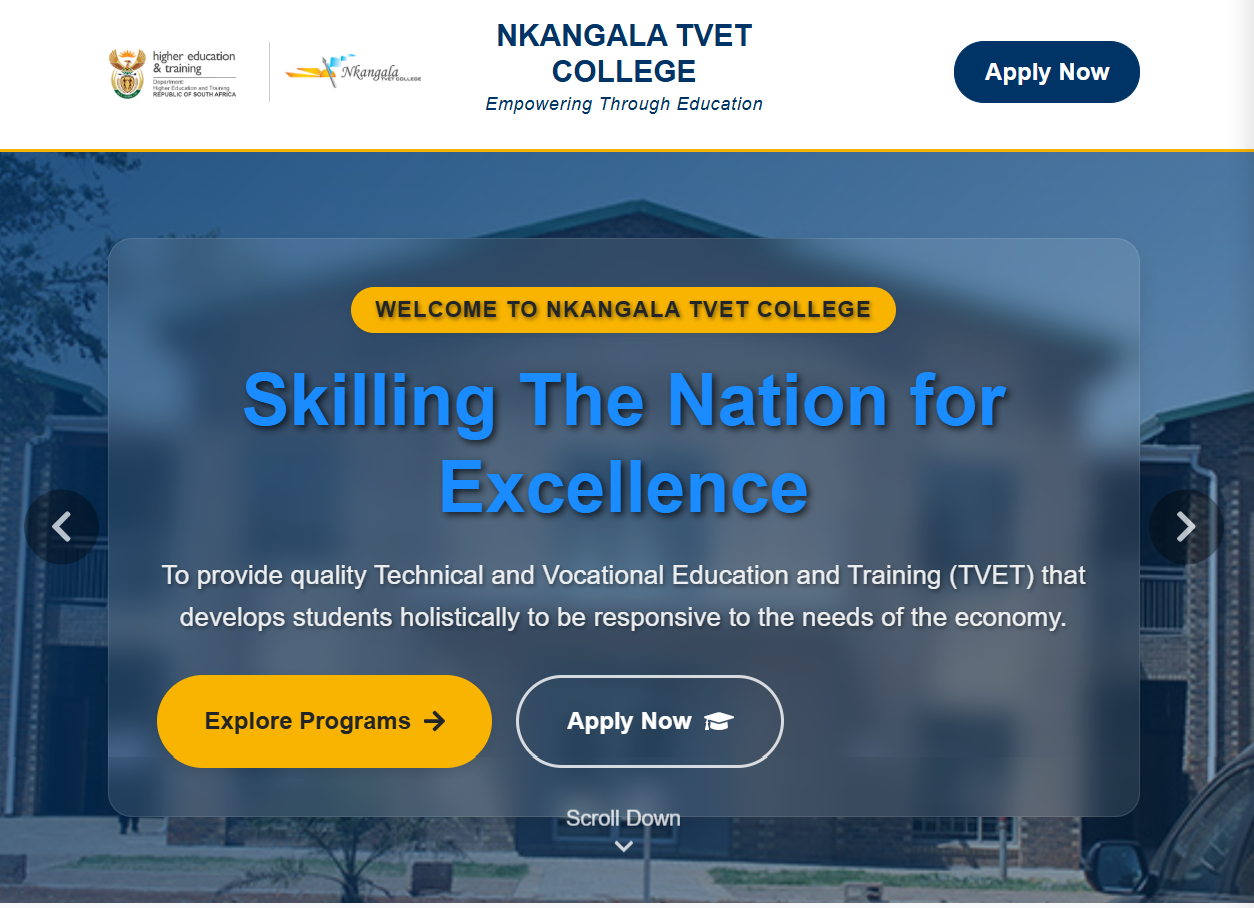
If you’re looking to study a public vocational course in Mpumalanga next year, Nkangala TVET College is one of the best places to start. It’s the largest public TVET college in the province, with six campuses spread across the Nkangala district, and it offers a wide mix of NCV and NATED (Report 191) programmes that lead directly into engineering, business, IT, and hospitality careers.
This guide walks you through everything you need to know about applying to Nkangala TVET College for the 2027 academic year — from when applications open, to what documents you need, to how to actually submit your application online.
Official application portal: https://www.ntc.edu.za/apply.html
Quick Overview: Nkangala TVET College at a Glance
Nkangala TVET College was formed in 2003 through the merger of the Witbank, Middelburg, Mpondozankomo, and CN Mahlangu technical colleges, with the Waterval Boven campus joining later in 2011. Today it’s the largest educational institution in Mpumalanga, serving communities across the Nkangala district and beyond.
- Head office: New Central Office, Corner Frans & Susanna Street, Witbank (eMalahleni)
- Campuses: Middelburg, Witbank, KwaMhlanga, CN Mahlangu, Mpondozankomo, and Waterval Boven
- Qualifications offered: NC(V) Levels 2–4, NATED (Report 191) N1–N6, and Occupational Programmes (QCTO)
- Funding: NSFAS-accredited — most qualifying students study tuition-free
- Official website: www.ntc.edu.za
When Do 2027 Applications Open?
Nkangala TVET College follows a fairly predictable application calendar each year:
- The main annual intake application window traditionally opens around September and closes at the end of September or into October the year before the intake. So, applications for the 2027 academic year are expected to open around September 2026.
- Because Nkangala runs on a trimester and semester system, there are also multiple entry points during the year for NATED and short programmes (for example, trimester and semester applications have historically opened in April and May of the same year).
Because exact dates can shift slightly from year to year, always double-check the live dates on the official site before you get started: www.ntc.edu.za. Popular programmes — especially Engineering and IT — tend to reach capacity quickly, so it pays to apply as early in the window as possible.
Step 1: Complete the Online Placement Test
Before you can even open the formal application form, Nkangala requires all new applicants to complete a pre-application Placement Test. This is a requirement from the Department of Higher Education and Training (DHET), not just a Nkangala rule.
A few important things to know about this step:
- It is not a pass-or-fail exam. It’s an academic and interest-profiling tool designed to check whether your chosen course actually matches your strengths and interests.
- You’ll usually complete it through the college’s designated testing platform (often linked via CareerXplora).
- Even if you decide to apply for a course different from what the test recommends, the college still needs proof that you understand the trade-offs of that choice.
- Save your completion certificate or reference number — you’ll need to upload or reference it during the main application.
Skipping this step is the single most common reason applications get delayed or rejected outright, so don’t skip it.
Step 2: Register on the Application Portal
Once your placement test is done, head to the official application page:
👉 https://www.ntc.edu.za/apply.html
From there:
- Click “Apply Now” (or “Apply Online”).
- Register using a valid email address and an active cellphone number. These are the two channels the college will use to communicate with you throughout the process — application updates, offer letters, and registration instructions all come through here, so use details you check regularly.
- Create your applicant profile and password. Keep these details safe, as you’ll use the same login to check your application status later.
Step 3: Gather Your Required Documents
Before you fill in the actual form, prepare clear, certified copies of the following documents. Certification simply means a certified copy stamp from a police station, commissioner of oaths, or the South African Post Office — an uncertified scan or photo is usually not accepted.
You’ll typically need:
- Certified copy of your ID document or birth certificate (for minors without an ID yet)
- Certified copy of your latest school report or Grade 9–12 results, depending on the programme you’re applying for
- Proof of residence (not older than three months)
- Placement Test completion certificate/reference number
- Passport-style photo (some campuses request this)
Having these ready and scanned in advance will save you a lot of back-and-forth once you’re inside the application form.
Step 4: Choose Your Qualification Type
Nkangala offers three distinct academic pathways, and choosing the correct one matters — applying for the wrong stream can result in an automatic rejection from the portal.
NC(V) — National Certificate Vocational (Level 2–4)
A three-year, full-time qualification designed as an alternative route to Grades 10–12. It’s aimed at learners who have completed Grade 9, 10, or 11 and want to specialise in a vocational career early, rather than finishing the traditional matric route.
NC(V) programme fields available at Nkangala:
- Civil Engineering and Building Construction
- Electrical Infrastructure Construction
- Engineering and Related Design
- Finance, Economics and Accounting
- Office Administration
- Transport and Logistics
- Information Technology and Computer Science
- Hospitality
- Pre-Vocational Learning (PLP)
NATED / Report 191 (N1–N6)
A trimester-based occupational programme, common for engineering trades such as:
- Boilermaking and Fitting
- Electrical Engineering
- Civil Engineering
These programmes generally require a matric or relevant N-level pass to progress and are popular with students working towards a National Diploma alongside workplace experience.
Occupational Programmes (QCTO)
Skills-focused programmes aligned with specific trade qualifications, registered under the Quality Council for Trades and Occupations.
Step 5: Fill In and Submit the Application Form
Once you’re logged into the portal:
- Complete your personal details (ID number, contact details, home address).
- Select your preferred programme and campus.
- Upload all the certified documents you prepared in Step 3.
- Review everything carefully — errors in ID numbers or missing documents are a leading cause of processing delays.
- Click Submit.
You should receive a confirmation email with a student/application number shortly after submitting. Keep this number safe — you’ll need it to track your application status and for any follow-up communication with the college.
Choosing Your Campus
Nkangala TVET College operates across six locations, each with its own character and, in some cases, specialised offerings:
| Campus | Location | Notes |
|---|---|---|
| Witbank (Head Office) | eMalahleni | Main administrative hub |
| Middelburg | Middelburg | Offers a wide range of student support services, including computer labs, workshop facilities, and an on-campus clinic |
| KwaMhlanga | KwaMhlanga | Serves the northern part of the district |
| CN Mahlangu | Rural Nkangala area | Predominantly rural intake |
| Mpondozankomo | Rural Nkangala area | Community-focused campus |
| Waterval Boven | Waterval Boven | Smaller, rural campus setting |
If you’re unsure which campus offers your chosen programme, it’s worth calling the campus directly before applying, since not every programme runs at every site.
NSFAS Funding: Will You Have to Pay?
One of the biggest draws of Nkangala TVET College is that it’s a fully NSFAS-accredited public institution. This means:
- Qualifying students can have their full tuition covered, along with a living allowance, for both NCV and NATED programmes.
- There is generally no fee to submit your application — applying is free at public TVET colleges.
- A registration fee may apply only once you’ve been formally accepted, and NSFAS can cover this too if you qualify.
- Tuition for non-NSFAS students typically ranges from around R2,000 to R16,000 per year, depending on the qualification level, with NATED N4–N6 usually costing more due to specialisation.
- If you don’t qualify for NSFAS, most campuses can arrange a payment plan.
To apply for NSFAS funding, you’ll generally need to complete a separate application on the NSFAS website once your Nkangala application is submitted, so don’t assume the two processes happen automatically together.
Common Mistakes to Avoid
- Skipping the Placement Test. Your application literally cannot be processed without it.
- Uncertified documents. A plain photocopy or phone photo of your ID won’t be accepted — get it properly certified.
- Applying for the wrong stream. Make sure your current grade level matches the NCV or NATED entry requirements before you select a programme.
- Using an email or number you don’t check. All official updates come through these channels — missing a message could cost you your spot.
- Waiting until the deadline. Popular programmes like Engineering and IT fill up well before the closing date.
Staying Safe: Watch Out for Scammers
Nkangala TVET College has publicly warned prospective students to be cautious of scammers impersonating the college through calls, messages, or emails. If you receive suspicious communication claiming to be from the college, don’t act on it immediately — verify it first by contacting a campus directly:
- Witbank Campus: 013 656 2597
- Middelburg Campus: 013 243 2148
- CN Mahlangu Campus: 013 973 9113 / 9114
- Mpondozankomo Campus: 013 690 0302
- Waterval Boven Campus: 065 588 9795
- General enquiries: [email protected] | 013 690 1885
Only ever apply through the official portal at www.ntc.edu.za/apply.html — never through a third-party link or an unsolicited message asking for payment to “secure” your spot.
Final Checklist Before You Apply
- Completed the online Placement Test and saved my reference number
- Certified copy of ID/birth certificate
- Certified copy of latest school results
- Proof of residence (less than 3 months old)
- Decided on my qualification stream (NCV, NATED, or Occupational)
- Chosen my preferred campus
- Active email address and cellphone number ready for registration
- Applied through the official portal only: www.ntc.edu.za/apply.html
Applying to a TVET college is one of the most direct paths into a hands-on career in South Africa, and Nkangala’s mix of campuses, programmes, and NSFAS support makes it a genuinely strong option if you’re based in Mpumalanga. Start your Placement Test early, keep your documents ready, and apply the moment the 2027 window opens — the earlier you get in, the better your chances of securing your first-choice programme and campus.
Always confirm exact dates and requirements on the official Nkangala TVET College website — www.ntc.edu.za — as colleges reserve the right to update admission rules and deadlines from year to year.



Conversation
0 Comments