

The Long March of the Chinese Red Army is a monumental event in modern Chinese history. It represents a strategic retreat and a turning point that ultimately led to the Communist Party’s victory. This arduous journey, spanning over 9,000 kilometers, tested the limits of human endurance and resilience. While historical accounts and oral traditions have preserved its memory, visual records offer a unique and powerful connection to this epic undertaking. Recently, a collection of rare photographs, preserved by American journalist Helen Foster Snow, has shed new light on the experiences of the Red Army during this critical period. These images provide a tangible link to the past, allowing us to witness firsthand the challenges, the people, and the spirit of those who participated in the Long March.
This article will explore the significance of these photographs, delve into their historical context, and examine what they reveal about the Red Army and the era in which they were taken. We will look at the journey of these images from the front lines of the Long March to their preservation in a university archive, and consider their value as historical documents.
The Significance of Visual Records in Understanding the Long March
Historical events are often understood through written accounts, official records, and personal testimonies. While these sources are invaluable, visual records like photographs offer a different dimension of understanding. They capture moments in time, providing direct evidence of people, places, and events that can evoke a stronger emotional response and offer insights that words alone might not convey.
For an event as vast and impactful as the Long March, photographs serve several crucial purposes. They humanize the soldiers and leaders, showing them not just as historical figures but as individuals enduring immense hardship. They document the diverse landscapes the Red Army traversed, from rugged mountains to vast plains, illustrating the sheer scale of the journey. Furthermore, these images can reveal details about the daily life, equipment, and interactions of the soldiers, offering a glimpse into the practical realities of their struggle. The rarity of such images from the Long March era makes this collection particularly important for historians and the public alike.
Helen Foster Snow’s Contribution to Documenting the Long March
Helen Foster Snow, an American journalist, played a pivotal role in bringing the story of the Chinese Revolution to the Western world. Alongside her husband, Edgar Snow, she was deeply involved in reporting on China during a tumultuous period. In 1937, Helen Snow undertook a dangerous journey to Yan’an, the revolutionary base area in northwest China. She spent over four months there, conducting interviews and gathering materials, which later formed the basis of her book, Inside Red China.
During her time in Yan’an and her travels, Snow collected a significant archive of documents, manuscripts, and photographs. These materials were not merely personal mementos; they were carefully gathered records of the revolutionary movement and the lives of those involved. Recognizing the historical importance of her collection, Helen Snow ensured its preservation. Before her death in 1997, she arranged for a substantial portion of her archives, including these precious photographs, to be donated to Brigham Young University (BYU) in the United States. This act of preservation has made these visual records accessible to researchers and the public, allowing for a deeper understanding of the Long March and the Chinese Revolution.
Uncovering Rare Images at Brigham Young University
To commemorate the 90th anniversary of the Long March victory, reporters from Xinhua News Agency visited Brigham Young University’s Harold B. Lee Library, specifically its L. Tom Perry Special Collections. This visit led to the uncovering of a remarkable collection of photographs documenting the Long March. Among these were two particularly rare and significant images that offer unique insights into the Red Army’s journey.
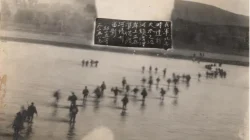
The first of these striking photographs captures soldiers of the 25th Army crossing the Wei River in August 1935. This image provides a rare visual record of a critical moment during the march, illustrating the challenges of river crossings and the determination of the soldiers. The second photograph is a portrait of two individuals from an ethnic minority group encountered along the Long March. This image holds special significance as it was personally given to Helen Snow by Kang Keqing, the wife of General Zhu De, a prominent leader of the Red Army. These two photographs, along with others in the collection, serve as powerful testaments to the diverse experiences and encounters of the Red Army.
A Deeper Look at the Photographic Collection
Beyond the two highlighted images, Helen Foster Snow’s collection at BYU contains numerous other precious photographs that offer a broader perspective on the Red Army’s activities and the context of the Long March. These images, exhibited in the L. Tom Perry Special Collections, depict various aspects of the Red Army’s life and operations, providing valuable historical context.
One photograph shows a graduation ceremony of a training unit of the Chinese Red Army in 1932. This image predates the main Long March but offers insight into the organized military training and development within the Red Army prior to the arduous retreat. It suggests a focus on building a disciplined and skilled fighting force even in the early stages of the revolution.
Another significant photograph is a group portrait of all delegates at the First National Political Work Conference of the Chinese Workers’ and Peasants’ Red Army in 1934. This gathering was a crucial event, likely taking place just before or at the very beginning of the Long March. The image captures the leadership and representatives who were instrumental in planning and executing the subsequent military campaign, highlighting the political and strategic importance of the conference.
The collection also includes images that document the Red Army’s movements and interactions with different regions and peoples. One photograph shows the Red Army’s 25th Army arriving in Yongping in September 1935. This image marks a significant moment where the 25th Army joined forces with the 26th and 27th armies. This consolidation of forces was vital for the overall strength and success of the Red Army during the Long March.
Further illustrating the diverse encounters during the march, another photograph features Wang Zhen, a political commissar of the Red Army’s Sixth Corps, posing with representatives of the Miao and Han ethnic groups. This image, taken in Bijie County, Guizhou Province, highlights the Red Army’s interactions with various ethnic communities across China. It suggests an effort to build relationships and gain support from local populations during their long journey.
The collection also provides glimpses into the military actions of the Red Army. One photograph depicts commanders and fighters of the first company, fourth regiment, second Division of the Red Army’s Anti-Japanese Vanguard capturing Xiangling in Shanxi Province in 1936. This image showcases the Red Army’s engagement in combat and territorial control during the later stages of the Long March, demonstrating their continued military operations.
Finally, images of Red Army cavalry conducting drills and soldiers firing a mortar on the front line in Ningxia Hui Autonomous Region offer a direct view of the military capabilities and operational tactics employed by the Red Army. These photographs underscore the fact that the Long March was not just a retreat but also a period of active military engagement and strategic maneuvering.
The Long March: A Historical Overview
To fully appreciate the context of these photographs, it is essential to understand the historical backdrop of the Long March. The Long March was not a single event but a series of marches undertaken by various Communist armies between 1934 and 1936. The primary impetus for the Long March was the failure of the Chinese Communist Party (CCP) to defend its main base in Jiangxi Province against the Nationalist (Kuomintang or KMT) forces led by Chiang Kai-shek.
Facing encirclement and annihilation, the CCP leadership decided to break out of the KMT blockade and relocate their forces to a new, more secure base in the north. This strategic withdrawal began in October 1934. The Red Army, initially comprising around 86,000 soldiers, embarked on a journey that would become legendary. They faced constant attacks from KMT troops, as well as harsh natural conditions, including treacherous mountain ranges, vast swamps, and extreme weather.
During the march, the CCP leadership underwent significant changes. Mao Zedong rose to prominence during the Zunyi Conference in January 1935, solidifying his leadership within the party and the Red Army. This marked a turning point in both the Long March and the future direction of the CCP. The various Red Army groups, after enduring immense hardships and losses, eventually converged in Shaanxi Province in late 1936, having covered an estimated distance of 12,500 kilometers (about 7,800 miles).
The Long March is often viewed as a defining moment for the CCP. It became a powerful symbol of resilience, sacrifice, and revolutionary spirit. Despite suffering heavy casualties, the Red Army preserved its core leadership and military strength, laying the foundation for its eventual victory in the Chinese Civil War in 1949. The narrative of the Long March has been central to the CCP’s historical discourse, shaping national identity and political ideology.
The Red Army: Composition and Challenges
The Red Army that undertook the Long March was a diverse force, composed of soldiers drawn from various backgrounds across China. While often depicted as a unified entity, it was made up of different armies and units, each with its own history and experiences. The primary forces involved included the First, Second, and Fourth Front Armies, along with smaller units like the Twenty-Fifth Army, whose crossing of the Wei River is captured in one of Helen Snow’s photographs.
The soldiers were predominantly peasants, many of whom had joined the Red Army seeking land reform and an end to the exploitation they faced under the Nationalist government and local warlords. There were also intellectuals, workers, and former soldiers who had been disillusioned with the KMT regime. The army was characterized by its revolutionary fervor, strong political indoctrination, and a commitment to the Communist cause.
However, the challenges faced by the Red Army were immense and multifaceted.
Military Opposition
The most immediate and constant threat came from the Nationalist forces. Chiang Kai-shek’s government deployed hundreds of thousands of troops to intercept and destroy the retreating Red Army. The KMT employed various tactics, including blockades, aerial bombardment, and ground assaults, making every step of the march a battle for survival. The Red Army had to constantly outmaneuver, engage, and overcome these superior numbers and better-equipped forces.
Natural Obstacles
The terrain itself was a formidable enemy. The Red Army traversed some of the most challenging landscapes in China. They crossed the treacherous Xiang River, where they suffered heavy losses. They navigated the perilous marshes of the Zhuge Liang Marsh, a vast and dangerous wetland where soldiers often sank and drowned. The journey also involved crossing numerous mountain ranges, including the snow-capped Luding Mountains, where soldiers had to endure freezing temperatures and thin air. These natural barriers tested the physical endurance of the soldiers to their absolute limits.
Logistical Difficulties
Supplying an army of tens of thousands of people over such a vast distance presented enormous logistical challenges. Food, ammunition, medical supplies, and equipment were scarce. The Red Army often had to forage for food, capture supplies from enemy outposts, or rely on the limited support of sympathetic local populations. This scarcity led to widespread hunger, disease, and exhaustion among the troops.
Internal Strife and Political Challenges
While the Long March is often portrayed as a unified effort, there were internal political struggles and disagreements within the Red Army and the CCP leadership. The Zunyi Conference, for instance, was a critical moment where Mao Zedong consolidated his power, sidelining rivals. Maintaining morale and discipline among troops facing constant death and hardship was also a significant challenge. Political commissars played a vital role in maintaining ideological commitment and preventing desertions.
Encounters with Ethnic Minorities
As the Red Army marched through diverse regions of China, they encountered numerous ethnic minority groups. The photograph featuring individuals from an ethnic minority group highlights these encounters. The Red Army’s interactions with these groups varied. In some instances, they sought to win their support by respecting their customs and promising land reform. In other cases, misunderstandings or conflicts arose. The ability of the Red Army to navigate these complex inter-ethnic relations was crucial for their survival and their ability to gain local support.
Analyzing the Photographs: What They Reveal
The photographs from Helen Foster Snow’s collection offer a unique window into the realities of the Long March, complementing written accounts with visual evidence. Each image tells a story, contributing to a richer understanding of this historical event.
The Wei River Crossing (August 1935)
The image of the 25th Army crossing the Wei River is particularly compelling. It shows soldiers actively engaged in crossing a significant body of water, likely using makeshift rafts or by wading through its currents. The scene suggests a determined effort to overcome a natural obstacle under challenging conditions. The soldiers appear focused and resolute, highlighting their commitment to the mission despite the inherent dangers of such a crossing. This photograph visually confirms the arduous nature of the Red Army’s movements and their constant struggle against the environment. It also points to the strategic importance of river crossings in controlling territory and maintaining momentum during the march.
Encounters with Ethnic Minorities
The photograph of two individuals from an ethnic minority group, personally given to Helen Snow by Kang Keqing, is significant for several reasons. Firstly, it underscores the diverse populations the Red Army encountered. Secondly, its presentation by Kang Keqing, a prominent figure, suggests that these interactions were considered important by the Red Army leadership. The individuals in the photograph appear to be observing the soldiers or perhaps engaging with them. This image prompts questions about the nature of these encounters: were they friendly exchanges, moments of curiosity, or perhaps tinged with apprehension? It serves as a reminder that the Long March traversed regions inhabited by various ethnic groups, each with their own cultures and histories, and the Red Army’s passage impacted and was impacted by these communities.
Daily Life and Military Operations
Other photographs in the collection provide further insights. The image of a graduation ceremony from 1932 illustrates the organized nature of the Red Army’s training and development, even before the Long March began. It shows a structured approach to building military capacity. The group photo of delegates at the 1934 Political Work Conference captures the leadership at a critical juncture, emphasizing the political and strategic planning that underpinned the military campaign.
Photographs depicting military actions, such as the capture of Xiangling or the cavalry drills, reveal the Red Army’s combat readiness and operational capabilities. The image of soldiers firing a mortar on the front line in Ningxia provides a stark visual of the active combat engagements the Red Army faced. These images move beyond the narrative of a simple retreat, showing the Red Army as an active military force engaged in strategic maneuvers and battles.
The photograph of Wang Zhen with representatives of the Miao and Han ethnic groups is a powerful illustration of the Red Army’s efforts to engage with local populations. It suggests a policy of seeking cooperation and understanding across different ethnic and cultural lines. This aspect of the Long March is often less emphasized than the military and survival aspects, making such visual evidence particularly valuable.
The Legacy of the Long March and its Visual Documentation
The Long March remains a cornerstone of modern Chinese history and a potent symbol for the Communist Party. It is celebrated as an epic feat of endurance, strategic brilliance, and revolutionary dedication. The narrative of the Long March has been instrumental in shaping the CCP’s legitimacy and its historical narrative. It is often presented as a heroic struggle against overwhelming odds, a testament to the unwavering spirit of the revolutionaries.
The visual documentation of this event, particularly through collections like Helen Foster Snow’s photographs, plays a crucial role in preserving and disseminating this legacy. These images offer a tangible connection to the past, allowing future generations to visualize the scale of the journey, the hardships endured, and the human faces behind the historical accounts. They provide a counterpoint to purely textual narratives, offering a more immediate and visceral understanding of the event.
The preservation of these photographs at Brigham Young University is a testament to the international interest in China’s modern history and the efforts of individuals like Helen Foster Snow to document and share these crucial stories. By making these images accessible, universities and archives contribute to a broader global understanding of historical events and the complex forces that shaped them.
The Long March continues to inspire and resonate within China and beyond. Its legacy is not just one of military achievement but also of political transformation, national identity formation, and enduring human spirit. The rare photographs unearthed from Helen Foster Snow’s collection serve as powerful reminders of this extraordinary journey, ensuring that its visual history is not lost to time.
Conclusion
The collection of rare photographs documenting the Chinese Red Army’s Long March, preserved through the efforts of Helen Foster Snow and housed at Brigham Young University, offers an invaluable visual record of a pivotal moment in history. These images move beyond abstract historical accounts, providing concrete glimpses into the soldiers’ lives, the challenging landscapes they traversed, and the diverse encounters they experienced. From the strategic crossing of the Wei River to interactions with ethnic minority groups and scenes of military operations, these photographs enrich our understanding of the Red Army’s resilience, determination, and the immense scale of their undertaking. The Long March remains a symbol of sacrifice and revolutionary spirit, and these visual documents ensure that its legacy is not only remembered but also vividly seen.


Conversation
0 Comments