

Understanding the Mechanics of Earthquakes: A Deep Dive into Tectonic Forces
Earthquakes are powerful natural events that can reshape landscapes and impact communities. While often perceived as a simple shaking of the ground, the underlying geological processes are complex and fascinating. Understanding the forces at play, particularly the movement of tectonic plates, is key to comprehending why and how earthquakes occur. This article will explore the fundamental mechanics of earthquakes, focusing on the different types of fault movements and the geological context in which they happen, using recent seismic activity as a case study.
The Earth’s Dynamic Crust: Tectonic Plates in Motion
Our planet’s outer shell, the lithosphere, is not a single, unbroken piece. Instead, it’s divided into several large and smaller tectonic plates that float on the semi-fluid asthenosphere beneath them. These plates are in constant, slow motion, driven by heat from the Earth’s interior. This movement is not uniform; plates can collide, pull apart, or slide past each other. The boundaries between these plates are where most of the Earth’s seismic activity originates.
The immense forces generated by these plate movements build up stress along fault lines, which are fractures in the Earth’s crust. When this stress exceeds the strength of the rocks, the rocks break or slip, releasing stored energy in the form of seismic waves. These waves travel through the Earth and cause the ground to shake, resulting in an earthquake. The type of movement along a fault determines the kind of earthquake that occurs.
Types of Faults and Their Seismic Signatures
Geologists classify faults based on the direction of movement of the rock blocks on either side of the fault. The three primary types are:
1. Normal Faults: The Result of Extension
Normal faults occur in areas where the Earth’s crust is being pulled apart, or extended. In this type of fault, the hanging wall (the block of rock above the fault plane) moves downward relative to the footwall (the block of rock below the fault plane). This downward movement is caused by tensional forces, essentially stretching the crust. Earthquakes associated with normal faults are typically found at divergent plate boundaries, where plates are moving away from each other, or in areas of crustal thinning.
The recent earthquake in the Xizang Autonomous Region, for instance, was identified as an extensional rupture. This means that even though the broader region is experiencing compression due to the collision of the India and Eurasia plates, this specific fault within the Qiangtang block was experiencing stretching. This phenomenon highlights that different forces can be at play in different parts of a larger tectonic system. The crust in this area is being stretched horizontally, leading to the upper block sliding down along the fault.
2. Reverse Faults and Thrust Faults: The Product of Compression
Reverse faults and thrust faults occur in areas where the Earth’s crust is being squeezed or compressed. In a reverse fault, the hanging wall moves upward relative to the footwall. This upward movement is driven by compressional forces. Thrust faults are a type of reverse fault where the fault plane is nearly horizontal, and the upper block is pushed up and over the lower block for a significant distance. These types of faults are common at convergent plate boundaries, where plates are colliding. The Himalayas, for example, are a result of such compressional forces and associated faulting.
Earthquakes generated by reverse and thrust faults can be particularly powerful and destructive because they involve large blocks of crust being pushed against each other. The energy released can be substantial, leading to significant ground shaking and potential for landslides and other secondary hazards.
3. Strike-Slip Faults: The Motion of Sliding Past
Strike-slip faults occur where two blocks of crust slide horizontally past each other. The movement is primarily lateral, with little to no vertical displacement. The San Andreas Fault in California is a famous example of a strike-slip fault. These faults are often found at transform plate boundaries, where plates slide past one another.
Earthquakes on strike-slip faults can be shallow and powerful. The sudden release of stress as the blocks grind past each other can cause intense shaking. While they may not produce the same magnitude of uplift or subsidence as reverse or normal faults, the horizontal motion can cause significant damage to structures built across the fault line.
The Geological Context of the Xizang Earthquake
The earthquake that struck Baqen County in the Xizang Autonomous Region provides a compelling example of how complex tectonic forces can manifest. This region is situated on the Tibetan Plateau, an area of immense geological significance formed by the ongoing collision between the Indian and Eurasian tectonic plates. This collision has caused the Earth’s crust to thicken and uplift, creating the world’s highest plateau.
The immense pressure from this collision results in widespread compression across the plateau. However, the plateau’s interior is also subject to significant east-west extension. This creates a complex stress field with two dominant sets of faults: those running roughly north-south and those running east-west.
The specific earthquake in question occurred within the Qiangtang block, a large geological unit within the Tibetan Plateau. It was located near the Baqen-Leiwuqi fault. The China Earthquake Networks Center (CENC) identified the rupture as an “extensional rupture,” meaning the crust was being stretched horizontally. This might seem counterintuitive in a region known for continental collision and compression.
This apparent contradiction is explained by the concept of isostasy and the complex deformation of the plateau. As the Indian plate pushes northward into the Eurasian plate, the crust is not simply crumpling like a rug. Instead, it deforms in a more complex manner. Some areas are pushed upwards, while others experience lateral spreading and extension. The Qiangtang block, in this context, is behaving as a region where the crust is being pulled apart, likely due to the immense pressure from surrounding areas and the force of gravity acting on the thickened crust.
This type of earthquake, where the crust is stretched and the upper block slides down, is characteristic of normal faulting. The energy released is a result of this stretching and sliding motion. The CENC noted that this event was a “release of energy stored in the block,” indicating that stress had accumulated over time due to these ongoing tectonic processes.
Secondary Hazards and Disaster Response
Earthquakes are not just about the initial shaking. They can trigger a cascade of secondary hazards that can be equally, if not more, dangerous. In high-altitude regions like Xizang, these hazards can include landslides, rockfalls, and avalanches, especially when the ground is already unstable due to seismic activity.
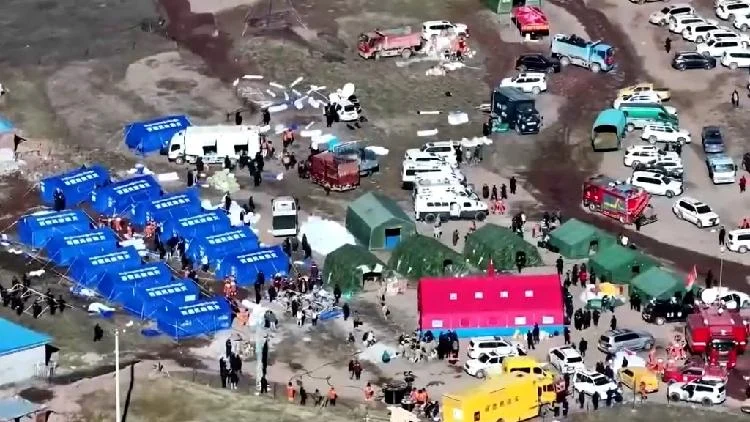
The earthquake’s epicenter was at a high altitude, nearly 4,800 meters above sea level. This environment presents unique challenges for rescue efforts and for the stability of the terrain. Cold nights and quake-loosened slopes increase the risk of rockfalls and landslides. Authorities in the affected region took immediate steps to mitigate these risks. Geologists were deployed to patrol roads and assess the stability of hillsides. Residents were moved to open, flat ground away from potential hazard zones.
The damage to infrastructure is another critical concern. Repeated aftershocks, some measuring above magnitude 3.0, can further weaken already damaged buildings. Officials warned residents not to return to cracked or tilted houses until they were declared safe by inspectors. This highlights the importance of structural integrity assessments following seismic events.
The response to the Xizang earthquake involved a significant mobilization of resources. Thousands of rescuers were sent to the disaster zone to conduct search and rescue operations, provide medical assistance, and deliver aid. The focus was on reaching affected communities, assessing damage, and ensuring the safety and well-being of the survivors.
Understanding Plate Tectonics for Better Preparedness
The study of earthquakes is fundamentally linked to the theory of plate tectonics. By understanding how tectonic plates interact, scientists can better identify regions at risk of seismic activity and the types of earthquakes that are likely to occur. This knowledge is crucial for developing effective building codes, early warning systems, and disaster preparedness plans.
The Xizang earthquake serves as a reminder that geological processes are dynamic and can produce unexpected results. While the region is under immense compressional stress from the India-Eurasia collision, localized areas can experience extensional forces. This complexity underscores the need for detailed geological mapping and ongoing seismic monitoring to understand the specific fault systems and stress regimes within different tectonic blocks.
For communities living in earthquake-prone areas, preparedness is key. This includes:
- Understanding local seismic risks: Knowing the types of faults in the area and the potential for different kinds of seismic events.
- Securing homes and buildings: Following building codes designed to withstand seismic forces and securing heavy furniture and objects that could fall.
- Developing emergency plans: Having a family emergency plan that includes meeting points, communication strategies, and supplies.
- Participating in drills: Regular earthquake drills help individuals and communities know how to react during and after an earthquake.
The ongoing research into the mechanics of earthquakes, such as the analysis of the Xizang event, contributes to our growing understanding of the Earth’s complex systems. This knowledge empowers us to better predict, prepare for, and respond to these powerful natural phenomena, ultimately saving lives and reducing the impact of seismic disasters. The continuous study of these events helps refine our models of tectonic plate movement and stress accumulation, leading to more accurate seismic hazard assessments worldwide.
The Role of Fault Systems in Earthquake Generation
Fault systems are the backbone of seismic activity. These are not isolated cracks but often extensive networks of fractures that can extend for miles through the Earth’s crust. The interaction and propagation of stress along these systems dictate the location, magnitude, and characteristics of earthquakes.
In regions like the Tibetan Plateau, the interplay between large-scale plate collisions and localized block movements creates intricate fault networks. The Qiangtang block, where the recent earthquake occurred, is a prime example of how a large tectonic unit can experience internal deformation distinct from the broader regional stress. The presence of both north-south and east-west trending faults suggests a complex stress field where different parts of the crust are responding to the overarching tectonic forces in varied ways.
The Baqen-Leiwuqi fault, near which the earthquake originated, is part of this complex system. When an earthquake occurs, it doesn’t just happen in isolation. It can trigger stress changes on nearby faults, potentially leading to aftershocks or even influencing future, larger seismic events. Understanding these fault interactions is a major focus of seismological research.
The concept of “pull-apart” basins, which can form in extensional settings along strike-slip fault systems, is another related geological phenomenon. While the Xizang earthquake was primarily an extensional rupture on a normal fault, the broader context of tectonic forces can lead to diverse geological structures and seismic behaviors. The fact that the plateau is being squeezed overall, yet this specific fault was pulled apart, highlights the non-uniform nature of deformation in such active tectonic zones.
Monitoring and Prediction: The Science of Seismology
Seismology, the scientific study of earthquakes, employs a variety of tools and techniques to monitor seismic activity and, where possible, to forecast future events. Seismic networks, consisting of seismometers placed around the globe, continuously record ground motion. These instruments can detect even the smallest tremors, providing valuable data about the Earth’s internal processes.
Data from these networks allow scientists to:
- Locate earthquakes: Determining the epicenter (the point on the surface directly above the focus) and the depth of the earthquake.
- Measure magnitude: Quantifying the energy released by the earthquake using scales like the moment magnitude scale.
- Analyze fault mechanisms: Studying the type of fault movement (normal, reverse, strike-slip) based on the pattern of seismic waves.
- Identify aftershock sequences: Tracking the decrease in seismic activity following a main earthquake.
While predicting the exact time, location, and magnitude of an earthquake remains a significant scientific challenge, seismologists can identify areas with a high probability of experiencing earthquakes based on historical seismicity, fault activity, and strain accumulation. This probabilistic forecasting is essential for long-term hazard assessment and planning.
The CENC’s rapid analysis of the Xizang earthquake, identifying it as an extensional rupture near a specific fault, is a testament to the advancements in seismic monitoring and analysis. This information is critical for understanding the immediate seismic hazard and for informing ongoing research into the region’s tectonic behavior.
The Human Impact and Resilience
Beyond the geological processes, earthquakes have a profound human impact. The loss of life, injuries, destruction of homes and infrastructure, and disruption of livelihoods are devastating consequences. The response to an earthquake involves not only immediate rescue and relief efforts but also long-term recovery and rebuilding.
The high-altitude environment of the Xizang earthquake added layers of complexity to the rescue and relief operations. Access to remote areas, harsh weather conditions, and the need to protect survivors from secondary hazards like landslides require specialized logistical planning and resources. The resilience of the affected communities, supported by national and international aid, is crucial for recovery.
The experience of such events also drives innovation in earthquake-resistant construction, early warning systems, and public education. By learning from each earthquake, societies can become better prepared to face future seismic challenges. The direct link to the organization’s website, CGTN, provides a source for further information on global events and their geological underpinnings.
Conclusion
Earthquakes are a natural consequence of the Earth’s dynamic plate tectonics. Understanding the different types of fault movements—normal, reverse, and strike-slip—and the geological context in which they occur is fundamental to comprehending seismic activity. The recent earthquake in Xizang, identified as an extensional rupture within a region of overall compression, exemplifies the complex and sometimes counterintuitive nature of tectonic deformation. By studying these events, seismologists continue to refine our understanding of the Earth’s processes, enabling better hazard assessment and preparedness. The resilience of communities in the face of such powerful natural forces, coupled with scientific advancements, offers hope for mitigating the impact of future earthquakes.



Conversation
0 Comments