

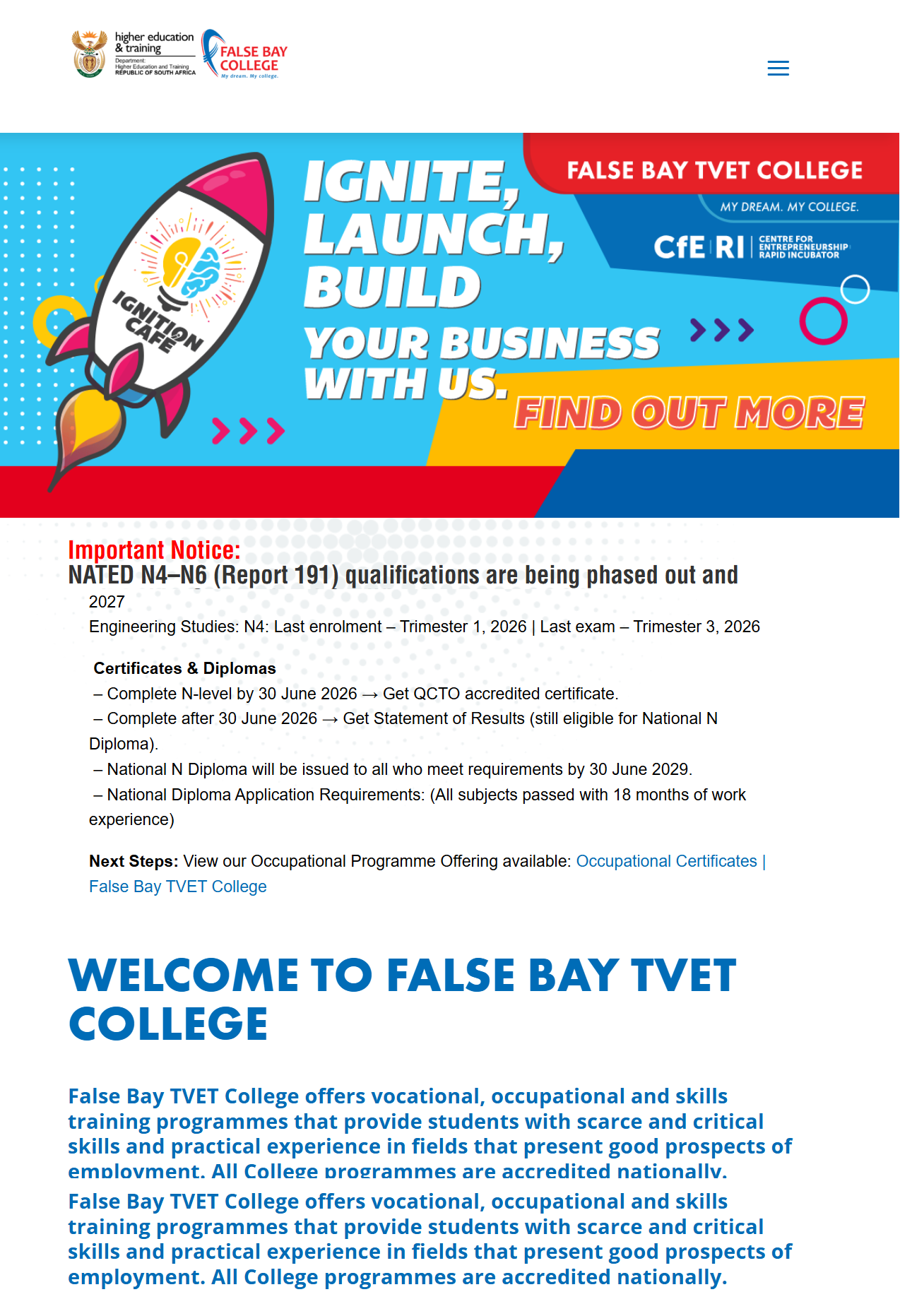
If you’re planning to study at False Bay TVET College for the 2027 academic year, you’re looking at one of the Western Cape’s most respected public Technical and Vocational Education and Training institutions. Whether you want to become an electrician, a chef, a bookkeeper, or an IT technician, False Bay TVET College offers a practical, hands-on route into a real career — without the price tag of a university degree.
This guide walks you through everything you need to know: what the college offers, when to apply, what documents you’ll need, and exactly how to submit your application online.
👉 Apply directly here: False Bay TVET College – How to Apply 👉 Application portal: falsebay.academiaerp.com/applicant-portal
About False Bay TVET College
False Bay TVET College is a public college located in the Western Cape, with its main administrative campus on Westlake Drive in Westlake, Cape Town. The college was formed through the merger of several technical colleges and has since grown into one of the top-performing TVET colleges in South Africa.
It operates across multiple campuses — including Westlake, Muizenberg, Khayelitsha, Fish Hoek, and Mitchell’s Plain — with each campus specialising in different fields of study. So before you apply, it’s worth checking which campus actually offers the programme you want, since not every course is available everywhere. For example, you generally can’t study Engineering at Fish Hoek or Tourism at Westlake — the course-to-campus matrix matters.
The college is accredited by the relevant SETAs and the QCTO, meaning your qualification will be nationally recognised and genuinely useful to employers.
Contact details:
- Address: Westlake Drive, Westlake, Cape Town
- Telephone: 021 701 1340
- Email: [email protected]
What Can You Study There?
False Bay TVET College offers three broad categories of qualifications, each suited to a different stage of your education.
1. National Certificate (Vocational) — NC(V)
This is designed for learners who have completed Grade 9 to Grade 11 and want a full-time, high-school-equivalent qualification with a vocational focus. NC(V) programmes typically run over three levels (Level 2 to Level 4) and cover fields such as:
- Engineering Studies
- Business Studies
- Information Technology (IT)
- Hospitality
- Tourism
- Safety in Society
NC(V) applications generally follow a single annual intake, starting in January.
2. NATED (Report 191) Programmes — N4 to N6
These are aimed at students who already have Grade 12 (or NCV Level 4) and want to specialise further. Common fields include:
- Electrical Engineering
- Mechanical Engineering
- Civil Engineering
- Business Management
- Human Resource Management
NATED programmes usually run on a semester system, with intakes in January and July, though some engineering streams run on trimesters with an additional intake around April.
3. Short Skills & Occupational Programmes
These are shorter, focused courses designed to get you into the workplace faster or help you upskill in a specific area. They’re aligned closely with what local industries in the Cape Town metro are actually hiring for.
When Do 2027 Applications Open?
Here’s the honest answer: the exact opening and closing dates for the 2027 intake had not yet been officially announced at the time of writing. This isn’t unusual — TVET colleges across South Africa typically confirm their next intake dates only a few months ahead of time.
That said, you can use past patterns to plan realistically. Looking at previous cycles:
- The main NC(V) application window has historically opened around August and closed by October or November of the preceding year (so, for a 2027 intake, expect applications to open sometime in the second half of 2026).
- NATED/Report 191 programmes have additional intakes mid-year, so if you miss the January window, a July intake is often still possible.
- Engineering trimester programmes have historically opened applications around March–April and again in July–August for later trimesters.
The safest move: don’t wait for a firm date. Register on the application portal now, complete your Career Interest Questionnaire, and keep checking the official website regularly. Spaces at TVET colleges fill up fast once applications do open — sometimes before the official closing date — because places per campus and per course are limited.
Step-by-Step: How to Apply
False Bay TVET College runs its entire application process online. Here’s exactly what to do, from start to finish.
Step 1: Complete the Career Interest Questionnaire
Before you can apply, all new applicants are required to complete a Career Interest Questionnaire. This short assessment helps the college match you to a suitable programme based on your interests and strengths. You’ll find the link to this on the official “Apply Now” page.
Step 2: Accept the POPIA Clause
You’ll be asked to read and accept the college’s data protection clause under South Africa’s Protection of Personal Information Act (POPIA). This simply confirms you understand how your personal information will be used and stored.
Step 3: Register Your Online Profile
Create your applicant profile on the portal. Use an email address and phone number you check regularly, since all updates about your application status, offer letters, and document requests come through this profile.
Step 4: Complete the Online Application Form
This is where you’ll enter your personal details, select your preferred programme(s), and choose your preferred campus. Take your time here — accuracy matters, and mistakes can delay your application.
Step 5: Upload Certified Supporting Documents
You’ll need to upload clear, certified copies of the following:
- Identity Document — your South African ID. If you’re under 18, a certified birth certificate is accepted. Foreign applicants must submit a valid passport.
- Latest Academic Results — Grade 9 results for NC(V) applicants, or Grade 12 results (or your most recent NATED results) for higher-level programmes. If you’re still in Grade 12, your latest available results (e.g. Term 3 results) are usually sufficient to start the process.
- Proof of Address — a recent, certified proof of residence.
Make sure every document is properly certified and clearly legible — blurry or uncertified scans are one of the most common reasons applications get delayed.
Step 6: Submit and Track Your Application
Once submitted, your application goes to campus administration for verification, and then to a Selection Committee, which reviews it against the college’s admission policy and the applicant’s academic results. You can track your status at any time through the online portal.
Step 7: Receive and Accept Your Offer Letter
If successful, you’ll receive an official offer letter through the portal. Read it carefully — offer letters expire just 5 days after they’re issued, so don’t sit on it. Accept it promptly to secure your place.
Step 8: Registration
Once you’ve accepted your offer, you’ll need to visit your selected campus in person to complete registration. This typically involves:
- Submitting certified proof of residence and a certified copy of your parent or guardian’s ID (if applicable)
- Completing biographical and registration forms, along with a Finance Agreement and Code of Conduct
- Paying your first instalment fee (for private, non-NSFAS students), either via bank transfer or the campus card facility
Good News: Applying Is Free
There is no application fee to apply to False Bay TVET College. You only pay once you’ve been accepted and are registering — covering your registration and tuition fees, which vary by programme.
Funding Your Studies: NSFAS
Many students at False Bay TVET College fund their studies through NSFAS (the National Student Financial Aid Scheme), which covers tuition and, for qualifying students, additional allowances. If you plan to apply for NSFAS funding, don’t leave it until the last minute — NSFAS applications have their own separate deadline, which in previous years has closed shortly after the college’s own application window (historically around mid-November). Apply for NSFAS as early as possible, ideally at the same time as your college application, to avoid missing the cut-off.
Practical Tips Before You Apply
- Use Google Chrome. The application portal is optimised for Chrome; Firefox works too, but Internet Explorer is explicitly not supported and can cause your application to fail silently.
- Double-check your campus choice against your course. Not every campus offers every programme — confirm this on the college’s course matrix before applying, so you don’t apply for a course that isn’t actually offered where you want to study.
- Get your documents certified early. Certification (at a police station or by a commissioner of oaths) can take time, especially closer to deadlines when queues get longer.
- Apply as early as the window allows. Because seats are limited per course and per campus, applications are often reviewed and filled on a rolling basis — waiting until the closing date can mean your preferred programme is already full.
- Be cautious of unofficial pages. Apply only through the official college website. Avoid submitting your ID or personal details to third-party Facebook pages or agents claiming to process applications on the college’s behalf.
- Know your intake type. If you’re applying mid-year, remember that only NATED (Report 191) courses typically accept new students outside the January intake — NC(V) is a full academic-year programme and doesn’t have a mid-year entry point.
Quick Reference Summary
| What | Details |
|---|---|
| Apply online at | falsebaycollege.co.za – Apply Now |
| Application portal | falsebay.academiaerp.com/applicant-portal |
| Application fee | None — applying is free |
| Main campuses | Westlake, Muizenberg, Khayelitsha, Fish Hoek, Mitchell’s Plain |
| NC(V) entry requirement | Grade 9–11 |
| NATED (N4–N6) entry requirement | Grade 12 or NCV Level 4 |
| Documents needed | Certified ID/birth certificate/passport, latest results, proof of address |
| Offer letter validity | 5 days from issue |
| Funding option | NSFAS (apply early, separate deadline) |
| Contact | 021 701 1340 / [email protected] |
Final Word
False Bay TVET College has built a genuine reputation for turning out job-ready graduates in fields the Cape Town job market actually needs — engineering, business, hospitality, IT, and more. The 2027 application dates weren’t finalised at the time of writing, but that’s exactly why the smart move is to start preparing now: complete your Career Interest Questionnaire, get your documents certified, and keep an eye on the official site so you’re ready to submit the moment applications open.
Your next step: head to the official application page and begin your Career Interest Questionnaire today.



Conversation
0 Comments