

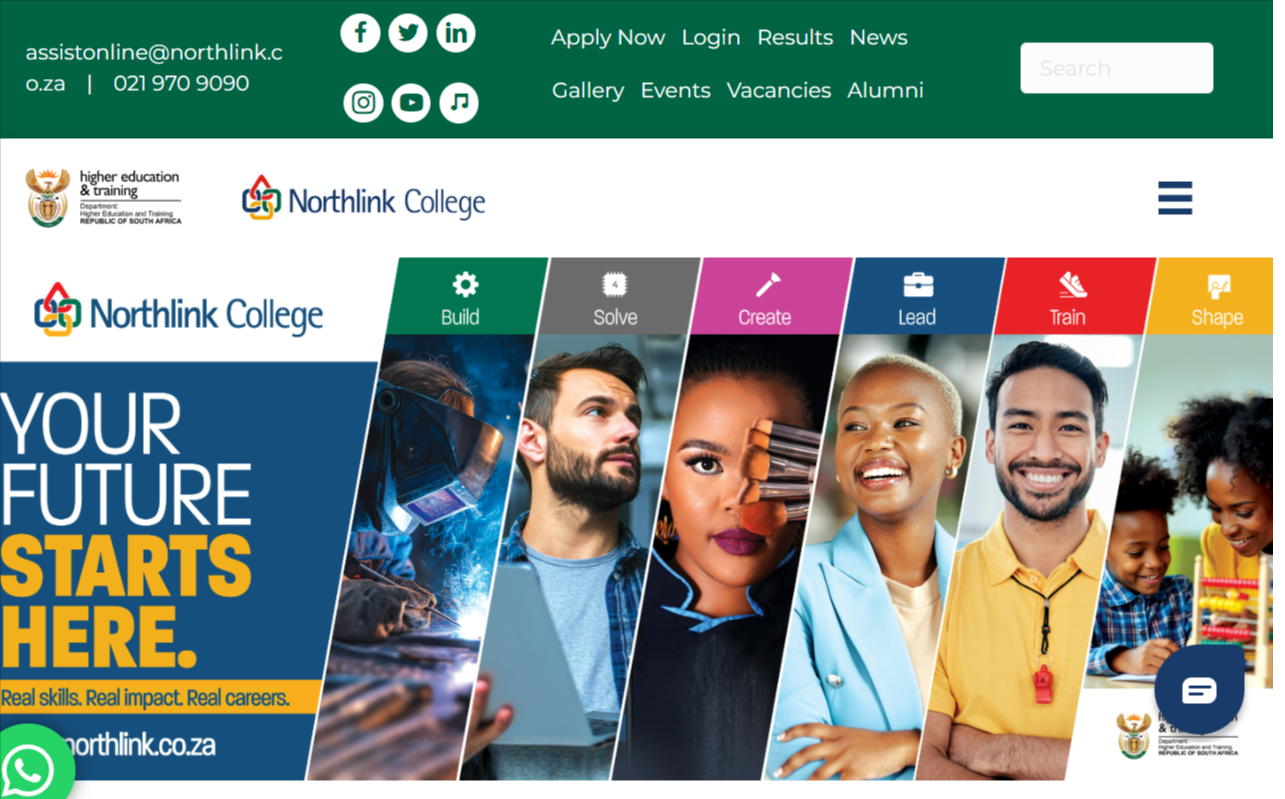
If you’re planning to study at Northlink TVET College in the Western Cape for the 2027 academic year, this guide walks you through everything — from the application process and required documents to campus options, programmes, funding, and important dates. Whether you’re a Grade 12 school leaver, an adult learner returning to education, or a parent helping a child plan ahead, this article gives you a clear, step-by-step roadmap.
Official application portal: https://www.northlink.co.za/apply/
About Northlink TVET College
Northlink TVET College is one of South Africa’s largest and most respected public Technical and Vocational Education and Training (TVET) institutions, based in Cape Town’s northern suburbs. It falls under the Department of Higher Education and Training (DHET) and has built a strong reputation for producing work-ready graduates through practical, industry-aligned training.
The college was formed in 2002 through the merger of several colleges — Wingfield Technical College, Tygerberg College, and Bellville Technical College — and later added Belhar College in 2005. Today, Northlink operates across seven campuses:
- Belhar
- Bellville
- Goodwood
- Parow
- Protea
- Tygerberg
- Wingfield
Each year, Northlink serves over 20,000 students, offering more than 70 accredited courses, and has been recognised with multiple awards, including being voted a top NCV college.
Why Consider Northlink for 2027?
TVET colleges like Northlink are designed to bridge the gap between school and the working world. Instead of a purely academic path, you gain hands-on, practical skills in fields that are in real demand — engineering, business, hospitality, education support, and more. Because programme spaces are limited and demand is high, applying early for the 2027 intake is strongly recommended. Late applications are often not considered once a programme reaches capacity.
Programmes Offered at Northlink
Northlink structures its qualifications into a few main categories. Understanding these will help you choose the right path.
1. National Certificate (Vocational) — NCV, Levels 2–4
This is the main option for school leavers who have completed Grade 9, 10, or 11 and want a vocational alternative to matric. NCV programmes run over three years (Level 2 to Level 4) and are offered in fields such as:
- Civil Engineering and Building Construction
- Electrical Infrastructure Construction
- Engineering and Related Design
- Information Technology and Computer Science
- Office Administration
- Finance, Economics and Accounting
- Hospitality
- Tourism
NCV intake generally happens once a year, in January.
2. NATED (Report 191) Programmes — N1 to N6
These are the traditional “N-course” qualifications, popular for both engineering studies and business studies.
- Engineering Studies (N1–N6): Covers trades like Electrical Engineering, Mechanical Engineering (Fitting and Turning, Motor Trade), and Civil Engineering. These typically have three intakes a year — January, April/May, and August/September.
- Business and General Studies (N4–N6): Covers fields like Human Resource Management, Public Management, Financial Management, Marketing, Legal Secretary, and Management Assistant. These usually have two intakes a year — January and July.
N-course students also need to complete practical work experience (an “S-permit” logbook) to obtain the full National Diploma alongside their theoretical N6 certificate.
3. Short Courses and Skills Programmes
For those who want to upskill quickly without committing to a multi-year qualification, Northlink also offers short, occupational skills courses throughout the year.
Minimum Admission Requirements
Requirements vary depending on the programme and level, but general guidelines are:
- NCV Level 2: Grade 9 certificate or equivalent
- NATED N1–N3: Grade 9 certificate (for engineering studies) or Grade 10/11 (varies by course)
- NATED N4–N6 / Diploma routes: Grade 12 (matric) or an equivalent N3 qualification
- Some programmes may require a career screening or placement assessment to check readiness and subject fit before you’re accepted
Always check the specific requirements listed for your chosen course on the official prospectus, since subject and level requirements differ between engineering, business, and general studies streams.
How to Apply: Step-by-Step
Applying to Northlink is done entirely online. Here’s the process broken down simply:
Step 1: Choose Your Programme and Campus
Before applying, decide which qualification and campus suit you best. Review the full course list and fee structure on the official site so you know what to expect financially.
Step 2: Complete the Student Profiler / Career Screening
Northlink requires prospective students to complete a career guidance/screening assessment. This helps match you to a programme suited to your interests and academic background, and helps the college confirm your readiness for the course.
Step 3: Register and Complete the Online Application
Go to the official application portal: 👉 https://www.northlink.co.za/apply/
Create your profile using a valid email address and active cell phone number (you’ll receive SMS and email updates on your application status), then complete the online application form (the “Wizard”) in full, using accurate personal and academic details.
Step 4: Upload Your Documents
You’ll need to upload clear, certified copies (not older than 3 months) of:
- Your South African ID (or passport, for international applicants)
- Your latest academic results (school report or matric certificate)
- Proof of residence (where required)
- Any additional documents specific to your chosen programme
Important: Incomplete, blurry, or uncertified documents can delay or invalidate your application, so double-check everything before submitting.
Step 5: Submit and Track Your Application
Once submitted, you’ll receive an SMS and email confirming receipt. You can log back into the Northlink website at any time to check your application status — there’s no need to call or visit a campus just to check progress.
Step 6: Apply for NSFAS Funding (If You Need It)
If you’ll need financial assistance, apply separately (but as early as possible, ideally at the same time) through the National Student Financial Aid Scheme (NSFAS) at www.nsfas.org.za. NSFAS is accredited at Northlink and can cover tuition, learning materials, transport, and accommodation for eligible South African students from qualifying households.
International Applicants
If you are not a holder of a South African ID book, Northlink has a separate application route for international students — look for the “international students” link on the official apply page before starting.
2027 Application Timeline: What to Expect
Northlink has not yet published a confirmed opening date for 2027 applications at the time of writing — this typically gets confirmed as part of the 2026/2027 application cycle. Based on recent years’ patterns, here’s a general idea of what to expect:
| Programme Type | Typical Intake Months |
|---|---|
| NCV (Levels 2–4) | January (once a year) |
| Business & General Studies (N4–N6) | January and July |
| Engineering Studies (N1–N6) | January, April/May, and August/September |
Because dates shift slightly year to year and spaces fill quickly, the safest approach is to:
- Bookmark the official apply page: https://www.northlink.co.za/apply/
- Check it regularly from around mid-to-late 2026 for the confirmed 2027 opening date
- Apply as soon as the portal opens for your chosen intake, rather than waiting for the closing date
Quick Tips for a Smooth Application
- Apply early. Popular programmes like Engineering and IT fill up fast.
- Prepare your documents in advance. Have certified copies of your ID and results scanned and ready before you start the online form.
- Use a working email and cell number. All official communication comes through these channels.
- Apply for NSFAS at the same time, if you’ll need funding — don’t wait until after your college application is accepted.
- Double-check your course choice against the entry requirements before applying, so you’re not caught off guard by a mismatch.
- Keep your SMS/email confirmations. They’re your proof of a submitted application if any query comes up later.
Frequently Asked Questions
Is the Northlink 2027 application already open? As of now, 2027 dates have not been officially confirmed. Applications are expected to be announced later in the 2026 cycle — check the official apply page for the latest update.
Can I apply if I only have Grade 9? Yes — many NCV Level 2 and NATED N1 engineering programmes accept applicants with a Grade 9 certificate, depending on the specific course.
Do I need matric to apply? Not necessarily. It depends on the qualification level and stream you choose. Higher-level N-courses (N4–N6) typically require Grade 12 or an equivalent N3.
How will I know if my application was successful? You’ll be notified by SMS and email, and you can log in to the Northlink website at any time to check your status.
Can international students apply? Yes, Northlink accepts applications from international students through a separate application route on the official site.
Final Thoughts
Northlink TVET College remains one of the Western Cape’s top choices for practical, career-focused education heading into 2027. The key to a successful application is simple: decide on your programme early, prepare your documents, apply as soon as the portal opens, and apply for NSFAS funding alongside your college application if you need it.
For the most accurate and up-to-date information — including the confirmed 2027 opening date, full course list, and fee structure — always refer to the official source:
🔗 Official Northlink Application Portal: https://www.northlink.co.za/apply/ 🔗 NSFAS Funding Portal: https://www.nsfas.org.za



Conversation
0 Comments