

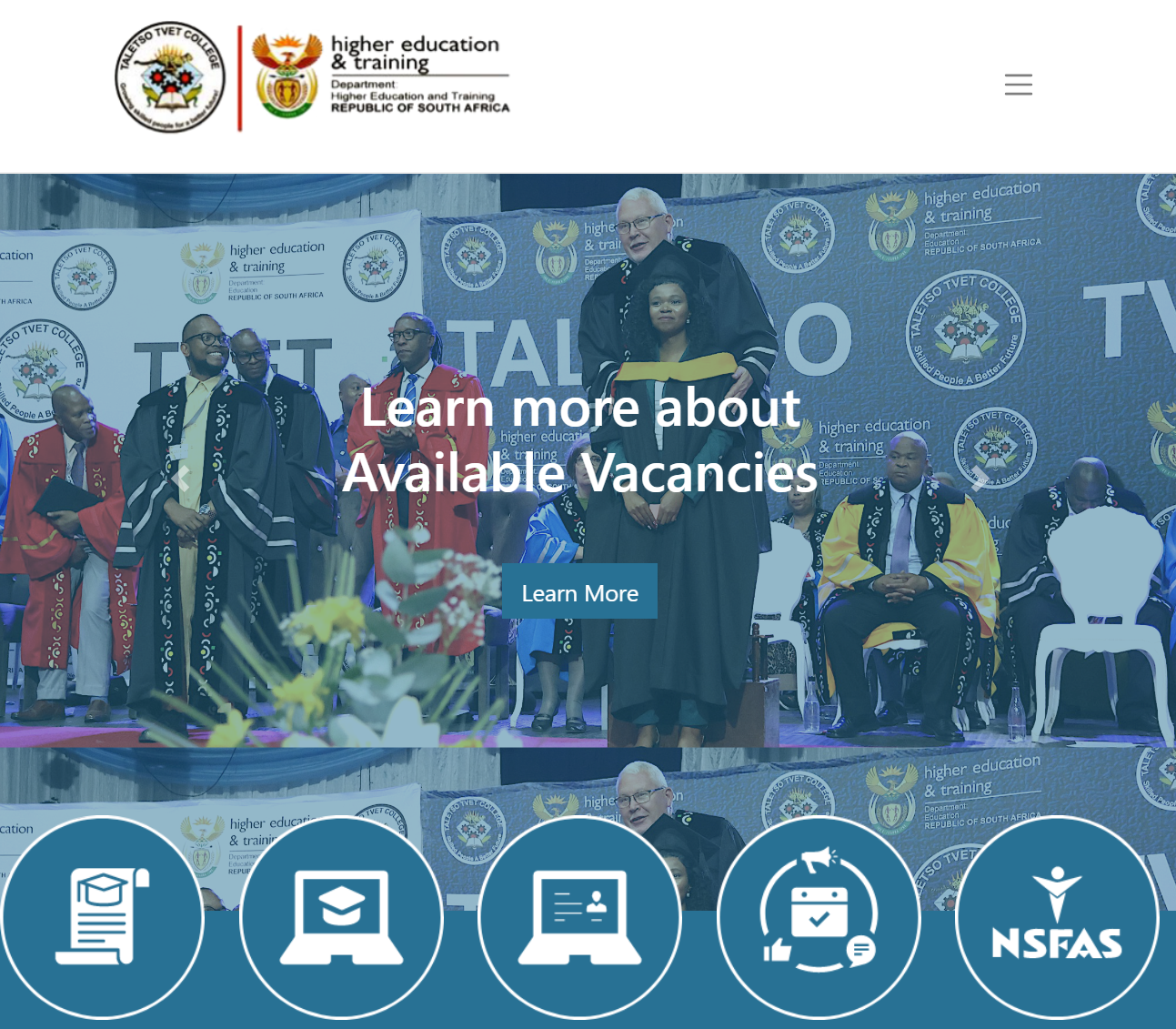
The Complete Guide for Prospective Students
If you’re finishing matric or looking to pick up a practical, career-focused qualification, Taletso TVET College is one of the most popular public colleges in the North West province — and applications for the 2027 academic year are now something you should be planning for early. This guide walks you through everything you need to know: what the college offers, how to apply, what documents you need, funding options, and key dates to keep in mind.
Official website: https://taletso.edu.za
1. What Is Taletso TVET College?
Taletso TVET College is a public Technical and Vocational Education and Training institution based in Mahikeng, North West Province, South Africa. It’s registered and accredited by the Department of Higher Education and Training (DHET) and is one of the country’s 50 public TVET colleges.
The college was formed through the merger of three former institutions:
- Lehurutshe College
- Mafikeng College
- Lichtenburg College
Today, Taletso operates across multiple campuses in the Ngaka Modiri Molema District Municipality, giving students in both urban and rural parts of the province access to vocational training close to home.
Taletso’s mission is simple but important: to equip young people with practical, job-ready skills they can use to find employment, start their own businesses, or move on to further studies at a university of technology.
2. Programmes Offered at Taletso
Taletso offers three main categories of qualifications:
National Certificate (Vocational) — NC(V)
These are three-year programmes (Levels 2–4) designed as an alternative to the traditional matric route, combining theory with hands-on workplace-related skills. Popular NCV fields include:
- Engineering and Related Design
- Information Technology and Computer Science
- Office Administration
- Finance, Economics and Accounting
- Hospitality
- Tourism
- Marketing
NATED (Report 191) Programmes — N1 to N6
These are semester-based programmes typically taken after Grade 10, 11 or 12, popular for students pursuing trades and technical careers such as:
- Electrical Engineering
- Civil Engineering
- Mechanical Engineering
- Business Management
- Human Resource Management
- Financial Management
N6 graduates typically need to complete 18 months of relevant workplace experience to obtain a National Diploma.
Occupational Programmes
Short, skills-based qualifications aligned to specific trades and occupations (such as plumbing, electrical work, and welding), often leading to trade tests and artisan certification.
3. Entry Requirements
Requirements vary by programme, but generally:
- NC(V): A Grade 9 certificate or equivalent for Level 2 entry.
- NATED N1–N3: A Grade 9, 10, 11 or relevant N-level certificate, depending on the subject stream.
- NATED N4–N6: A relevant N3 certificate or matric with the required subjects.
- Occupational programmes: Requirements vary depending on the trade.
You’ll also need:
- A certified copy of your South African ID (not older than 3 months)
- Your latest school report or highest qualification certificate
- Proof of residence
- Passport-size photographs (some campuses request this at registration)
Always check the specific programme page or contact the campus directly, since requirements can differ slightly between courses and campuses.
4. How to Apply to Taletso TVET College for 2027
Applying is a straightforward process if you prepare in advance. Here’s the step-by-step:
Step 1: Choose Your Programme
Decide on the NC(V), NATED, or occupational programme that matches your interests and career goals. Think about job demand in your field and whether you’d like to study further afterward.
Step 2: Gather Your Documents
Make certified copies of your ID, school reports/certificates, and proof of residence ahead of time. Certification at a police station or Home Affairs office is usually valid for 3 months.
Step 3: Submit Your Application
You can apply in two ways:
- Online through the official Taletso website: https://taletso.edu.za
- In person at your nearest Taletso campus (Mafikeng, Lehurutshe, or Lichtenburg)
When applying online, you’ll typically need to create an account, complete a career guidance questionnaire, and then select and submit your chosen programme.
Step 4: Apply for NSFAS Funding (Separately)
NSFAS (National Student Financial Aid Scheme) is a separate application process from your college application. If your household income is R350,000 or less per year, you may qualify for full funding covering tuition, accommodation/travel allowance, and a book/learner allowance.
Apply directly at: https://www.nsfas.org.za
NSFAS applications typically open around September and remain open until January, so it’s wise to apply for both your college place and NSFAS funding as early as possible rather than waiting until the last minute.
Step 5: Track Your Application
Once submitted, keep your login details safe so you can log back in to check your application status, see whether you’ve been provisionally accepted, and follow any next steps the college sends you.
5. Key Dates to Keep in Mind
TVET college applications generally run on a rolling basis, opening early in the year and staying open until courses are full or the intake begins. Because Taletso runs on a trimester/semester system for some programmes, there can be more than one intake per year. To avoid missing out:
- Start preparing your documents as early as possible, ideally before the year you intend to enrol.
- Apply for both the college programme and NSFAS as soon as applications open — don’t wait for one before starting the other.
- Contact the college directly or check the official website regularly, since exact opening and closing dates can shift from year to year.
6. Why Choose Taletso TVET College?
- Affordable, practical education — NSFAS-funded options make it accessible to students from lower-income households.
- Strong regional presence — Multiple campuses across North West mean students from both cities and rural towns have access.
- Career-focused curriculum — Programmes are built around actual workplace skills and trades in demand.
- Pathways to further study — NATED N6 graduates can progress toward a National Diploma with relevant work experience, and many NCV graduates move on to universities of technology.
7. Frequently Asked Questions
Is it free to apply to Taletso? Application processes at public TVET colleges are generally low-cost or free; confirm with the college directly for the current year.
Do I need an APS score to apply? No — TVET colleges don’t use the APS (Admission Point Score) system that universities use. Entry is based on your grade level and subject requirements for the specific programme.
Can I apply if I didn’t finish matric? Yes. Many NCV and lower-level NATED programmes accept students from Grade 9 upward, making TVET college a strong option if you didn’t complete Grade 12.
Where is Taletso TVET College located? Its head office is in Mahikeng, North West, with additional campuses in Lehurutshe and Lichtenburg.
Direct Link to Apply
👉 Official Taletso TVET College website: https://taletso.edu.za 👉 NSFAS funding application: https://www.nsfas.org.za
Bonus: A Simple Guide for Writing This Blog Post (or Similar Ones)
If you’re publishing this as a blog post — for a school, education portal, or your own site — here’s a quick structural guide you can reuse for any “College Application [Year]” article:
1. Hook + Direct Link Up Top
Open with a short paragraph explaining why the reader should care, and place the official application link near the top so time-pressed readers can act immediately.
2. “What Is [Institution]” Section
Give a quick factual overview: location, accreditation body, and what makes the institution notable. This builds trust and SEO relevance for “what is X college” searches.
3. Programmes/Courses Breakdown
Use subheadings for each qualification type. Readers scanning for a specific course (e.g., “NATED N6 Electrical”) should be able to find it via headers alone.
4. Entry Requirements
Bullet this clearly — readers often skim straight to this section to check if they qualify.
5. Step-by-Step Application Process
Numbered steps work best here. Keep each step to 1–2 sentences with a clear action.
6. Funding Information
Always separate the college application from bursary/funding applications (like NSFAS) — this is a common point of confusion for students.
7. Key Dates
Even if exact dates change yearly, give readers guidance on when to start preparing rather than leaving them guessing.
8. FAQ Section
Answer the 4–6 most commonly searched questions related to the topic. This improves both readability and SEO (FAQ sections often get pulled into search engine snippets).
9. Closing Call-to-Action + Direct Link (repeated)
End by repeating the direct application link, since many readers skip to the bottom of an article looking for exactly this.
Tone & Style Tips
- Write in plain, encouraging language — many readers are first-generation college applicants.
- Avoid jargon; explain acronyms (NCV, NATED, NSFAS, APS) the first time you use them.
- Keep paragraphs short (2–4 sentences) for mobile readability.
- Update the “Key Dates” and any statistics annually, since this is exactly the kind of content that needs refreshing each admissions cycle.



Conversation
0 Comments