

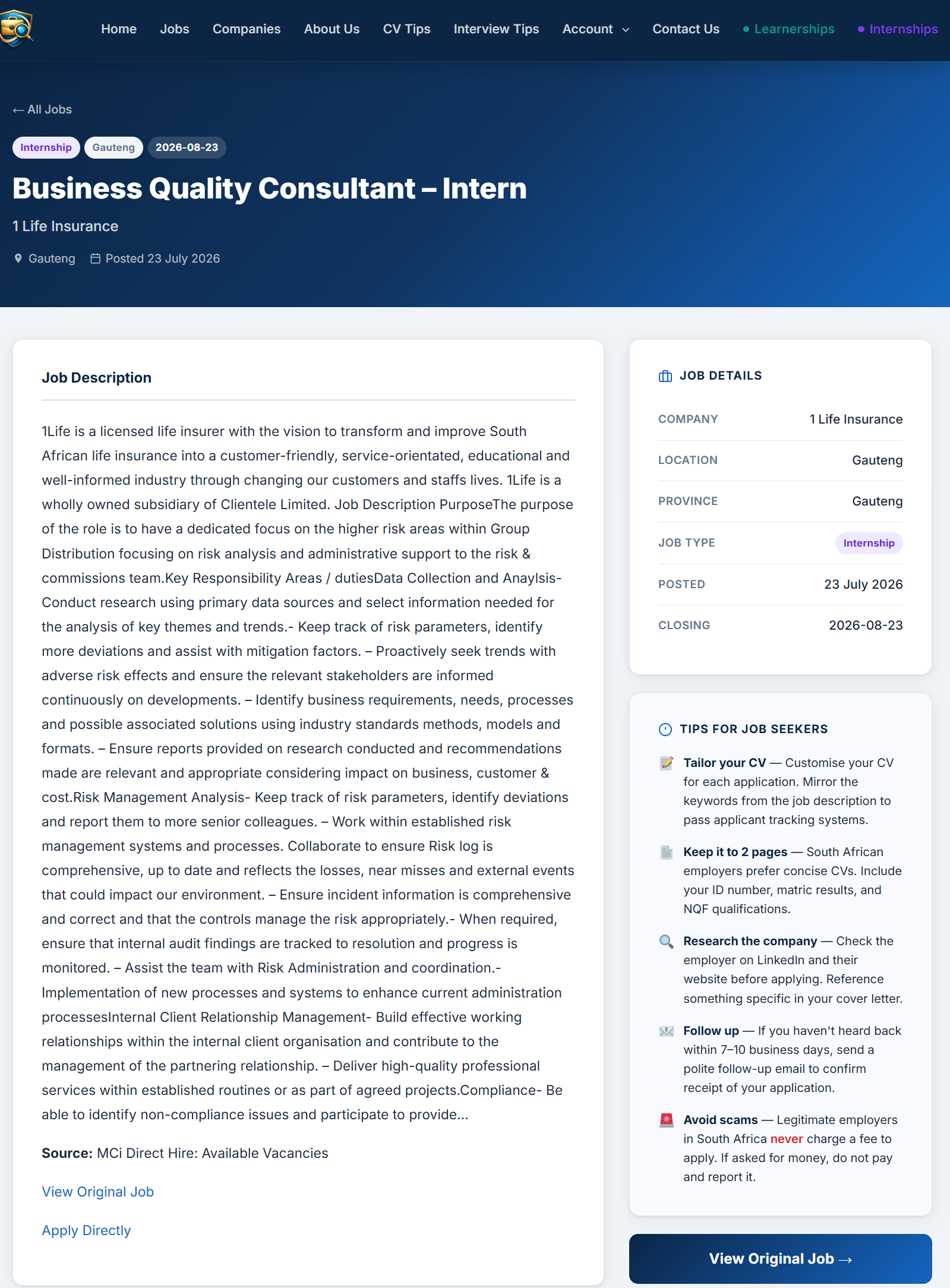
If you’ve ever wondered how companies keep their processes consistent, their products defect-free, and their clients happy year after year, you’ve already brushed up against the world of quality consulting. A Business Quality Consultant Internship sits right at the intersection of two disciplines that every serious organization depends on: business strategy and quality assurance. It’s a role that blends analytical rigor with people skills, and for students or early-career professionals, it’s one of the most practical ways to break into consulting.
This guide walks through what the internship actually involves, the skills you’ll need, how to prepare a standout application, and where to start looking for real openings.
What Does a Business Quality Consultant Actually Do?
Before chasing the internship, it helps to understand the job itself. A Business Quality Consultant helps organizations improve how they operate — not by telling them what to do from an ivory tower, but by digging into processes, data, and workflows to find where quality breaks down.
Typical responsibilities include:
- Process auditing — reviewing how a business currently operates and identifying gaps between what’s supposed to happen and what actually happens.
- Data quality analysis — checking whether the information a company relies on (customer records, financial data, operational metrics) is accurate, consistent, and usable.
- Compliance and standards work — making sure a business meets industry certifications like ISO 9001, or internal quality benchmarks.
- Client communication — translating technical findings into recommendations a non-technical stakeholder can act on.
- Continuous improvement projects — running root-cause analyses (think Six Sigma or Lean methodologies) to solve recurring problems.
As an intern, you won’t be leading these engagements solo, but you’ll be embedded in real projects, shadowing senior consultants, and contributing meaningfully to deliverables that clients actually see.
Why This Internship Is Worth Pursuing
1. It teaches you how businesses really work
Unlike internships confined to a single department, quality consulting exposes you to finance, operations, IT, and customer service all at once, because quality issues rarely live in just one silo.
2. It builds a transferable skill set
Skills like root-cause analysis, data auditing, stakeholder communication, and process mapping are valuable whether you end up in consulting, operations, product management, or entrepreneurship.
3. It’s a strong signal to future employers
“Quality” is one of those words that shows up on nearly every job description, from manufacturing to SaaS. Having hands-on quality consulting experience on your resume tells employers you understand how to build reliable systems, not just fast ones.
4. Consulting internships often convert to full-time offers
Firms use internships as extended interviews. Performing well and building relationships during the internship is one of the more reliable paths into a full-time analyst or associate role.
What Skills and Qualifications Employers Look For
Postings for this type of internship vary by industry, but a few themes come up consistently:
- Analytical thinking — comfort with spreadsheets, data analysis, and drawing conclusions from imperfect information.
- Communication skills — both written (reports, proposals) and verbal (client meetings, presentations).
- Attention to detail — quality work is, unsurprisingly, about catching what others miss.
- Business fundamentals — coursework or exposure to business strategy, operations management, or economics helps.
- Familiarity with quality frameworks — even a basic understanding of Six Sigma, Lean, ISO standards, or QA/QC principles is a plus, though most firms will train you.
- Tools — Excel is close to universal; some roles also value exposure to SQL, Power BI, Tableau, or ERP systems.
You generally don’t need a quality management background to apply. Many successful applicants come from business administration, industrial engineering, economics, or even the sciences — what matters more is your ability to think systematically and communicate clearly.
How to Prepare a Standout Application
Tailor your resume around outcomes, not tasks. Instead of listing “assisted with data entry,” reframe it as “audited 500+ records for accuracy, reducing reporting errors by 15%.” Quality consulting is a metrics-driven field, so speak its language.
Highlight any process-improvement experience, even informal ones — a class project where you streamlined a workflow, a part-time job where you spotted and fixed a recurring error, a student org where you introduced a new system.
Prepare for behavioral interviews. Expect questions like:
- “Tell me about a time you found an error others missed.”
- “Describe a situation where you had to explain something technical to a non-technical audience.”
- “How do you approach a problem when you don’t have all the data?”
Know the basics of quality frameworks going in. You don’t need mastery, but being able to explain, in plain language, what Six Sigma or ISO 9001 is about will set you apart in an interview.
Ask smart questions. Interviewers remember candidates who ask things like “What does a typical client engagement look like for an intern here?” or “How is quality measured differently across the industries you serve?”
Where to Find Real Openings
Business Quality Consultant internships are posted under a range of titles — “Quality Consultant Intern,” “Business Consulting Intern,” “Risk & Quality Assurance Intern,” and similar variations — so it pays to search broadly. A few solid starting points:
- ZipRecruiter — Internship Quality Consultant Jobs — a continuously updated listing of quality-consulting internships across industries and locations.
- ZipRecruiter — Business Consultant Internship Jobs — broader business consulting internships, many with a quality or process-improvement component.
- Indeed — Business Consulting Summer Internships — one of the largest aggregators, useful for filtering by location and start date.
- Internshala — Consultant Internships — especially useful if you’re searching internationally or want remote-friendly listings.
When searching on your own, try combining keywords like “quality,” “process improvement,” “QA,” “risk,” and “business consulting” rather than relying on one exact phrase — the role goes by many names depending on the company.
Making the Most of the Internship Once You’re In
Getting the internship is only step one. To turn it into a launchpad:
- Ask for feedback early and often. Quality-minded teams tend to value this instinct — it mirrors the very work you’re doing for clients.
- Document your projects. Keep a running log of what you worked on and the measurable impact, even in rough form. You’ll thank yourself when it’s resume-update time.
- Build relationships beyond your immediate team. Consulting firms are relationship businesses; the analyst you grab coffee with today might be the one referring you for a full-time role next year.
- Say yes to client-facing opportunities, even small ones. Comfort in front of clients is a skill that compounds quickly with practice.
Final Thoughts
A Business Quality Consultant Internship isn’t just another line on a resume — it’s a crash course in how businesses actually diagnose and fix their own problems. You’ll leave with a sharper analytical eye, real client exposure, and a skill set that travels well across industries. If you’re weighing internship options this cycle, it’s well worth putting in your search rotation.
Good luck — and don’t be afraid to reach out directly to firms even when they don’t have a posted opening. Quality consulting teams are often smaller and more relationship-driven than people expect, and a well-timed, well-written email can open doors that job boards don’t show.


Conversation
0 Comments