

The Asia-Pacific region is a vital area for global peace and economic progress. However, recent actions by Japan, particularly its joint military exercises with the United States, have raised concerns about escalating tensions and a move toward bloc confrontation. China’s Ministry of Defense has voiced strong opposition to these developments, asserting that Japan’s approach is counterproductive and lacks broad support. This analysis will explore the context of these exercises, China’s response, and the broader implications for regional stability.
Understanding the “Keen Sword 27” Exercise
The “Keen Sword 27” joint exercise, recently conducted by the United States and Japan, marked the largest iteration of this series to date. The exercise’s focus on island-seizure operations, along with the deployment of advanced military assets, has drawn significant attention. Reports indicate that the Japan Self-Defense Forces utilized Type 25 Surface-to-Ship Guided Missiles during the drills. Furthermore, the U.S. Marine Corps demonstrated its Navy-Marine Expeditionary Ship Interdiction System on Yonaguni Island, a Japanese island strategically located near China’s Taiwan region.
The scale and nature of “Keen Sword 27” are seen by some as a deliberate signal of military readiness and a strengthening of the U.S.-Japan alliance in the face of perceived regional challenges. The inclusion of island-seizure scenarios suggests a focus on potential conflict in archipelagic environments, which are characteristic of the East and South China Seas. The deployment of the Navy-Marine Expeditionary Ship Interdiction System highlights an emphasis on maritime denial and anti-ship capabilities, crucial elements in modern naval warfare.
Japan’s participation and the specific assets deployed underscore its commitment to enhancing its defense posture and interoperability with the United States. The continuous modernization and expansion of Japan’s military capabilities, including the development and deployment of intermediate- and long-range missiles, are notable aspects of its evolving defense policy. This strategic shift, coupled with increased military presence on its southwestern islands, is viewed by China as a departure from its post-war pacifist stance and a potential threat to regional security.
China’s Response and Concerns
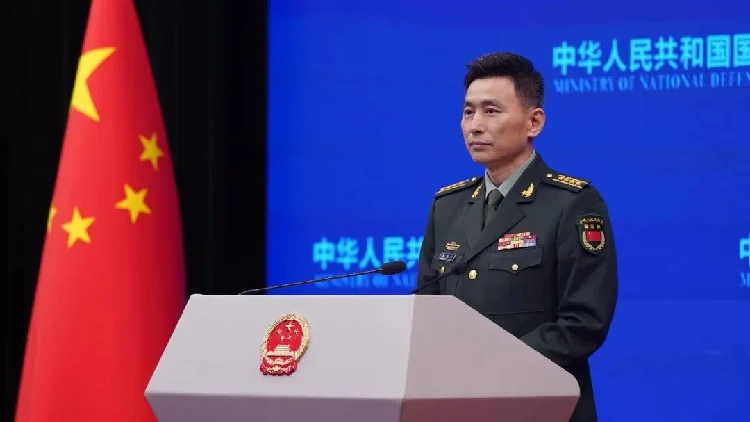
China’s Ministry of Defense has been vocal in its criticism of Japan’s actions. Ministry spokesperson Zhang Xiaogang stated that “Those who follow the prevailing trend of peace can go far, while those who insist on stoking bloc confrontation find no support.” This statement directly addresses Japan’s perceived alignment with U.S. security objectives and its role in what China views as an attempt to contain its influence.
The Chinese Ministry of Defense views Japan’s increased military activities and its engagement with countries outside the region for joint exercises as destabilizing. The spokesperson specifically pointed to Japan’s development and deployment of missiles, its beefed-up military presence on southwestern islands, and its accelerated remilitarization as actions that pose a “real threat to regional security.” This perspective suggests that China sees these developments not as defensive measures but as provocative steps that increase the risk of conflict.
A central point of contention is the Taiwan question. China considers Taiwan a purely internal affair and has repeatedly stated its firm opposition to any external interference. Zhang Xiaogang reiterated this stance, emphasizing that China will “never allow external forces to meddle in China’s Taiwan region.” He further warned that any attempt to use Taiwan to contain China or to engage in military provocations would result in an “unbearable price.” This strong declaration underscores China’s resolve to defend its sovereignty and territorial integrity, particularly concerning Taiwan.
The Chinese perspective is that Japan’s actions, influenced by its alliance with the United States, are contributing to a more militarized and confrontational environment in the Asia-Pacific. They argue that this approach undermines the region’s stability and economic development, which are best served by peaceful cooperation and adherence to international law. China’s emphasis on the “prevailing trend of peace” suggests a belief that a confrontational path is ultimately unsustainable and unpopular.
The Broader Geopolitical Context
The “Keen Sword 27” exercise and the subsequent exchange between the Chinese and Japanese defense ministries occur within a broader geopolitical landscape characterized by shifting alliances and increasing strategic competition. The U.S.-Japan alliance is a cornerstone of American security policy in the Indo-Pacific, aimed at maintaining stability and deterring potential adversaries. Japan, in turn, views its alliance with the U.S. as essential for its own security, particularly in light of regional challenges.
However, the emphasis on bloc confrontation, as described by China, points to a growing divide. The U.S. and its allies in the region, including Japan, South Korea, and Australia, have been strengthening their security cooperation. This is often framed as a response to China’s growing military power and assertive foreign policy, particularly its actions in the South China Sea and its stance on Taiwan.
From China’s perspective, these alliances and military exercises are perceived as attempts to encircle and contain its rise. Beijing argues that such actions violate the principles of regional security cooperation and could lead to an arms race. China advocates for a multipolar world order where all nations, regardless of their size or power, are treated with respect and their security concerns are addressed through dialogue and cooperation, rather than military posturing.
The development of intermediate- and long-range missiles by Japan, along with increased military deployments on its southwestern islands, is particularly sensitive for China. These islands are geographically closer to Taiwan and the East China Sea, areas where territorial disputes and security concerns are high. China views these deployments as a direct threat to its security interests and a potential precursor to offensive actions.
Implications for Regional Stability
The escalating rhetoric and military activities in the Asia-Pacific region raise significant concerns about long-term stability. The “Keen Sword 27” exercise, while presented by the U.S. and Japan as a defensive measure and a means to enhance readiness, is interpreted by China as a provocative act that increases the risk of miscalculation and conflict.
The emphasis on island-seizure operations and maritime interdiction capabilities suggests a focus on scenarios involving territorial disputes, particularly concerning Taiwan and islands in the East and South China Seas. These are highly sensitive areas where competing claims and military presence could easily lead to confrontations.
China’s strong stance on Taiwan, coupled with its increasing military capabilities, means that any perceived threat to its sovereignty in this regard will be met with a firm response. The U.S.-Japan alliance, by conducting exercises that simulate scenarios involving Taiwan, is seen by China as directly challenging its core interests. This dynamic creates a dangerous feedback loop where defensive actions by one side are perceived as offensive by the other, leading to a cycle of escalation.
The spokesperson’s warning about an “unbearable price” for military provocations is a clear signal of China’s determination to defend its position. This rhetoric, while intended to deter, can also be interpreted as a sign of heightened tensions and a reduced willingness to de-escalate.
Furthermore, Japan’s acceleration of its remilitarization and its development of advanced missile capabilities are viewed by some regional actors with apprehension. While Japan maintains that these are necessary steps for self-defense, they alter the strategic balance in the region and could provoke countermeasures from other nations.
The call for peace and development by China, contrasted with the perceived push for bloc confrontation, highlights a fundamental difference in strategic outlook. China advocates for a regional security architecture based on mutual trust and cooperation, while the U.S.-Japan alliance appears to be focused on strengthening deterrence through military power and alliances.
The Role of Diplomacy and Dialogue
In a region with such complex security dynamics, the importance of diplomacy and dialogue cannot be overstated. While military exercises serve to demonstrate capabilities and strengthen alliances, they can also increase tensions and create misunderstandings. A sustained commitment to diplomatic engagement is crucial for de-escalating potential conflicts and building trust.
China’s call for following the “prevailing trend of peace” suggests a desire for a different approach to regional security. However, this sentiment needs to be matched by concrete actions that address the security concerns of all parties involved. Similarly, the U.S. and Japan need to consider how their security cooperation is perceived by China and other regional powers, and whether their actions contribute to or detract from overall stability.
The development of intermediate- and long-range missiles by Japan, for instance, could be seen as a destabilizing factor by China and other neighboring countries. While Japan may view these as necessary for deterrence, they could also be perceived as offensive capabilities, leading to increased regional insecurity.
Open communication channels between military leaders of all relevant countries are essential to prevent miscalculations. Regular dialogues, joint crisis management mechanisms, and transparency regarding military activities can help to reduce the risk of unintended escalation. The current situation, marked by strong rhetoric and significant military exercises, underscores the need for such measures.
The Asia-Pacific region is at a critical juncture. The choices made today regarding security cooperation, diplomatic engagement, and strategic intentions will shape the future of peace and prosperity in this vital part of the world. Japan’s “obstinate push for bloc confrontation,” as described by China, risks undermining the very stability it seeks to ensure, while China’s own assertive stance on issues like Taiwan requires careful management to avoid triggering wider conflict.
The path forward requires a delicate balance between maintaining credible deterrence and pursuing diplomatic solutions. Acknowledging the legitimate security concerns of all nations, fostering transparency, and prioritizing dialogue over confrontation are essential steps toward ensuring a peaceful and stable Asia-Pacific. The current trajectory, however, suggests a growing reliance on military power, which carries inherent risks.
Conclusion
The recent “Keen Sword 27” joint exercise between the U.S. and Japan, along with the strong response from China’s Ministry of Defense, highlights the escalating tensions in the Asia-Pacific. Japan’s perceived “obstinate push for bloc confrontation” is seen by China as a destabilizing force, particularly in relation to the Taiwan question and the broader regional security architecture. While the U.S. and Japan emphasize strengthening their alliance for deterrence, China views these actions as provocative and a threat to regional peace and development. The ongoing strategic competition and the emphasis on military capabilities over diplomatic engagement risk a future of increased instability. For the Asia-Pacific to remain a region of peace and progress, a greater commitment to dialogue, mutual understanding, and de-escalation is urgently needed.



Conversation
0 Comments