

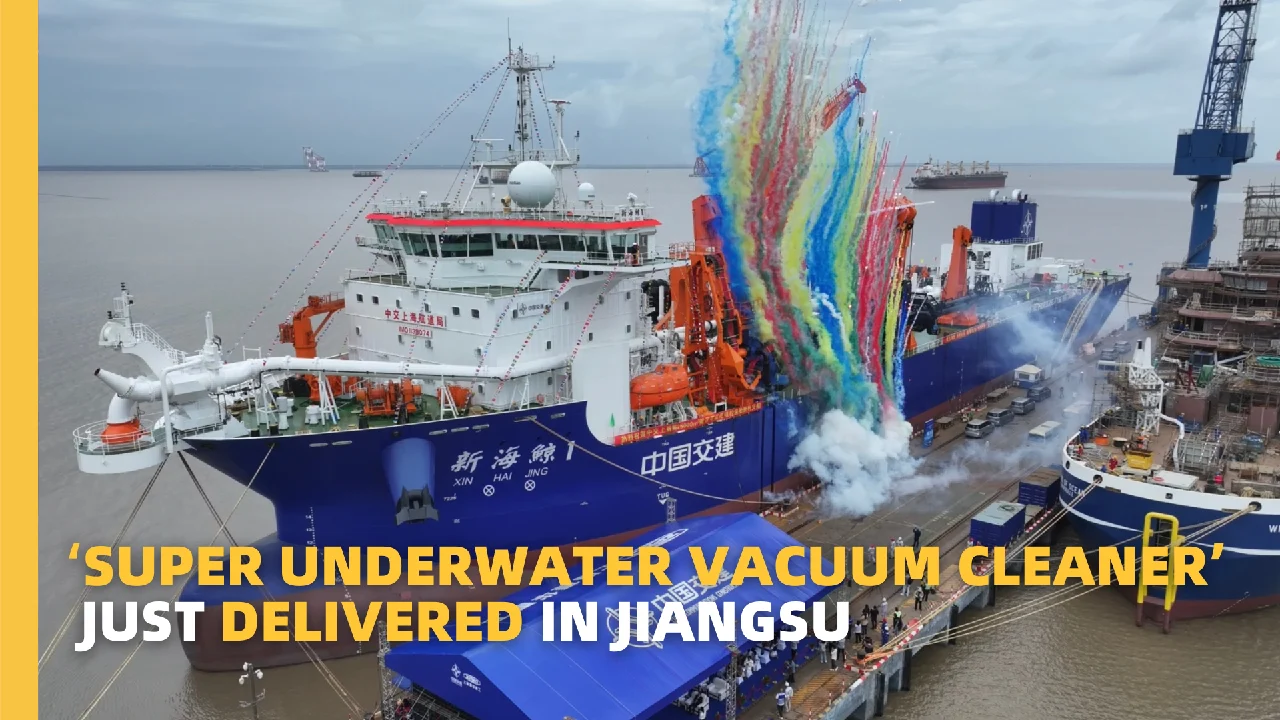
The Rise of the “Super Underwater Vacuum Cleaner”: Revolutionizing Marine Engineering
The ocean floor, a vast and often overlooked frontier, is increasingly becoming a site of significant human activity. From the extraction of vital resources to the construction of critical infrastructure, our interaction with the marine environment is growing. This expanding engagement necessitates advanced tools capable of operating efficiently and effectively in challenging underwater conditions. Recently, China unveiled a groundbreaking piece of marine engineering, dubbed a “super underwater vacuum cleaner,” that promises to transform how we approach seabed operations. This article will explore the capabilities of this new technology, its potential applications, and the broader implications for marine engineering and environmental management.
Introducing “XIN HAI JING 1”: A New Era in Dredging Technology
The vessel at the heart of this innovation is named “XIN HAI JING 1.” It represents a significant leap forward in dredging technology, being China’s first ultra-large trailing suction hopper dredger equipped with a distributed in-hull mud pump. This advanced design allows it to function much like a powerful vacuum cleaner for the seabed, capable of removing large volumes of sediment and material with unprecedented efficiency. The delivery of this vessel in Qidong, Jiangsu Province, marks a milestone in the development of marine engineering capabilities.
The sheer scale of “XIN HAI JING 1” is impressive. Its maximum hopper capacity is a staggering 27,929 cubic meters. To put this into perspective, this volume is enough to fill over ten standard Olympic-sized swimming pools in a single load. This immense capacity means fewer trips and significantly reduced operational time for large-scale projects. Furthermore, its maximum dredging depth reaches 120 meters, which is roughly equivalent to the height of a 40-story building. This capability allows for operations in deeper waters than previously feasible with many conventional dredging vessels.
Beyond its impressive physical dimensions and dredging capacity, “XIN HAI JING 1” is also a marvel of modern technology. It is equipped with a sophisticated monitoring platform that provides real-time data on its operations. This allows for precise control and optimization of the dredging process. Adding to its advanced nature is an AI-powered “digital sentinel” system. This intelligent system likely enhances operational safety, efficiency, and environmental monitoring, ensuring that the dredging activities are conducted with maximum precision and minimal impact.
The Mechanics of a “Super Underwater Vacuum Cleaner”
The term “super underwater vacuum cleaner” effectively captures the essence of how a trailing suction hopper dredger like “XIN HAI JING 1” operates. The process involves a large vessel that moves slowly over the seabed, dragging a specialized suction pipe, known as a draghead, along the bottom. This draghead is designed to dislodge and ingest sediment and other materials. Powerful pumps then transport this mixture of soil and water up through a pipe into the vessel’s large cargo hold, called a hopper.
The “trailing suction” aspect means the vessel moves forward, pulling the suction pipe behind it. This method is highly effective for large-scale dredging operations where vast areas need to be cleared or excavated. The “hopper” is the storage area on the vessel where the dredged material is collected. Once the hopper is full, the vessel can sail to a designated disposal site or a location where the material is needed for reclamation projects, and then discharge its load.
The innovation in “XIN HAI JING 1” lies in its “distributed in-hull mud pump” system. Traditional dredgers often have a single, powerful pump. By distributing multiple pumps within the hull, the system can achieve greater efficiency, better control over the flow of material, and potentially allow for more varied types of sediment to be handled. This distributed system likely contributes to the vessel’s ultra-large capacity and its ability to dredge at significant depths. The AI integration further refines this process, allowing for intelligent adjustments to suction power, speed, and angle based on real-time seabed conditions and project requirements.
Applications and Potential Impact
The capabilities of “XIN HAI JING 1” open up a wide range of applications, many of which are critical for economic development and infrastructure maintenance. Its primary roles will include:
Deep-Sea Sand Extraction
Sand is a fundamental resource for construction, particularly for land reclamation projects. Deep-sea sand extraction is becoming increasingly important as easily accessible sand deposits near coastlines are depleted. The ability of “XIN HAI JING 1” to dredge at depths of up to 120 meters makes it ideal for accessing these deeper, richer sand reserves. This capability is vital for supporting the growth of coastal cities and developing new land areas for housing, industry, and infrastructure.
Deep-Water Port Channel Dredging
Efficient maritime trade relies on deep and wide shipping channels that can accommodate large vessels. Over time, ports can become silted up, reducing their capacity and efficiency. “XIN HAI JING 1” is perfectly suited for maintaining and deepening these crucial navigation channels. Its large capacity means that significant volumes of silt can be removed quickly, minimizing disruption to port operations and ensuring that ports remain accessible to global shipping fleets. This is essential for maintaining a country’s competitiveness in international trade.
Land Reclamation
Land reclamation is a common practice in many coastal regions, especially in areas with limited land availability. This process involves creating new land from the sea, often for urban expansion, industrial development, or the creation of new infrastructure like airports or artificial islands. The dredged material, particularly sand, can be used as fill material for these reclamation projects. The massive hopper capacity of “XIN HAI JING 1” makes it an extremely efficient tool for supplying the vast quantities of material needed for large-scale land reclamation efforts.
Coastal Protection
Coastal erosion is a growing concern due to rising sea levels and increased storm intensity. Projects aimed at protecting coastlines often involve reshaping the seabed or creating artificial barriers. Dredging can play a role in these efforts by supplying materials for constructing breakwaters, artificial reefs, or by altering underwater topography to reduce wave energy. The precision and capacity of advanced dredgers like “XIN HAI JING 1” can contribute to more effective and sustainable coastal protection strategies.
Technological Advancements and Environmental Considerations
While the primary function of a dredger is to move large amounts of material, modern marine engineering also places a strong emphasis on environmental responsibility. The AI-powered “digital sentinel” system on “XIN HAI JING 1” likely plays a crucial role in mitigating the environmental impact of dredging operations. This system could monitor water turbidity, sediment plumes, and the presence of marine life, allowing operators to adjust dredging parameters in real-time to minimize disturbance.
Dredging can have several environmental effects, including the disruption of benthic habitats (the ecosystems on the seafloor), increased turbidity that can affect marine life and water quality, and the potential release of contaminants from disturbed sediments. Advanced monitoring and control systems are therefore essential for responsible dredging. By providing detailed operational data and employing intelligent control, “XIN HAI JING 1” aims to conduct its work with greater precision, reducing its ecological footprint.
The ability to dredge at greater depths and with higher efficiency also means that projects can potentially be completed faster, reducing the overall duration of underwater operations and the associated environmental impacts. Furthermore, the controlled disposal of dredged material is a critical aspect of environmental management. Modern vessels are designed to discharge material in ways that minimize resuspension and impact on the surrounding environment, or to transport it to designated beneficial use sites.
The Future of Marine Engineering
The development of vessels like “XIN HAI JING 1” signifies a broader trend in marine engineering towards larger, more sophisticated, and more intelligent equipment. As global demand for resources and infrastructure continues to grow, and as we face the challenges of climate change, our reliance on the marine environment will only increase. This necessitates continuous innovation in the technologies that allow us to interact with the ocean.
The integration of artificial intelligence, advanced sensor technology, and sophisticated hydraulic and mechanical systems is becoming standard in the design of large marine vessels. This trend is driven by the need for greater efficiency, improved safety, reduced operational costs, and enhanced environmental performance. The “super underwater vacuum cleaner” is not just a single vessel; it represents a paradigm shift in how we approach large-scale marine construction and resource management.
Looking ahead, we can expect to see further advancements in autonomous dredging systems, more precise environmental monitoring and control technologies, and the development of vessels capable of operating in even more extreme marine environments. The ability to effectively and responsibly manage our oceans will be critical for sustainable development in the 21st century, and technologies like “XIN HAI JING 1” are paving the way for that future.
Conclusion
The delivery of “XIN HAI JING 1,” China’s first ultra-large trailing suction hopper dredger with a distributed in-hull mud pump, marks a significant achievement in marine engineering. This “super underwater vacuum cleaner” possesses remarkable capacity and dredging depth, positioning it as a vital tool for a range of critical applications, including deep-sea sand extraction, port channel maintenance, land reclamation, and coastal protection. Its advanced technological features, including AI-powered monitoring, underscore a growing commitment to efficiency, precision, and environmental responsibility in marine operations. As the world continues to develop and interact with its oceans, innovations like “XIN HAI JING 1” are essential for building the infrastructure and managing the resources needed for a sustainable future. The ongoing evolution of marine engineering promises even more sophisticated solutions for the challenges and opportunities that lie beneath the waves.



Conversation
0 Comments