

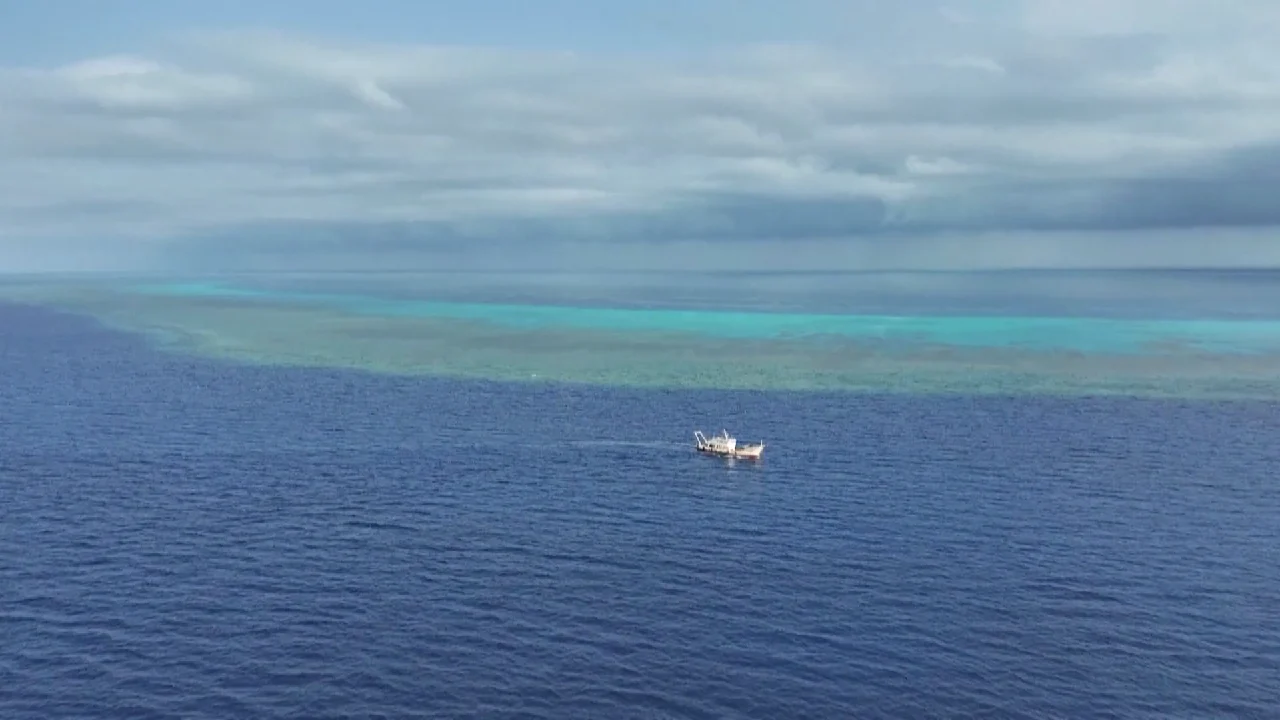
The South China Sea, a vital waterway for global trade and a region of immense strategic importance, has long been a focal point of geopolitical discussions and maritime activities. Its waters are dotted with numerous islands, reefs, and shoals, many of which are claimed by multiple nations. Among these features, Huangyan Dao, also known as Scarborough Shoal, stands out as a significant point of contention and a symbol of ongoing territorial disputes. Recent events have highlighted the heightened military and coast guard presence in this area, with China’s People’s Liberation Army (PLA) conducting combat readiness patrols. This article will delve into the context surrounding these patrols, examining the historical claims, the current geopolitical landscape, and the implications of increased military activity around Huangyan Dao. Understanding the dynamics at play is crucial for grasping the complexities of maritime security and international relations in the South China Sea.
Historical Claims and Sovereignty Over Huangyan Dao
The dispute over Huangyan Dao is rooted in differing interpretations of historical claims and international law. China asserts that Huangyan Dao has been an inherent part of its territory since ancient times, citing historical records and traditional fishing grounds as evidence of its sovereignty. This perspective is central to China’s broader claims in the South China Sea, often referred to as the “nine-dash line.”
The Philippines, on the other hand, bases its claims on geographical proximity and the principle of international law, particularly the United Nations Convention on the Law of the Sea (UNCLOS). Under UNCLOS, features within a nation’s exclusive economic zone (EEZ) and continental shelf are subject to its sovereign rights. The Philippines argues that Huangyan Dao falls within its EEZ, making it a part of its territory.
This divergence in claims has led to a long-standing disagreement, with both nations asserting their rights and presence in the vicinity of the shoal. The historical context is not merely academic; it forms the bedrock of each nation’s legal and political arguments, influencing their actions and reactions in the disputed waters. The continuous assertion of these claims by both sides underscores the deep-seated nature of the territorial dispute.
The Role of the People’s Liberation Army (PLA) in South China Sea Operations
The People’s Liberation Army (PLA), China’s armed forces, plays a pivotal role in asserting and defending China’s territorial claims, particularly in the South China Sea. The PLA Southern Theater Command (STC) is responsible for operations in this strategically vital region. Its activities, such as combat readiness patrols, are often framed as necessary measures to safeguard national sovereignty and security.
These patrols involve both naval and air units, demonstrating a comprehensive approach to maintaining a presence and projecting power. The stated purpose of these patrols, as seen in the recent activities around Huangyan Dao, is to enhance control and management over relevant waters and airspace. They are also described as countermeasures against what China perceives as “rights violations and provocative acts” by other nations.
The PLA’s involvement is not limited to routine patrols. It includes exercises, the development of military infrastructure on disputed features, and the deployment of advanced weaponry. This sustained military presence is a key element of China’s strategy to solidify its claims and deter actions it deems contrary to its interests in the South China Sea. The readiness and capability of the PLA are therefore central to the ongoing maritime dynamics in the region.
Recent Patrols and China’s Stated Justification
Recent reports indicate that naval and air units of the PLA Southern Theater Command conducted combat readiness patrols in the territorial sea and airspace of Huangyan Dao and its surrounding areas. This action was explicitly stated as a “necessary countermeasure in response to the Philippines’ rights violation and provocative acts.” The STC emphasized that Huangyan Dao is China’s inherent territory and that these patrols have been strengthened since the beginning of October.
The patrols are designed to further enhance control and management over the relevant waters and airspace. They are intended to serve as an effective response to “all sorts of rights violations and provocative acts.” The STC further declared that its forces will “resolutely safeguard China’s sovereignty and security and firmly uphold peace and stability in the South China Sea.”
In parallel with the PLA’s activities, the China Coast Guard also conducted law enforcement patrols near Huangyan Dao. This coordinated effort between the military and coast guard underscores a multi-faceted approach to asserting control and enforcing maritime regulations as defined by China. The consistent messaging from both the PLA and the China Coast Guard highlights a unified stance on the issue of Huangyan Dao and the broader South China Sea.
The Philippines’ Perspective and Actions
The Philippines views the actions of China in the South China Sea, including those around Huangyan Dao, as infringements upon its sovereign rights and maritime entitlements. The Philippines has consistently protested against what it describes as China’s aggressive behavior and incursions into its exclusive economic zone. These protests are often lodged through diplomatic channels and international forums.
The Philippines’ stance is largely supported by the 2016 ruling of the Permanent Court of Arbitration (PCA) in The Hague, which invalidated China’s expansive nine-dash line claims and affirmed the Philippines’ sovereign rights in its EEZ. Despite this ruling, China has not recognized it, and maritime incidents continue to occur.
The Philippines has also been strengthening its own maritime capabilities and alliances to bolster its defense and assert its claims. This includes increasing joint patrols with allies, enhancing its coast guard and naval forces, and engaging in diplomatic efforts to garner international support for its position. The actions of the Philippines are aimed at defending its territorial integrity and ensuring freedom of navigation and overflight in the South China Sea.
Geopolitical Implications and Regional Stability
The heightened military activity around Huangyan Dao and in the broader South China Sea has significant geopolitical implications for regional stability. The South China Sea is a critical global trade route, and any disruption or escalation of tensions can have far-reaching economic consequences. The ongoing disputes contribute to a complex security environment, characterized by a delicate balance of power and competing interests.
The involvement of major powers, including the United States, which has a vested interest in freedom of navigation and regional security, further complicates the geopolitical landscape. Alliances and partnerships between regional nations and external powers play a crucial role in shaping the dynamics of the South China Sea. These relationships can either de-escalate tensions or inadvertently fuel them, depending on the nature of the engagement.
The actions of China, particularly its assertive patrols and island-building activities, are closely watched by neighboring countries and the international community. These actions are often seen as a test of regional resolve and a challenge to the existing international maritime order. Maintaining peace and stability in the South China Sea requires continuous diplomatic engagement, adherence to international law, and a commitment to peaceful dispute resolution.
International Law and the South China Sea Disputes
International law, particularly the United Nations Convention on the Law of the Sea (UNCLOS), provides a framework for managing maritime claims and resolving disputes in areas like the South China Sea. UNCLOS defines the rights and responsibilities of states in their territorial waters, contiguous zones, exclusive economic zones, and on the high seas. It also establishes mechanisms for the settlement of disputes.
The 2016 PCA ruling on the South China Sea arbitration case, brought by the Philippines against China, is a significant legal development. The tribunal found that China’s claims to historic rights within the nine-dash line had no legal basis under UNCLOS and that certain features in the Spratly Islands and Scarborough Shoal were not islands capable of generating an EEZ.
However, the effectiveness of international law in resolving these disputes is often challenged by the political will of the states involved. China’s non-recognition of the PCA ruling, for instance, highlights the difficulties in enforcing international legal decisions when they conflict with a state’s perceived national interests. Despite these challenges, international law remains a critical reference point for claims and a basis for diplomatic negotiations and multilateral discussions aimed at managing the disputes.
The Strategic Importance of Huangyan Dao
Huangyan Dao, or Scarborough Shoal, is more than just a disputed feature; it holds significant strategic importance for several reasons. Its location in the South China Sea places it within a vital maritime corridor, making it a point of interest for naval operations, fishing, and resource exploration. Control or significant influence over the shoal can enhance a nation’s ability to monitor maritime traffic, project power, and assert its claims over surrounding waters.
The shoal’s proximity to major shipping lanes means that any military presence or activity there can have implications for freedom of navigation and the security of international trade. For the Philippines, controlling access to Huangyan Dao is also important for its fishing industry, which relies on the rich fishing grounds in the area.
For China, asserting control over Huangyan Dao is part of its broader strategy to solidify its presence and influence in the South China Sea. It is seen as a key component in its efforts to establish maritime dominance and secure its strategic interests in the region. The strategic value of Huangyan Dao thus contributes to the intensity of the territorial dispute and the ongoing military activities.
The Role of the China Coast Guard
The China Coast Guard (CCG) plays an increasingly prominent role in China’s maritime strategy, often working in conjunction with the PLA. The CCG is responsible for law enforcement, maritime safety, search and rescue, and environmental protection in China’s maritime jurisdictions. However, its operations have also become a key tool in asserting China’s territorial claims, particularly in disputed areas like Huangyan Dao.
The CCG’s patrols near Huangyan Dao, as reported, are framed as law enforcement actions but are seen by other claimants as extensions of China’s assertive maritime policy. The CCG’s vessels are often more numerous and can operate in areas where naval vessels might be seen as a direct escalation. This allows China to maintain a persistent presence and exert control without necessarily triggering a full-blown military confrontation.
The integration of the CCG into China’s maritime security apparatus reflects a strategy of using a combination of military and law enforcement tools to achieve its objectives in the South China Sea. This approach allows for a more flexible and sustained assertion of sovereignty and control over disputed features and waters.
International Reactions and Concerns
The ongoing military activities and territorial disputes in the South China Sea, including those involving Huangyan Dao, have drawn significant attention and concern from the international community. Many nations, particularly those reliant on maritime trade, advocate for the peaceful resolution of disputes and adherence to international law.
The United States, for example, has consistently called for freedom of navigation and overflight in the South China Sea and has conducted freedom of navigation operations (FONOPs) to challenge what it views as excessive maritime claims. Other countries, such as Japan, Australia, and various European nations, have also expressed concerns about the implications of China’s actions for regional stability and the rules-based international order.
Regional organizations, like the Association of Southeast Asian Nations (ASEAN), have also been actively involved in discussions aimed at managing the disputes and developing a Code of Conduct for the South China Sea. However, progress on a binding code has been slow, reflecting the diverse interests and positions of the member states and China. The international community’s reactions underscore the global significance of the South China Sea and the desire for a peaceful and stable maritime environment.
The Impact on Regional Maritime Security
The assertive actions and counter-actions in the South China Sea, exemplified by the patrols around Huangyan Dao, have a profound impact on regional maritime security. The increased military presence and the potential for miscalculation or accidental escalation create an environment of heightened tension. This can lead to a security dilemma, where actions taken by one state to enhance its security are perceived as threatening by others, prompting them to increase their own military capabilities, thus leading to a cycle of escalating tensions.
The disputes also affect the operational environment for commercial shipping and fishing vessels. Concerns about safety, security, and freedom of access can impact economic activities and livelihoods. Furthermore, the militarization of the region can hinder cooperation on shared maritime interests, such as environmental protection, marine scientific research, and combating piracy and illegal fishing.
Maintaining regional maritime security requires a commitment to de-escalation, transparency, and confidence-building measures. Diplomatic dialogue, adherence to international norms, and the peaceful resolution of disputes are essential to preventing the situation from deteriorating further and ensuring a stable maritime environment for all stakeholders.
Future Outlook and Potential Resolutions
The future outlook for the South China Sea, including the situation around Huangyan Dao, remains complex and uncertain. The fundamental disagreements over territorial claims and the differing interpretations of international law are unlikely to be resolved quickly. China’s continued assertion of its claims, coupled with the Philippines’ and other claimants’ determination to defend their rights, suggests that tensions may persist.
Potential resolutions or pathways toward de-escalation could involve several elements. Enhanced diplomatic engagement and dialogue, both bilaterally and multilaterally, are crucial for managing disagreements and building trust. The successful conclusion of a meaningful Code of Conduct for the South China Sea could provide a framework for managing activities and preventing incidents.
Furthermore, increased transparency regarding military activities and a commitment to de-escalation protocols could help reduce the risk of accidental conflict. International cooperation on shared maritime challenges, such as environmental protection and maritime safety, could also foster a sense of common interest and collaboration. Ultimately, a sustainable resolution will likely require a combination of diplomatic efforts, adherence to international law, and a shared commitment to peace and stability in the region.
Conclusion
The combat readiness patrols conducted by the PLA around China’s Huangyan Dao, as reported, are a clear manifestation of the ongoing territorial disputes and geopolitical tensions in the South China Sea. These actions, framed by China as necessary countermeasures, underscore the deep-seated historical claims and strategic interests at play. The Philippines, supported by international law and a 2016 arbitration ruling, continues to assert its sovereign rights in the area.
The South China Sea remains a critical global waterway, and the heightened military activities in and around features like Huangyan Dao have significant implications for regional stability, international trade, and the rules-based maritime order. The involvement of various state actors, including the PLA and the China Coast Guard, alongside the perspectives of international powers and regional organizations, paints a complex picture of competing interests and security concerns.
Navigating these complexities requires a steadfast commitment to international law, robust diplomatic engagement, and a collective effort to promote peace and stability. While immediate resolutions may be elusive, continued dialogue, transparency, and a focus on de-escalation are essential for managing the disputes and ensuring the long-term security and prosperity of the South China Sea region. The situation around Huangyan Dao serves as a potent reminder of the challenges and the importance of peaceful dispute resolution in this vital maritime domain.



Conversation
0 Comments