

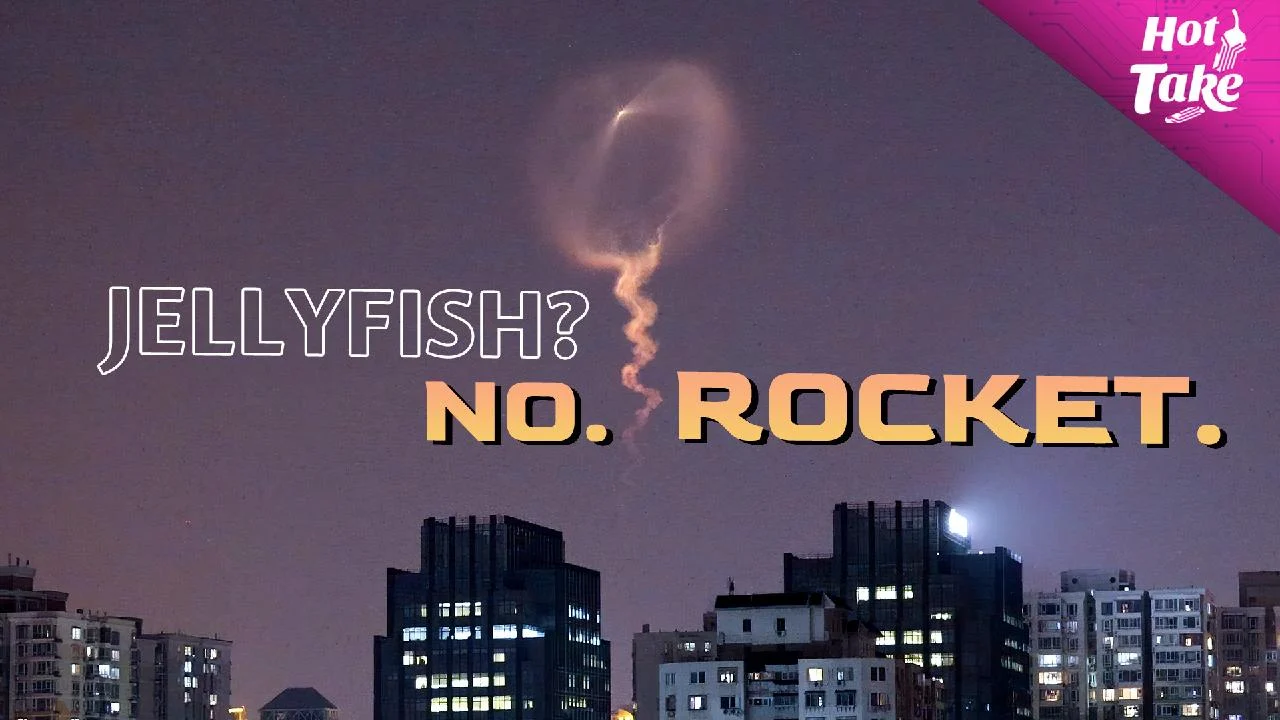
The night sky can be a canvas for incredible sights, and sometimes, these sights are not what they seem. Recently, a spectacular display resembling a glowing jellyfish captivated observers, lighting up social media. This ethereal apparition wasn’t a marine creature drifting through the atmosphere, but rather the impressive trail left by China’s Long March-6A rocket. As the rocket ascended, its hot exhaust expanded in the thin upper atmosphere, creating a vast, jellyfish-like form. The tail of this celestial jellyfish glowed with golden and blue hues, a result of the exhaust plume catching the lingering sunlight. This phenomenon, often called a “twilight phenomenon,” depends on a precise combination of launch timing, atmospheric conditions, and an unobstructed view of the sky. Understanding how these rocket trails form and why they appear so striking can offer a fascinating glimpse into the physics of space travel and atmospheric science. This article will explore the science behind these mesmerizing rocket trails, explaining the conditions that lead to their formation and the visual characteristics that make them so memorable.
The Science Behind the Jellyfish Effect
The appearance of rocket trails as glowing, jellyfish-like structures is a fascinating intersection of rocket propulsion and atmospheric optics. It’s not magic, but rather a predictable outcome of physics when specific conditions align. The key elements involved are the rocket’s exhaust, the upper atmosphere, and sunlight.
Rocket Exhaust and Atmospheric Interaction
When a rocket launches, it expels a massive amount of hot gas and particles from its engines. This exhaust is incredibly hot, often thousands of degrees Celsius, and it expands rapidly as it leaves the rocket. As the rocket ascends into higher altitudes, the atmosphere becomes much thinner, meaning there are fewer air molecules present. This low-density environment allows the hot exhaust plume to spread out more freely and for a longer duration.
The composition of the exhaust itself plays a role. Rocket fuels, depending on their type, can release various chemicals, including water vapor, carbon dioxide, and unburned fuel particles. When these hot gases mix with the extremely cold and thin air of the upper atmosphere, they can undergo rapid cooling and condensation. This process can create visible ice crystals or fine particulate matter that forms the visible trail.
The Role of Sunlight and Altitude
The “glowing” aspect of these trails is primarily due to how they interact with sunlight. Rockets often launch at times that coincide with twilight – either dawn or dusk. During twilight, the sun is below the horizon for observers on the ground, but its light can still illuminate objects at very high altitudes. The upper atmosphere, where the rocket trail exists, is still bathed in sunlight even when the ground is in darkness.
This high-altitude sunlight illuminates the particles and ice crystals within the exhaust plume. The way this light is scattered and reflected by these particles determines the color and brightness of the trail. Different particle sizes and compositions will scatter light differently, leading to variations in the visual appearance. The “jellyfish” shape itself arises from the way the expanding exhaust plume drifts and is shaped by atmospheric currents at high altitudes. The denser, brighter “head” of the jellyfish is often the initial, more concentrated exhaust, while the trailing “tentacles” are the wisps of gas and particles spreading out.
Factors Influencing the Visual Display
Several factors contribute to whether a rocket trail will exhibit this spectacular “jellyfish” appearance:
- Launch Time: Launches occurring during twilight are most likely to produce these visible, illuminated trails. A launch in broad daylight might have a visible trail, but it would likely be less dramatic and not “glow” in the same way.
- Altitude of the Trail: The higher the altitude of the exhaust plume, the longer it remains illuminated by sunlight after the rocket has passed. Trails formed at very high altitudes can persist for many minutes.
- Atmospheric Conditions: Wind patterns and temperature at the altitude of the trail affect how the plume disperses and shapes. Stable, calm conditions might allow for more defined shapes, while turbulent air can break up the trail quickly.
- Observer’s Location and Angle: The angle from which the observer views the trail relative to the sun and the rocket’s trajectory can significantly impact its appearance.
- Rocket Type and Fuel: Different rocket engines and fuels produce exhaust with varying chemical compositions and temperatures, which can influence the visual characteristics of the trail.
The combination of these elements creates a fleeting, yet breathtaking, spectacle in the sky, transforming a piece of engineering into an artistic, natural-looking phenomenon.
Understanding the “Twilight Phenomenon”
The “jellyfish” effect is a specific instance of a broader atmospheric optical phenomenon known as the “twilight phenomenon.” This occurs when sunlight illuminates atmospheric particles at high altitudes during the period after sunset or before sunrise. For rocket trails, this means the plume itself becomes a temporary, elevated cloud that catches the sun’s rays.
The Mechanics of Twilight Illumination
During twilight, the sun is below the horizon for an observer on the ground. However, at altitudes above 15-20 kilometers, the atmosphere is still directly illuminated by the sun. This is why the sky can remain bright for a period after sunset and why the upper reaches of the atmosphere are often the last to darken.
When a rocket ascends through these altitudes, its exhaust plume, consisting of hot gases and condensed particles, becomes a target for this high-altitude sunlight. The plume acts like a screen, reflecting and scattering the sunlight back towards observers on the ground. The color of the trail depends on the wavelengths of light that are scattered most effectively by the particles in the plume.
Color and Brightness Variations
The golden and blue hues mentioned in the description of the jellyfish-like trail are common in such phenomena. These colors are a result of Rayleigh scattering and Mie scattering, the same principles that give the sky its blue color during the day and create colorful sunsets.
- Blue: Shorter wavelengths of light, like blue and violet, are scattered more effectively by smaller particles and air molecules. If the particles in the rocket trail are small enough, they can scatter blue light, making parts of the trail appear blue.
- Gold/Yellow/Red: Longer wavelengths of light, like red and yellow, are scattered less effectively by small particles but can be more prominent when sunlight passes through a denser concentration of particles or when the light path is longer. The “golden” glow often comes from the direct illumination of the plume by sunlight, where the light hasn’t been significantly filtered or scattered by the lower atmosphere.
The brightness of the trail is directly proportional to the amount of sunlight hitting the plume and the density of the particles within it. A denser, more concentrated plume will appear brighter and more distinct against the darkening sky.
Timing is Everything
The precise timing of a rocket launch is critical for observing these twilight phenomena. A launch that occurs just as the sun dips below the horizon, or just before it rises, is ideal. If the launch is too early, the entire sky might still be bright, and the trail might not stand out. If it’s too late, the upper atmosphere may have already fallen into shadow.
The Long March-6A rocket launch, which produced the jellyfish-like trail, was timed perfectly to catch the sun’s rays at a high altitude. This allowed the exhaust plume to act as a temporary, luminous cloud, creating a spectacle that was both scientifically interesting and visually stunning. The duration of the visibility also depends on how long the plume remains intact and at an altitude where it can still catch sunlight.
Why “Jellyfish”? The Shape and Form
The comparison of rocket trails to jellyfish is not arbitrary; it stems from the characteristic shapes these plumes can adopt in the upper atmosphere. The fluid dynamics at play, combined with atmospheric conditions, can sculpt the expanding exhaust into forms that bear a striking resemblance to these marine creatures.
Fluid Dynamics in a Thin Atmosphere
When the hot exhaust gases are expelled from the rocket engine, they are under high pressure. As they enter the much lower pressure of the upper atmosphere, they expand rapidly. This expansion is not uniform. It is influenced by the shape of the nozzle, the velocity of the exhaust, and the surrounding atmospheric currents.
The expanding gas plume can become turbulent, creating eddies and swirls. These turbulent motions, along with the overall outward expansion, can cause the plume to spread out in a radial or fan-like manner. The denser, initial part of the exhaust might form a more compact “bell” or “head,” while the trailing gases, carried by high-altitude winds, stretch out into long, wispy “tentacles.”
Atmospheric Currents and Diffusion
At altitudes of 80 kilometers and above, the atmosphere is extremely thin, and wind speeds can be quite high. These high-altitude winds act like currents in an ocean, pushing and shaping the expanding exhaust plume. The plume doesn’t just dissipate instantly; it diffuses and drifts, its shape evolving over time.
The “tentacles” of the jellyfish are essentially streams of exhaust gas and condensed particles being stretched and pulled by these winds. The way these streams interact with each other and with the surrounding air can create complex, branching patterns that are reminiscent of a jellyfish’s oral arms or tentacles. The overall effect is a large, diffuse cloud with a brighter central region and fainter, extended tendrils.
Visual Perception and Analogy
The human eye is adept at finding patterns and making analogies. When observers see a large, luminous cloud with trailing extensions against the dark sky, the comparison to a jellyfish is a natural and intuitive one. The ethereal, glowing quality of the illuminated plume further enhances this perception, evoking the translucent and bioluminescent nature of real jellyfish.
The scale of these formations can also be impressive. A rocket plume can spread out to cover many kilometers in the upper atmosphere, making it a truly colossal structure, albeit a temporary one. This vastness, combined with the distinctive shape and glow, solidifies the “jellyfish” analogy.
Factors Affecting Trail Visibility and Appearance
While the “jellyfish” effect is a specific outcome, the visibility and appearance of any rocket trail are influenced by a variety of factors. Not all rocket launches produce spectacular light shows, and even when they do, the details can vary significantly.
Altitude and Duration of the Trail
The altitude at which the rocket’s exhaust is released is a primary determinant of visibility. Trails formed at lower altitudes, within the denser parts of the atmosphere, tend to dissipate more quickly due to atmospheric friction and mixing. These trails are often less visually striking and may not persist long enough to be illuminated by twilight.
Conversely, trails formed at very high altitudes, in the rarefied upper atmosphere, can persist for much longer periods. These high-altitude trails are more likely to catch sunlight during twilight, leading to brighter and more prolonged visual displays. The longer the trail remains intact and at a suitable altitude, the greater the chance it will be observed and appreciated.
Atmospheric Density and Composition
The density of the atmosphere at the altitude of the trail plays a crucial role. In denser air, the exhaust gases mix and cool more rapidly, leading to quicker dissipation. In the thin air of the upper atmosphere, the exhaust can spread out more widely and remain visible for longer.
The composition of the atmosphere itself can also affect the appearance. The presence of ice crystals, dust particles, or other aerosols at high altitudes can interact with the rocket exhaust and sunlight, influencing the colors and patterns observed. For instance, if the upper atmosphere already contains a high concentration of ice crystals, the rocket exhaust might readily condense onto these particles, creating a larger and more visible trail.
Weather Conditions on the Ground
While the trail itself is high in the atmosphere, ground-based weather conditions are essential for observation. A clear, unobstructed view of the sky is necessary to see the trail. Clouds, fog, or haze at lower altitudes can completely obscure the view of high-altitude phenomena.
The timing of the launch relative to sunset or sunrise is also critical. For the “jellyfish” effect, the launch must occur when the sun is below the horizon but still illuminating the upper atmosphere. This means observing during the civil, nautical, or astronomical twilight periods. The specific phase of twilight will determine the ambient light levels and the angle of the sun’s rays, influencing the brightness and color of the illuminated trail.
Rocket Performance and Trajectory
The performance of the rocket itself can influence the trail. A more powerful rocket might produce a larger volume of exhaust, potentially leading to a more extensive trail. The trajectory of the rocket also matters. A rocket that ascends vertically might produce a trail that appears to rise straight up, while a rocket on an angled trajectory will create a trail that stretches across the sky.
The specific design of the rocket engine and the type of fuel used can also affect the exhaust composition and temperature, which in turn can influence the visual characteristics of the trail. Some fuels might produce more water vapor, which readily condenses into ice crystals at high altitudes, while others might release different chemical byproducts.
Can You Spot One Yourself?
Witnessing a rocket trail transform into a glowing, jellyfish-like spectacle is a rare but achievable experience for those who know when and where to look. It requires a combination of luck, timing, and awareness of space launch schedules.
Tracking Rocket Launches
The first step to potentially seeing such a phenomenon is to stay informed about upcoming rocket launches. Many space agencies and private companies announce their launch schedules in advance. Websites and apps dedicated to tracking space launches can provide information on launch dates, times, and locations.
Key organizations to follow include:
- NASA (National Aeronautics and Space Administration): For launches from the United States.
- ESA (European Space Agency): For launches from Europe.
- Roscosmos: For launches from Russia.
- CNSA (China National Space Administration): For launches from China.
- ISRO (Indian Space Research Organisation): For launches from India.
- SpaceX, Blue Origin, ULA (United Launch Alliance): Major private launch providers.
When looking at launch schedules, pay close attention to the planned launch time. Launches scheduled for twilight hours, especially from launch sites located at latitudes that experience significant twilight periods, are more likely candidates.
Choosing the Right Location and Time
The best viewing locations are those with clear skies and an unobstructed view of the horizon in the direction of the launch site. If you are far from a launch site, you might still be able to see the trail if it ascends high enough and is illuminated by sunlight.
Consider the time of year and the latitude of the launch. Higher latitudes often experience longer and more pronounced twilight periods, increasing the chances of seeing illuminated high-altitude phenomena. For example, launches from Cape Canaveral, Florida, or Vandenberg Space Force Base in California can sometimes produce spectacular trails visible across large areas of North America. Similarly, launches from Jiuquan or Wenchang in China can create displays visible across Asia.
What to Look For
When a rocket launches, especially during twilight, look towards the horizon in the direction of the launch. Initially, you might see the bright ascent of the rocket itself. As the rocket ascends and its stages separate, pay attention to the exhaust plumes.
If the launch is timed correctly and the plume reaches sufficient altitude, you might start to see a faint glow. This glow will likely appear as a diffuse cloud. As the sunlight catches it, the cloud may brighten and take on colors, often starting with white or yellow and potentially developing blue or golden hues.
Observe how the plume spreads and drifts. If atmospheric conditions are right, you might notice it elongating and forming wispy tendrils, giving it that characteristic “jellyfish” appearance. The entire phenomenon can last from a few minutes to over half an hour, depending on the altitude and atmospheric conditions.
Photography and Sharing
If you are fortunate enough to witness such an event, capturing it with a camera can be a rewarding experience. Long exposure photography can help reveal the subtle colors and shapes that might be missed by the naked eye. Sharing your observations and photos online can also help raise awareness and appreciation for these natural and man-made spectacles.
While spotting a “jellyfish” rocket trail is not guaranteed, understanding the science behind it and knowing when and where to look significantly increases your chances of witnessing this extraordinary sight.
The Broader Implications of Rocket Trails
Beyond their visual appeal, rocket trails, including the striking “jellyfish” formations, have broader implications related to atmospheric science, environmental impact, and the public perception of space exploration.
Atmospheric Science and Research
Rocket exhaust plumes provide scientists with unique opportunities to study the upper atmosphere. By analyzing the composition and behavior of these plumes, researchers can gain insights into:
- Atmospheric Chemistry: The interaction of exhaust products with atmospheric gases can reveal details about chemical reactions occurring at high altitudes.
- Atmospheric Dynamics: The way plumes spread and disperse helps scientists understand wind patterns, turbulence, and diffusion processes in the mesosphere and thermosphere.
- Ionospheric Effects: Rocket exhaust can temporarily alter the ionization levels in the ionosphere, which is crucial for radio communications and GPS signals. Studying these effects helps in predicting and mitigating disruptions.
The “jellyfish” phenomenon, in particular, highlights how sunlight interacts with particles at extreme altitudes, providing data points for atmospheric optics research.
Environmental Considerations
While space launches are essential for scientific research, communication, and exploration, the environmental impact of rocket emissions is a growing area of concern. Rocket exhaust releases various substances into the atmosphere, including greenhouse gases like carbon dioxide and water vapor, as well as other chemicals like nitrogen oxides and soot.
At high altitudes, these emissions can persist longer and have different effects than emissions at lower altitudes. Water vapor, for instance, can form ice clouds in the cold upper atmosphere, potentially influencing atmospheric temperature and circulation patterns over time. The cumulative effect of increasing numbers of launches is a subject of ongoing research. Understanding the formation of visible trails like the “jellyfish” effect is part of understanding the broader atmospheric footprint of rocketry.
Public Engagement and Education
Spectacular visual events like the “jellyfish” rocket trail can serve as powerful tools for public engagement and education. They capture the imagination and spark curiosity about space exploration and atmospheric science.
When people see such a striking phenomenon, they are more likely to ask questions about how it works, what rockets do, and why they are important. This can lead to increased interest in STEM fields and a greater appreciation for the scientific and technological achievements involved in space missions. Sharing these events through media and social platforms helps to demystify space travel and make it more accessible to the general public.
The Long March-6A rocket’s “jellyfish” trail, captured and shared widely, serves as a reminder that the pursuit of space exploration can yield not only scientific advancements but also moments of unexpected beauty and wonder in our own skies.
Conclusion
The mesmerizing “jellyfish” formation observed in the wake of the Long March-6A rocket launch is a stunning example of how physics and atmospheric conditions can combine to create breathtaking visual displays. It is a testament to the intricate interplay between human technology and the natural environment. The hot exhaust gases, expanding in the thin upper atmosphere and catching the oblique rays of sunlight during twilight, transform a functional rocket trail into an ethereal, glowing spectacle.
Understanding the science behind this phenomenon—from the fluid dynamics of expanding gases to the principles of light scattering—enhances our appreciation for the event. It reminds us that even the most powerful machines, designed for the rigors of space travel, can inadvertently create moments of profound natural beauty. As space exploration continues to expand, with more frequent launches and missions, the chances of witnessing such celestial artistry may increase, offering new opportunities for scientific study and public wonder. These glowing trails serve not only as a reminder of our reach into space but also as a beautiful, fleeting connection between the Earth’s atmosphere and the cosmos beyond.


Conversation
0 Comments