

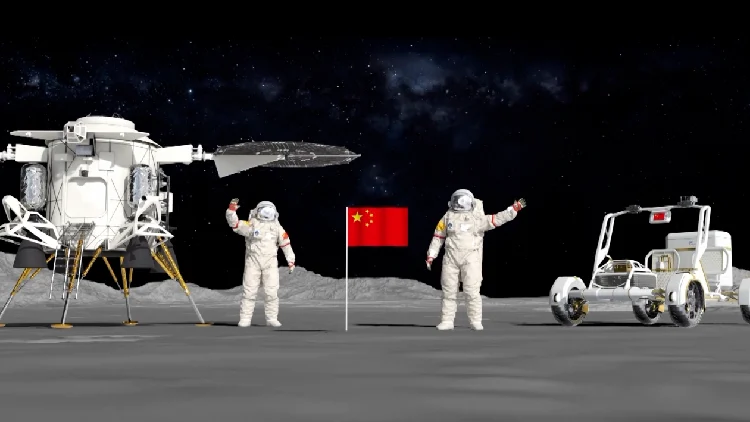
China’s Lunar Exploration Program: A Steady March Towards the Moon
China’s ambitious lunar exploration program is steadily advancing, with the lunar-landing phase showing consistent progress. This program, managed by the China Manned Space Agency (CMSA), involves a series of complex missions and technological developments aimed at expanding humanity’s presence on the Moon. The agency has outlined key upcoming milestones, including crucial rocket tests, spacecraft flights, and scientific missions, all contributing to a long-term vision for lunar exploration and research.
The CMSA’s commitment to this endeavor is evident in the detailed planning and execution of each phase. The program is not just about reaching the Moon but also about establishing a sustainable presence and fostering international collaboration. This includes opening the China Space Station to global scientists for research experiments, offering joint flight opportunities, and promoting space science education. These initiatives highlight China’s dedication to advancing space science for the benefit of all humankind.
Key Upcoming Missions and Technological Developments
The lunar-landing phase of China’s exploration program is marked by several critical upcoming missions and the development of new technologies. These are essential steps toward achieving the program’s ambitious goals. The China Manned Space Agency has detailed these plans, emphasizing the steady progress being made across all fronts.
Verification Flight of the Long March 10 Rocket
A significant upcoming event is the verification flight of the Long March 10 rocket. This new heavy-lift launch vehicle is specifically designed to support lunar missions, including the transportation of astronauts and large payloads to the Moon. Its successful development and testing are paramount for the program’s success. The Long March 10 is expected to provide the necessary power and reliability to carry the future generation of Chinese spacecraft beyond Earth’s orbit. This rocket represents a major leap in China’s launch capabilities, enabling more complex and ambitious space missions. Its design incorporates advanced features to ensure safety and efficiency, making it a cornerstone of the lunar exploration strategy.
First Flights of the Mengzhou Crewed Spacecraft and Lanyue Lunar Lander
Following the rocket verification, the program will see the maiden flights of the Mengzhou crewed spacecraft and the Lanyue lunar lander. The Mengzhou spacecraft is being developed to carry astronauts to lunar orbit and potentially to the lunar surface. It is designed with advanced life support systems and safety features to ensure the well-being of its crew during long-duration missions. The Lanyue lunar lander is equally critical, tasked with the actual touchdown on the lunar surface. This lander will be capable of carrying astronauts and scientific equipment, facilitating surface exploration and sample collection. The successful integration and operation of both the Mengzhou spacecraft and the Lanyue lander are vital for China’s human lunar landing ambitions. These vehicles are the culmination of years of research and development, pushing the boundaries of spacecraft engineering.
The Chang’e 7 Mission
The Chang’e 7 mission is another key component of the lunar exploration program. While the specifics of Chang’e 7 are still being detailed, previous Chang’e missions have successfully demonstrated China’s capabilities in lunar orbiting, soft landing, and sample return. Chang’e 7 is expected to build upon these successes, likely focusing on scientific investigation in a specific region of the Moon, possibly the lunar south pole, which is of great interest due to the potential presence of water ice. This mission will involve a suite of scientific instruments to conduct detailed surveys and analyses, contributing valuable data to our understanding of the Moon’s geology and environment. The Chang’e series has consistently pushed the envelope of lunar exploration, and Chang’e 7 promises to be another significant scientific undertaking.
The China Space Station: A Global Platform for Research
Beyond lunar ambitions, China’s commitment to space exploration extends to its operational space station. The CMSA has announced that the China Space Station will be opened to scientists from around the world. This initiative aims to transform the station into a versatile platform for conducting a wide range of space science experiments. By providing access to international researchers, China seeks to foster a collaborative environment that accelerates scientific discovery and technological innovation.
Fostering International Cooperation in Scientific Research
The opening of the China Space Station to global scientists is a strategic move to promote deeper cooperation in space science. Researchers from different countries will have the opportunity to propose and conduct experiments, leveraging the unique microgravity environment of the station. This collaborative approach is expected to lead to breakthroughs in various fields, including materials science, biology, medicine, and fundamental physics. By pooling resources and expertise, international partners can achieve more than they could individually, advancing the collective knowledge of space and its potential applications. This openness signifies a commitment to shared progress in space exploration.
Astronaut Training and Joint Flight Opportunities
In addition to research, the China Space Station will also serve as a hub for astronaut training and joint flight opportunities. This means that astronauts from other nations may have the chance to train aboard the station and participate in crewed missions. Such collaborations are crucial for building trust and understanding between spacefaring nations. Joint missions also allow for the sharing of operational expertise and the development of common protocols for spaceflight. This aspect of the program is vital for building a robust international framework for future space endeavors, including potential missions to the Moon and beyond.
Science Education and Outreach
The China Space Station will also play a significant role in science education and outreach. Educational programs and activities will be developed to inspire the next generation of scientists and engineers. By showcasing real-world space science in action, the CMSA hopes to spark curiosity and encourage young people to pursue careers in STEM fields. This outreach component is essential for ensuring the long-term sustainability of space exploration, as it cultivates the talent pool needed for future missions. Sharing the wonders of space exploration with the public through educational initiatives is a key objective.
Future Prospects and International Collaboration
The steady progress in China’s lunar exploration program and the opening of its space station signal a growing role for the nation in global space activities. The CMSA’s plans extend beyond current missions, with a clear vision for future endeavors and a strong emphasis on international collaboration.
Welcoming International Astronauts
A significant step in fostering international ties will be the introduction of the first international astronaut to the China Space Station. This milestone will mark a new era of cooperation, demonstrating China’s willingness to share its space infrastructure with the global community. The presence of astronauts from different countries working together aboard the station will serve as a powerful symbol of unity and shared purpose in space exploration. This integration is expected to pave the way for more complex joint missions in the future.
Introduction of a Low-Cost Cargo Transportation System
To further enhance the accessibility and efficiency of space operations, the CMSA plans to introduce a low-cost cargo transportation system. This system will be crucial for resupplying the space station and supporting future lunar missions by reducing the cost of sending essential supplies and equipment into orbit and beyond. Lowering transportation costs is a key factor in making space exploration more sustainable and affordable, enabling more frequent missions and a greater scope of scientific activities. This development is expected to benefit all users of the space station and contribute to the overall advancement of space logistics.
The 7th Manned Space Symposium
The updates on these exciting developments were shared at the 7th Manned Space Symposium, which commenced on October 31, 2026, in Beijing. Such symposia are vital forums for exchanging ideas, presenting research findings, and discussing future directions in manned spaceflight and exploration. They bring together scientists, engineers, policymakers, and industry leaders from around the world, fostering dialogue and collaboration. The discussions at this symposium likely covered a wide range of topics, from the technical challenges of lunar missions to the broader implications of space exploration for humanity. These gatherings are instrumental in shaping the future of space endeavors.
Conclusion
China’s lunar exploration program is demonstrating remarkable progress, particularly in its lunar-landing phase. With key missions like the Long March 10 verification flight, the maiden voyages of the Mengzhou spacecraft and Lanyue lander, and the scientific endeavors of the Chang’e 7 mission, China is steadily building its capabilities for lunar exploration. Furthermore, the opening of the China Space Station to international partners for research, astronaut training, and joint flights underscores a commitment to global collaboration in space. The introduction of a low-cost cargo system and the ongoing dialogue at events like the Manned Space Symposium highlight a forward-looking approach. These advancements collectively point towards a future where China plays an increasingly significant role in humanity’s journey beyond Earth, fostering scientific discovery and international cooperation in the final frontier.



Conversation
0 Comments