

China’s Deep-Sea Floating Island: A New Frontier in Marine Research
The vast, unexplored depths of the ocean represent one of Earth’s last great frontiers. For centuries, humanity has gazed at the sea, driven by curiosity and the need to understand its mysteries. Now, China is poised to take a monumental leap in this endeavor by constructing the world’s first deep-sea floating island. This ambitious project, a testament to cutting-edge engineering and a commitment to scientific advancement, promises to revolutionize our ability to conduct long-term, all-weather research in the open ocean.
This groundbreaking initiative is more than just a marvel of construction; it’s a strategic investment in understanding and protecting our planet’s marine ecosystems. The deep sea, with its extreme pressures, perpetual darkness, and unique life forms, holds secrets crucial to fields ranging from climate science to biotechnology. Establishing a permanent, mobile research base in this challenging environment will unlock unprecedented opportunities for discovery. The development of this ultra-large marine scientific research platform signifies a new era in ocean exploration, pushing the boundaries of what is possible and paving the way for future generations of marine scientists.
The Vision: An All-Weather Deep-Sea Research Hub
The concept behind China’s deep-sea floating island is to create a robust, self-sustaining platform capable of operating in the most demanding oceanic conditions. Unlike traditional research vessels that are limited by weather and sea state, this artificial island is designed for continuous, long-term presence in the open ocean. This means scientists can conduct experiments and gather data without interruption, regardless of storms or challenging sea states. The platform’s mobility also allows it to be deployed to specific research areas quickly, adapting to changing oceanic phenomena or research priorities.
This facility is envisioned as a national major science and technology infrastructure project, underscoring its importance to China’s scientific and technological ambitions. It will serve as a vital hub for frontier studies across several key disciplines. These include marine science, focusing on the fundamental understanding of ocean processes; marine equipment, developing and testing new technologies for underwater exploration; and marine meteorology, improving our ability to predict weather patterns and climate change impacts. The island’s design prioritizes resilience, ensuring it can withstand extreme sea conditions, including category 17 typhoons, while maintaining a stable environment for sensitive research equipment and personnel.
Engineering a Marvel: Design and Capabilities
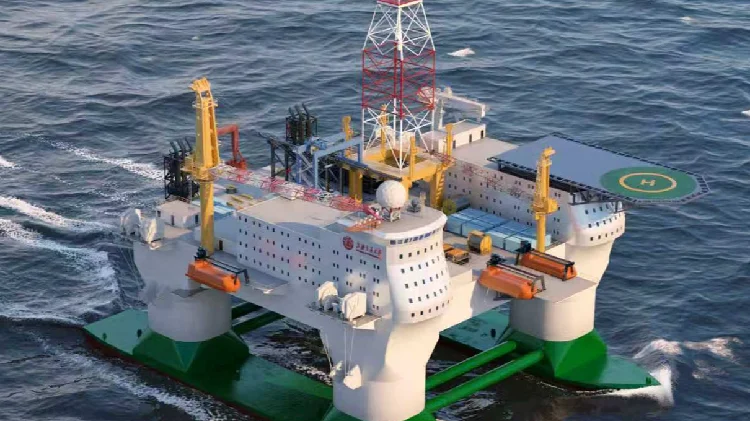
The engineering behind this deep-sea floating island is as impressive as its purpose. The main facility platform will feature a “semi-submersible twin-hull” design. This configuration is known for its stability in rough seas, as the submerged hulls provide buoyancy and reduce the impact of waves. The sheer scale of the platform is remarkable: it will measure 138 meters in length and 85 meters in width, with a main deck standing 45 meters above the water. This substantial size will accommodate a wide array of research facilities, living quarters, and operational systems.
Crucially, the island is engineered to sustain sea state 7 conditions, which refers to rough seas with significant wave heights. More impressively, it is designed to safely survive a category 17 typhoon, one of the most powerful storm classifications. This level of resilience is paramount for ensuring the safety of the crew and the integrity of the research conducted onboard. The twin-hull design, combined with advanced ballast systems and structural reinforcements, will provide the necessary stability and strength to face the ocean’s fury. The platform’s ability to maintain its position and operational capacity even in such extreme weather is a testament to the advanced engineering principles being applied.
A Three-Part System for Comprehensive Research
The deep-sea floating island is not a single monolithic structure but a sophisticated system comprising three main components, each designed to complement the others for maximum research efficiency. This integrated approach ensures that the platform can function as a self-contained research ecosystem, minimizing reliance on external support for extended periods.
The Main Facility Platform
This is the core of the operation, the massive semi-submersible twin-hull structure described earlier. It will house the primary laboratories, living quarters for researchers and crew, power generation systems, and essential life support. The platform’s design will incorporate modularity, allowing for future upgrades and adaptations as research needs evolve. Its stability and robust construction are the foundation upon which all other research activities will be built. The sheer size of this platform will enable the integration of advanced scientific instruments and equipment that might be too large or power-intensive for conventional vessels.
Ship-Based Laboratories
Complementing the main platform, the island will also feature ship-based laboratories. These are essentially specialized research vessels that can dock with or operate in close proximity to the main island. This arrangement offers several advantages. Firstly, it allows for specialized research that might require specific environmental controls or equipment not housed on the main platform. Secondly, these ships can be deployed for fieldwork, venturing further from the island to collect samples or conduct surveys in more remote areas. Their mobility ensures that research can extend beyond the immediate vicinity of the floating island, providing a broader scope for data collection.
Shore-Based Support
While the deep-sea floating island is designed for long-term autonomy, shore-based support remains a critical element of its operational strategy. This support network will handle logistics, supply chain management, personnel rotation, and the transfer of large datasets. It ensures that the island can be resupplied with provisions, fuel, and specialized equipment as needed. Furthermore, shore-based facilities will be crucial for the analysis of samples and data that require extensive laboratory infrastructure not feasible on the island itself. This connection to land-based resources ensures the sustainability and continuous operation of the research mission, bridging the gap between the remote ocean environment and the scientific community.
Strategic Importance and Economic Impact
The development of this deep-sea floating island is a significant national undertaking for China, reflecting a broader strategy to advance its capabilities in marine science and technology. The project’s value, estimated at 2.76 billion yuan (approximately 413 million US dollars), highlights the substantial investment being made. This investment is not merely in a physical structure but in the intellectual capital and technological innovation it will foster.
The construction itself will create jobs and stimulate growth within the shipbuilding and marine engineering sectors. Shanghai Waigaoqiao Shipbuilding, a subsidiary of the China State Shipbuilding Corporation (CSSC), is tasked with its construction, leveraging the expertise of the world’s largest shipbuilding group. This collaboration is expected to drive advancements in shipbuilding techniques, materials science, and offshore engineering. The project is slated to begin construction in 2028, with delivery anticipated in June 2030, marking a significant milestone in China’s technological development.
Beyond the immediate economic benefits, the island’s operational capabilities will position China at the forefront of global oceanographic research. Access to deep-sea environments is crucial for understanding climate change, discovering new resources, and developing sustainable marine technologies. By investing in such advanced infrastructure, China aims to enhance its influence in international scientific endeavors and contribute significantly to global efforts in ocean conservation and exploration.
Advancing Scientific Discovery in the Deep Sea
The deep sea is a realm of extreme conditions and unique biodiversity, holding immense potential for scientific discovery. The floating island will provide an unparalleled platform for researchers to explore these largely unknown environments.
Marine Science and Ecology
The island will serve as a base for studying the complex ecosystems of the deep ocean. Scientists can investigate the unique adaptations of marine life to high pressure, low temperatures, and complete darkness. This research could lead to breakthroughs in understanding the origins of life, discovering new species, and identifying novel biochemical compounds with potential applications in medicine and industry. The ability to conduct long-term observations will allow for the study of ecological processes, such as deep-sea food webs, the impact of human activities on these fragile environments, and the role of the deep ocean in global biogeochemical cycles.
Marine Equipment and Technology
Operating in the deep sea presents significant engineering challenges. The floating island will be a testbed for developing and refining new marine equipment and technologies. This includes advanced underwater vehicles, deep-sea sampling tools, high-pressure sensors, and communication systems. The harsh environment of the deep ocean provides the ultimate proving ground for such innovations. Success in developing robust and efficient equipment for deep-sea operations will have broader applications in offshore energy, underwater resource exploration, and marine infrastructure development.
Marine Meteorology and Climate Change
The ocean plays a critical role in regulating Earth’s climate. The deep-sea floating island will enhance our ability to monitor oceanic conditions and their impact on weather patterns and climate change. Researchers can deploy sensors to measure ocean currents, temperature, salinity, and carbon dioxide levels at various depths. This data is vital for improving climate models, predicting extreme weather events, and understanding the ocean’s capacity to absorb atmospheric carbon. Long-term, continuous monitoring from a stable platform will provide a more accurate picture of oceanic changes than intermittent measurements from ships.
Challenges and Future Implications
The construction and operation of a deep-sea floating island are not without their challenges. Engineering such a massive structure to withstand extreme oceanic forces requires meticulous planning and execution. Maintaining a continuous supply chain and ensuring the safety and well-being of personnel in remote, harsh environments are complex logistical tasks. Furthermore, the environmental impact of such a large structure and its operations must be carefully managed to minimize disruption to marine ecosystems.
Despite these challenges, the implications of this project are profound. It represents a significant advancement in humanity’s capacity to explore and understand the ocean. The knowledge gained from research conducted on the floating island could lead to solutions for global challenges, from food security and resource management to climate change mitigation. It also signifies a new era of large-scale, ambitious scientific infrastructure projects, pushing the boundaries of human ingenuity and our relationship with the natural world. The success of this endeavor could inspire similar projects worldwide, fostering a new wave of ocean exploration and scientific discovery.
Conclusion
China’s deep-sea floating island project is a bold vision for the future of ocean exploration. By creating an ultra-large, all-weather research platform, the nation is set to unlock new frontiers in marine science, technology, and meteorology. This ambitious undertaking, involving advanced engineering and a comprehensive three-part system, will provide an unprecedented capability for long-term, in-depth study of the deep ocean. The project not only promises significant scientific breakthroughs and economic benefits but also underscores a global commitment to understanding and protecting our planet’s most enigmatic environment. As construction progresses towards its 2030 delivery, the world watches with anticipation, ready to witness the dawn of a new era in deep-sea research.



Conversation
0 Comments