

China’s Bold Leap: Charting the Course for a Manned Moon Landing
The dream of humans walking on the moon, a vision that has captivated imaginations for generations, is once again taking center stage. As nations around the globe push the boundaries of space exploration, China has unveiled a detailed and ambitious plan for its first crewed mission to the lunar surface. This endeavor, set to unfold before 2030, is not just a technological feat but a testament to strategic planning and international collaboration in space. The core of China’s strategy involves a sophisticated “two launches, lunar orbit rendezvous” architecture, a method designed to maximize efficiency and leverage existing capabilities while tackling the immense challenges of reaching another celestial body.
This approach signifies a significant step in China’s growing presence in space, building upon its successful uncrewed lunar missions and its established human spaceflight program. The plan outlines a clear path forward, detailing the necessary hardware, mission profiles, and the underlying principles guiding this monumental undertaking. Understanding this strategy is key to appreciating the complexity and foresight involved in returning humans to the moon.
The “Two Launches, Lunar Orbit Rendezvous” Strategy
At the heart of China’s manned moon landing plan is a carefully considered mission architecture known as “two launches, lunar orbit rendezvous.” This strategy dictates that two separate rocket launches will be required to send the necessary components into space. The first launch will carry the Mengzhou crewed spaceship, designed to transport the astronauts. The second launch will be dedicated to sending the Lanyue lunar lander, the vehicle that will actually carry astronauts from lunar orbit down to the moon’s surface.
This dual-launch approach is a deliberate choice, offering several distinct advantages. By separating the crewed spacecraft and the lunar lander, China can optimize the design and production of each component independently. This allows for standardization and the potential to develop a family of vehicles that can be adapted for future missions. It also means that each spacecraft can be tailored precisely to its specific role, ensuring maximum effectiveness and safety.
Once both the Mengzhou spaceship and the Lanyue lander are in orbit around the Earth, they will embark on a journey towards the moon. The critical phase of the mission will occur in lunar orbit. Here, the two spacecraft will perform a rendezvous and docking maneuver. This complex operation will allow the astronauts to transfer from the Mengzhou spaceship into the Lanyue lander. From this point, the Lanyue lander will detach and begin its descent to the lunar surface, carrying the astronauts for their historic exploration.
Key Components of the Mission Architecture
The success of the “two launches, lunar orbit rendezvous” strategy hinges on the development and integration of several key pieces of hardware. Each component has undergone rigorous testing and development to ensure its readiness for the demanding conditions of space travel and lunar exploration.
The Long March-10 Carrier Rocket
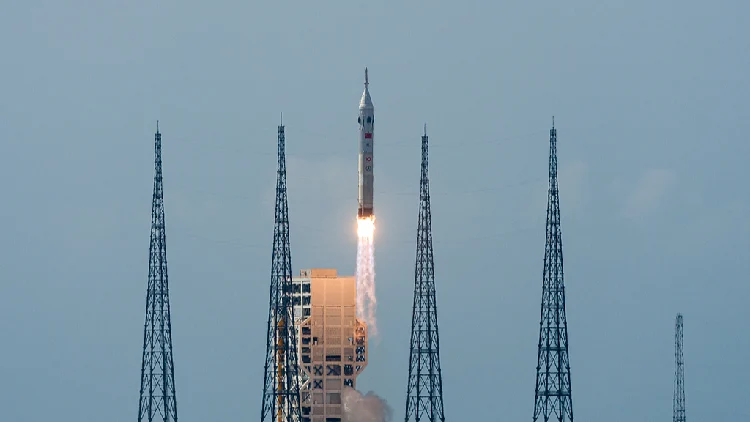
The backbone of any space mission is the rocket that propels it into orbit. For China’s manned moon landing, the Long March-10 rocket is the designated launch vehicle. This powerful rocket is specifically designed to meet the heavy-lift requirements of sending both the crewed spaceship and the lunar lander towards the moon. Its development represents a significant advancement in China’s rocket technology, enabling it to carry larger payloads over greater distances.
Recent tests of the Long March-10 have focused on critical aspects of its performance. This includes low-altitude demonstration and validation tests, which are essential for verifying the rocket’s stability and control during the initial stages of flight. These tests also incorporate the testing of the Mengzhou crewed spacecraft’s escape system under maximum aerodynamic pressure. This ensures that the astronauts have a reliable means of safely ejecting from the spacecraft in the event of an emergency during launch. The successful completion of these tests is a crucial step in validating the rocket’s overall capability and safety for crewed missions.
The Mengzhou Crewed Spaceship
The Mengzhou, meaning “dream vessel,” is the state-of-the-art spacecraft that will carry China’s astronauts to lunar orbit. Its design prioritizes crew safety, comfort, and the ability to perform complex orbital maneuvers. The spaceship is engineered to withstand the harsh environment of space and to support the astronauts during their journey to and from the moon.
Development of the Mengzhou has progressed steadily, with significant milestones achieved. Among these are the successful completion of zero-height abort tests and maximum dynamic pressure escape tests. The zero-height abort test simulates a scenario where the escape system must function immediately after liftoff, ensuring the crew’s safety even in the earliest moments of the mission. The maximum dynamic pressure escape test verifies the system’s ability to protect the crew when the rocket is experiencing the most intense aerodynamic forces during ascent. These tests are vital for building confidence in the spaceship’s safety features.
The Lanyue Lunar Lander
The Lanyue, translating to “embracing the moon,” is the specialized vehicle designed for the actual descent to the lunar surface. This lander is a critical piece of the mission, responsible for safely transporting astronauts from lunar orbit to the moon and back to orbit. Its design must account for the unique challenges of landing on an extraterrestrial body, including navigating the lunar terrain and operating in a vacuum.
The Lanyue has also undergone substantial testing. Key tests include its landing and takeoff capabilities. This means that engineers have simulated and verified the process of descending to the lunar surface, touching down gently, and then successfully launching back into lunar orbit. These tests are fundamental to ensuring that the lander can perform its primary function reliably and safely. The ability of the Lanyue to execute these maneuvers is paramount for the success of the entire manned lunar landing mission.
Mission Profile: Step-by-Step to the Lunar Surface
The execution of the manned moon landing mission will follow a precise sequence of events, carefully orchestrated to ensure the safety of the crew and the success of the scientific objectives. The “two launches, lunar orbit rendezvous” strategy dictates a specific flow for the mission.
Launch and Earth Orbit Insertion
The mission begins with the separate launches of the Long March-10 rocket carrying the Mengzhou crewed spaceship and the Long March-10 rocket carrying the Lanyue lunar lander. Each launch will be conducted from a dedicated launch site, likely the Wenchang Space Launch Site in Hainan Province, which is equipped to handle heavy-lift rockets. Following successful ascent and stage separation, both the Mengzhou and the Lanyue will be placed into Earth orbit.
Trans-Lunar Injection
Once both spacecraft are confirmed to be in stable Earth orbits and all systems are functioning correctly, the next critical step is the trans-lunar injection (TLI). This is a propulsive maneuver that accelerates the spacecraft, sending them out of Earth orbit and onto a trajectory that will carry them to the moon. The timing and execution of the TLI are crucial for ensuring that the spacecraft arrive at the moon at the correct time and position for the subsequent rendezvous.
Journey to the Moon
The journey from Earth to the moon typically takes several days. During this transit phase, the astronauts aboard the Mengzhou spaceship will monitor their spacecraft’s systems and prepare for the upcoming orbital operations. Ground control will also be closely tracking the spacecraft’s progress, making any necessary course corrections.
Lunar Orbit Insertion and Rendezvous
Upon arrival at the moon, the Mengzhou spaceship will perform a lunar orbit insertion (LOI) burn, slowing down to enter orbit around the moon. Shortly after, the Lanyue lunar lander, which has also traveled to the moon, will be in a position to rendezvous with the Mengzhou. This rendezvous is a complex orbital mechanics challenge, requiring precise navigation and control to bring the two spacecraft together safely.
Docking and Crew Transfer
Once the Mengzhou and Lanyue are in close proximity in lunar orbit, they will perform a docking maneuver. This involves physically connecting the two spacecraft. Following successful docking, the astronauts will transfer from the Mengzhou into the Lanyue lunar lander. This transfer is a critical moment, as the astronauts will be leaving their primary transport vehicle to enter the specialized craft for the descent.
Lunar Descent and Surface Operations
With the crew safely aboard the Lanyue, the lander will undock from the Mengzhou spaceship. The Mengzhou will remain in lunar orbit, serving as a communication relay and a potential return vehicle. The Lanyue will then initiate its descent sequence, using its engines to slow its rate of descent and navigate to a pre-selected landing site on the lunar surface. After a successful landing, the astronauts will disembark to conduct their scientific research and exploration activities.
Lunar Ascent and Rendezvous with Mengzhou
After completing their surface operations, the astronauts will re-enter the Lanyue lander. The ascent stage of the Lanyue will then launch from the lunar surface, carrying the crew back into lunar orbit. Here, it will rendezvous and dock with the waiting Mengzhou spaceship.
Return to Earth
Once the crew has transferred back to the Mengzhou spaceship and the Lanyue ascent stage is no longer needed, the Mengzhou will begin its journey back to Earth. This will involve another trans-Earth injection burn. The spaceship will then travel back to Earth, where it will perform a de-orbit burn and re-enter the atmosphere, landing safely at a designated recovery zone.
Advantages and Challenges of the Strategy
China’s chosen strategy for its manned moon landing is a well-thought-out approach that balances innovation with practicality. However, like any ambitious space mission, it comes with its own set of advantages and challenges.
Advantages
One of the primary advantages of the “two launches, lunar orbit rendezvous” strategy is its flexibility and modularity. By developing the crewed spaceship and the lunar lander as separate entities, China can refine each system independently. This allows for parallel development, potentially speeding up the overall timeline. Furthermore, it facilitates the creation of a standardized family of vehicles that can be adapted for various future missions, not just lunar landings. This modular approach can also simplify maintenance and upgrades over time.
Another significant benefit is the ability to optimize each spacecraft for its specific role. The Mengzhou is designed for the long journey through space and the rigors of orbital operations, while the Lanyue is optimized for the critical tasks of lunar descent, surface operations, and ascent. This specialization can lead to more efficient designs and improved performance in each phase of the mission. The separation also means that if one component experiences a significant issue during development, it may not necessarily halt the progress of the other, offering a degree of risk mitigation.
The strategy also aligns with China’s existing technical capabilities and infrastructure. It builds upon the experience gained from previous uncrewed lunar missions and the development of its human spaceflight program. This allows China to leverage its established expertise and resources, rather than having to develop entirely new systems from scratch. The approach also allows for the formation of a long-term vehicle family, supporting sustained lunar exploration and potential future deep-space missions.
Challenges
Despite its advantages, the “two launches, lunar orbit rendezvous” strategy presents considerable challenges. The most apparent is the complexity of the rendezvous and docking maneuvers in lunar orbit. These operations require extremely precise navigation, control, and a high degree of reliability from both spacecraft. Any minor miscalculation or system malfunction during these critical phases could have severe consequences for the mission and the crew.
The need for two separate heavy-lift launches also increases the overall cost and logistical complexity of the mission. Each launch requires significant resources, and coordinating two such events adds another layer of planning and execution. Furthermore, the mission profile involves more critical stages than a single-launch mission, with each stage presenting its own set of potential failure points.
The development of entirely new spacecraft, the Mengzhou and Lanyue, along with the specialized Long March-10 rocket, represents a massive engineering undertaking. Ensuring the reliability and safety of these complex systems under the extreme conditions of space travel requires extensive testing and validation. The integration of these new systems with existing ground infrastructure and mission control capabilities also poses a significant challenge.
Principles Guiding Lunar Exploration
Beyond the technical aspects of the mission architecture, China’s approach to lunar exploration is guided by a set of fundamental principles. These principles emphasize a methodical, knowledge-driven progression towards human presence on the moon.
Building Knowledge and Capability First
A core tenet of China’s lunar exploration strategy is the principle of building knowledge and capability before moving into resource utilization. This means that the initial phases of manned lunar exploration will focus on scientific research, data collection, and gaining a deeper understanding of the lunar environment. The emphasis is on learning as much as possible about the moon’s geology, resources, and potential for future human habitation or utilization.
This approach is a departure from a purely resource-driven strategy, prioritizing a thorough scientific investigation. It acknowledges that a comprehensive understanding of the moon is essential before any large-scale resource extraction or utilization activities can be safely and effectively undertaken. This methodical approach aims to ensure that future endeavors are based on solid scientific data and a well-developed technological foundation.
Prolonged Survey Phase
To achieve this deep understanding, China’s plan includes a prolonged survey phase. This suggests that initial manned missions will involve extended stays on the lunar surface, allowing astronauts ample time to conduct detailed scientific investigations. This contrasts with shorter “flags and footprints” missions and aims for a more in-depth exploration.
A prolonged survey phase allows for a wider range of experiments, sample collection, and in-situ analysis. It also provides valuable data on the long-term effects of the lunar environment on human physiology and equipment, which is crucial for planning future, more ambitious missions. This extended presence will contribute significantly to our scientific knowledge of the moon.
Step-by-Step Progression
The overarching principle is a steady, step-by-step progression in lunar exploration. This means that each mission will build upon the successes and lessons learned from previous ones. The development of manned lunar landing capabilities is seen as an evolutionary process, with each stage carefully planned and executed.
This phased approach helps to manage risk and ensure that technological advancements are integrated systematically. It allows for the gradual development of expertise and infrastructure, creating a robust foundation for future space endeavors. This methodical progression is key to achieving long-term success in space exploration.
Synergy with Unmanned Lunar Exploration
China’s manned lunar landing program is not being developed in isolation. It is closely linked to and will benefit from the country’s highly successful uncrewed lunar exploration program, known as Chang’e. This synergy is a critical factor in the overall strategy.
Common Elements in Technology, Infrastructure, and Personnel
There are many common elements shared between manned and unmanned lunar exploration. Key technologies, such as those related to propulsion, navigation, communication, and life support systems (for manned missions), often have roots in or can be adapted from uncrewed missions. Similarly, the infrastructure developed for launching and tracking spacecraft, as well as the ground control centers, can serve both types of missions.
Furthermore, the personnel involved in these programs, from engineers and scientists to mission controllers, gain valuable experience through uncrewed missions. This experience is directly transferable to the more complex demands of manned spaceflight. The Chang’e program has provided a wealth of knowledge about the lunar environment, landing techniques, and scientific instrumentation, all of which will be invaluable for the manned missions.
Leveraging Achievements of the Chang’e Program
The achievements of the Chang’e program, which has successfully landed rovers on the moon, returned lunar samples to Earth, and conducted extensive orbital surveys, will directly support the manned landing effort. For instance, data gathered by Chang’e missions on potential landing sites, lunar geology, and resource distribution will inform the selection of landing zones for the crewed mission. The technologies developed for sample return missions, such as sophisticated robotic arms and sample containment systems, could also be adapted for use by astronauts.
The success of Chang’e missions has also demonstrated China’s capability in deep-space communication and navigation, essential for maintaining contact with spacecraft far from Earth. This proven track record builds confidence and provides a solid foundation upon which the manned lunar program can be built.
Conclusion
China’s detailed plan for a manned moon landing, centered around the “two launches, lunar orbit rendezvous” architecture, represents a significant leap forward in its space exploration ambitions. This strategy, supported by the development of powerful new hardware like the Long March-10 rocket, the Mengzhou crewed spaceship, and the Lanyue lunar lander, is designed for efficiency, modularity, and safety. By carefully orchestrating separate launches, orbital rendezvous, and lunar surface operations, China aims to place astronauts on the moon before 2030.
The mission’s success will be underpinned by a commitment to building knowledge and capability through a prolonged survey phase, emphasizing a step-by-step progression. Furthermore, the program will draw heavily on the proven successes and technological advancements of China’s uncrewed Chang’e lunar missions, creating a powerful synergy between robotic and human exploration. As development continues and rigorous testing progresses, the world watches with anticipation as China charts its course for this historic return to the lunar surface, promising new scientific discoveries and a deeper understanding of our celestial neighbor.


Conversation
0 Comments