

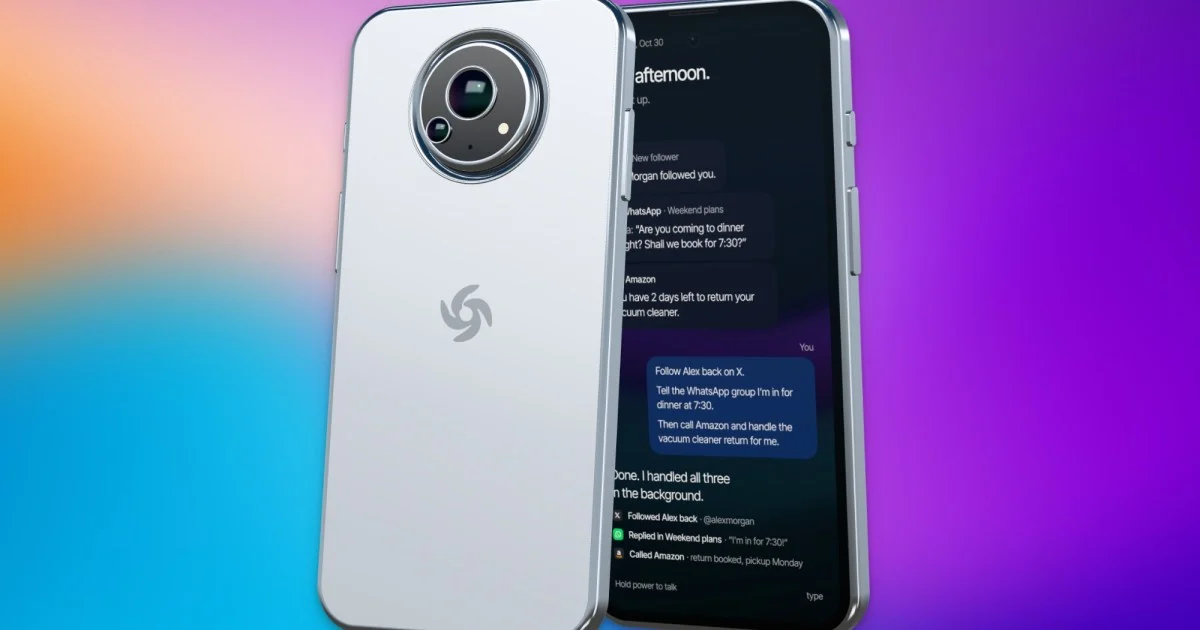
Cyclon: The AI Phone Aiming to Redefine Smartphone Interaction
The way we use our smartphones has remained largely the same for years. We open individual apps, navigate through menus, and complete tasks ourselves. A new startup, Cyclon, is looking to change this by handing over these routines to artificial intelligence. Their goal is ambitious: to create an AI phone that can truly replace your iPhone and other familiar devices by making your phone do the work for you. This approach moves beyond current AI assistants, which often depend on specific developer integrations. Cyclon aims to operate more like a human user, navigating apps independently and even creating new ones when needed.
How Cyclon Differs from Existing AI Assistants
The core innovation of Cyclon lies in its ability to interact with applications directly, without needing pre-built integrations. Unlike many AI assistants that require developers to create specific connections for them to function within an app, Cyclon mimics how a person would use the phone. It can tap through screens, select options, and complete multi-step processes across different applications. This means Cyclon can handle tasks that involve multiple apps seamlessly.
For example, imagine you want to share photos that are buried deep within a WhatsApp chat. Instead of manually searching, downloading, and then sending them, you could simply ask Cyclon to find those specific photos within WhatsApp and send them to your friend. This ability to understand and execute complex commands across various applications is a significant step forward.
Furthermore, Cyclon’s capability extends to situations where the necessary app doesn’t even exist. In such cases, Cyclon can reportedly build a temporary application on the spot to complete the task. This dynamic app creation means that the AI can adapt to almost any user need, even those not anticipated by app developers. The AI also works in the background, meaning your phone can continue performing tasks even when it’s not actively in use or when you’re using another application.
Availability and Hardware Approach
Cyclon is not just a concept; it is available for preorder. The initial offering consists of a Google Pixel 8a device with Cyclon preinstalled. The company states that these phones ship within 30 days of placing a preorder. Choosing the Pixel 8a as a starting point makes strategic sense, as Cyclon’s functionality is largely built at the operating system level. This allows the AI to deeply integrate with the phone’s core functions and existing applications.
Looking ahead, Cyclon has plans for custom hardware. The development of their own phone is intended to enable the use of more powerful AI models that can run locally on the device. This on-device processing is crucial for privacy and speed, as it means more personal data can be kept on the phone rather than being sent to the cloud. By combining powerful local AI models with cloud-based processing, Cyclon aims to offer a robust and responsive AI experience while prioritizing user privacy. This hybrid approach seeks to balance cutting-edge AI capabilities with the need to protect sensitive user information.
Reliability and App Compatibility Challenges
The primary question surrounding Cyclon’s success is its reliability in working with a wide array of applications. Every app has its unique design, user interface, and operational quirks. An AI that navigates these interfaces by simulating human touch inputs must be incredibly adaptable to handle these variations. If Cyclon can master this challenge, it has the potential to automate a vast amount of tedious and repetitive smartphone tasks, saving users significant time and effort.
However, if Cyclon struggles with the diversity of app layouts and functionalities, it risks becoming another AI assistant that promises more than it can deliver. The success of such a system hinges on its ability to interpret visual cues on the screen, understand context, and execute actions accurately, regardless of the app being used. This requires sophisticated computer vision and natural language processing capabilities, along with a robust system for learning and adapting to new app interfaces. The development of such a versatile AI is a significant technical hurdle, but one that could fundamentally change how we interact with our mobile devices if overcome.
The Future of AI in Smartphones
The emergence of Cyclon highlights a broader trend: the increasing integration of artificial intelligence into smartphones. Companies like OpenAI are reportedly working on their own AI-powered smartphones, signaling a potential shift in the market. Advancements in AI memory systems are also promising to make smartphone AI responses significantly faster. This suggests that the era of the AI phone is rapidly approaching, and it may lead to a shake-up in the industry, potentially challenging established brands.
The current smartphone landscape is dominated by a few major players, but the introduction of AI-native devices could disrupt this balance. Devices that can genuinely understand and act on user intentions, rather than just responding to commands, could offer a superior user experience. This could lead to a new generation of smartphones that are more intuitive, efficient, and personalized. The success of these AI-driven devices will likely depend on their ability to seamlessly integrate AI capabilities into everyday tasks, making them indispensable tools for users.
Understanding the AI Phone Concept
An AI phone, in essence, is a smartphone designed from the ground up with artificial intelligence as its central feature. Unlike current smartphones that have AI capabilities added on, an AI phone’s operating system and hardware are optimized to run advanced AI models. This allows for a deeper level of integration and functionality. For instance, an AI phone might be able to predict your needs before you even express them, proactively manage your schedule, or automate complex workflows without explicit instructions.
The distinction between a regular smartphone with AI features and a true AI phone lies in the AI’s autonomy and proactive nature. While current assistants like Siri or Google Assistant are reactive, responding to specific commands, an AI phone’s intelligence is designed to be more anticipatory and independent. It aims to understand the user’s goals and take the necessary steps to achieve them, often by orchestrating actions across multiple applications and system functions. This shift from a command-response model to a goal-oriented, autonomous system is what defines the AI phone.
How AI Phones Could Change Daily Life
The potential impact of AI phones on daily life is profound. Imagine waking up and your phone has already analyzed your calendar, checked traffic conditions, and suggested the optimal time to leave for work, perhaps even pre-ordering your usual coffee. Throughout the day, it could manage your communications, filter important messages, and draft responses, all while you focus on other tasks. For professionals, this could mean automating report generation, managing client interactions, or streamlining research processes.
For everyday users, the benefits could include simplified task management, enhanced entertainment experiences, and more personalized digital interactions. For example, an AI phone could curate news feeds based on your evolving interests, suggest recipes based on ingredients you have, or even help you learn new skills by providing tailored guidance. The goal is to offload cognitive load and allow users to engage with technology more effortlessly and productively. This could free up significant amounts of time and mental energy, allowing people to focus on more meaningful activities.
The Technical Hurdles of AI Phone Development
Developing a true AI phone is not without its challenges. One of the most significant is the computational power required to run advanced AI models. These models, especially large language models and sophisticated reasoning engines, demand substantial processing resources. Equipping a smartphone with enough power to run these models locally, without draining the battery too quickly or generating excessive heat, is a major engineering feat. This is why many current AI advancements rely on cloud processing, which introduces latency and privacy concerns.
Another hurdle is the development of AI that can reliably and safely interact with the vast ecosystem of existing mobile applications. Apps are designed with specific user interfaces and interaction patterns, and an AI must be able to interpret these accurately. This involves advanced computer vision to “see” the screen, natural language understanding to interpret text, and sophisticated decision-making algorithms to perform actions. Ensuring that the AI acts in the user’s best interest and does not make costly errors is paramount. Security is also a critical concern, as an AI that has deep access to a phone’s functions could be a target for malicious actors if not properly secured.
Cyclon’s Approach to AI Integration
Cyclon’s strategy addresses some of these challenges by focusing on an operating system-level integration. By working at this fundamental level, Cyclon can gain a deeper understanding of the phone’s operations and the interactions between different applications. This allows it to act as a central orchestrator, managing tasks and data flow more effectively than an app-based assistant. The ability to “jump between several apps to finish a job” is a testament to this deep integration.
The company’s plan to eventually develop custom hardware is also key. This would allow them to optimize the hardware specifically for AI processing, potentially incorporating specialized AI chips. This would enable more powerful AI models to run locally, enhancing both performance and privacy. By controlling both the hardware and the AI software, Cyclon aims to create a more cohesive and powerful AI phone experience. This vertical integration approach is common in the tech industry for achieving peak performance and differentiation.
The Role of Custom Hardware
Custom hardware is becoming increasingly important for unlocking the full potential of AI on mobile devices. Processors designed specifically for AI tasks, often referred to as Neural Processing Units (NPUs), can perform AI calculations much more efficiently than general-purpose CPUs. This allows for faster AI processing, lower power consumption, and the ability to run more complex AI models directly on the device.
For Cyclon, custom hardware would mean they are not limited by the capabilities of off-the-shelf components. They could design hardware that perfectly complements their AI software, enabling features that are simply not possible on standard smartphones. This could include advanced sensor integration for context awareness, specialized memory architectures for faster AI data access, or enhanced security features for protecting AI models and user data. The pursuit of custom hardware indicates Cyclon’s long-term vision to be a leader in the AI phone space, offering a distinct advantage over competitors who rely on generic hardware.
Privacy Considerations in AI Phones
Privacy is a major concern when discussing AI that has deep access to a user’s device and personal data. An AI that can read your messages, browse your photos, and interact with your banking apps needs robust privacy protections. Cyclon’s stated intention to run more powerful AI models locally on custom hardware is a positive step towards addressing these concerns. Keeping personal data on the device minimizes the risk of data breaches from cloud servers and reduces the amount of sensitive information transmitted over networks.
However, even with local processing, there are still privacy implications. The AI itself needs to process personal data to function. Ensuring that this processing is transparent, that users have control over what data the AI can access, and that the AI’s algorithms are not biased or exploitative are critical. The development of privacy-preserving AI techniques, such as federated learning and differential privacy, will be essential for building trust with users. As AI phones become more capable, clear policies and user controls regarding data usage will be paramount.
The Competitive Landscape of AI Phones
The AI phone market is poised to become highly competitive. With major tech companies and innovative startups all exploring this space, users can expect a rapid evolution of features and capabilities. Companies like OpenAI are rumored to be developing their own AI-centric hardware, which could bring significant competition. The race is on to define what an AI phone should be and to capture market share.
This competition is beneficial for consumers, as it drives innovation and pushes companies to offer more advanced features at competitive prices. We may see a divergence in approaches, with some companies focusing on AI as an integrated assistant, while others might offer AI as a core operating system component. The success of any AI phone will ultimately depend on its ability to deliver tangible benefits to users, such as increased productivity, simplified tasks, and a more intuitive user experience, all while maintaining strong privacy and security standards. The market is still in its early stages, and the ultimate form of the AI phone is yet to be determined.
Potential Impact on App Developers
The rise of AI phones could also have a significant impact on app developers. If AI can perform tasks across multiple apps, the need for users to manually interact with individual applications might decrease. This could change how developers design their apps and how they think about user engagement. Instead of focusing solely on in-app features, developers might need to consider how their apps can best integrate with AI systems.
This could lead to new opportunities for developers to create AI-specific functionalities or to optimize their apps for AI interaction. For example, developers might create “AI-friendly” versions of their apps that expose specific data or actions to AI agents in a structured way. This could lead to a more collaborative ecosystem where AI and traditional apps work together seamlessly. However, it also raises questions about how developers will monetize their applications if users are interacting with them less directly. The industry will need to adapt to this new paradigm.
The User Experience Revolution
The ultimate promise of an AI phone is a revolution in user experience. Instead of managing dozens of apps and complex interfaces, users could interact with their phone through natural language or even by simply stating their goals. The phone would then intelligently figure out the best way to achieve those goals, using its understanding of the user and the available applications. This could make technology more accessible to a wider range of people, including those who find current smartphones overwhelming or difficult to use.
This shift could transform how we work, learn, and communicate. Imagine a student using an AI phone to help with research, an elderly person using it to manage appointments and connect with family, or a busy professional using it to automate administrative tasks. The potential for increased efficiency, reduced stress, and greater personalization is immense. The AI phone represents a vision of technology that is not just a tool, but a truly intelligent partner that helps us navigate the complexities of modern life.
Cyclon’s Vision for the Future
Cyclon’s ambition to create an AI phone that can replace your iPhone is a bold statement in the evolving tech landscape. By focusing on an AI that can perform tasks autonomously across applications, they are aiming to address a fundamental limitation of current smartphone interactions. Their phased approach, starting with software on existing hardware and moving towards custom hardware, suggests a well-thought-out strategy for tackling the technical and market challenges.
The success of Cyclon, and indeed any AI phone, will hinge on its ability to deliver on the promise of a more intuitive, efficient, and personalized mobile experience. This requires overcoming significant technical hurdles in AI development, ensuring robust privacy and security, and adapting to a rapidly changing competitive environment. If Cyclon can successfully navigate these challenges, it could indeed usher in a new era of smartphone interaction, where our devices are not just tools we operate, but intelligent partners that help us achieve our goals. The journey of the AI phone is just beginning, and companies like Cyclon are at the forefront of this exciting technological frontier.
Conclusion
The concept of an AI phone, exemplified by Cyclon’s ambitious vision, represents a significant potential evolution in personal technology. By moving beyond the limitations of current app-centric smartphone usage, Cyclon aims to empower users by having AI handle complex tasks autonomously. This approach promises to streamline daily routines, boost productivity, and offer a more intuitive interaction with our devices. While challenges related to AI reliability, app compatibility, computational power, and privacy remain, the ongoing advancements in artificial intelligence and hardware suggest that these hurdles are not insurmountable. As the market for AI-driven devices expands, the development of truly intelligent phones could redefine our relationship with technology, making our digital lives more seamless and efficient. Cyclon’s efforts, alongside those of other innovators, are paving the way for a future where our smartphones are not just communication tools, but proactive, intelligent assistants capable of managing our digital world.


Conversation
0 Comments