

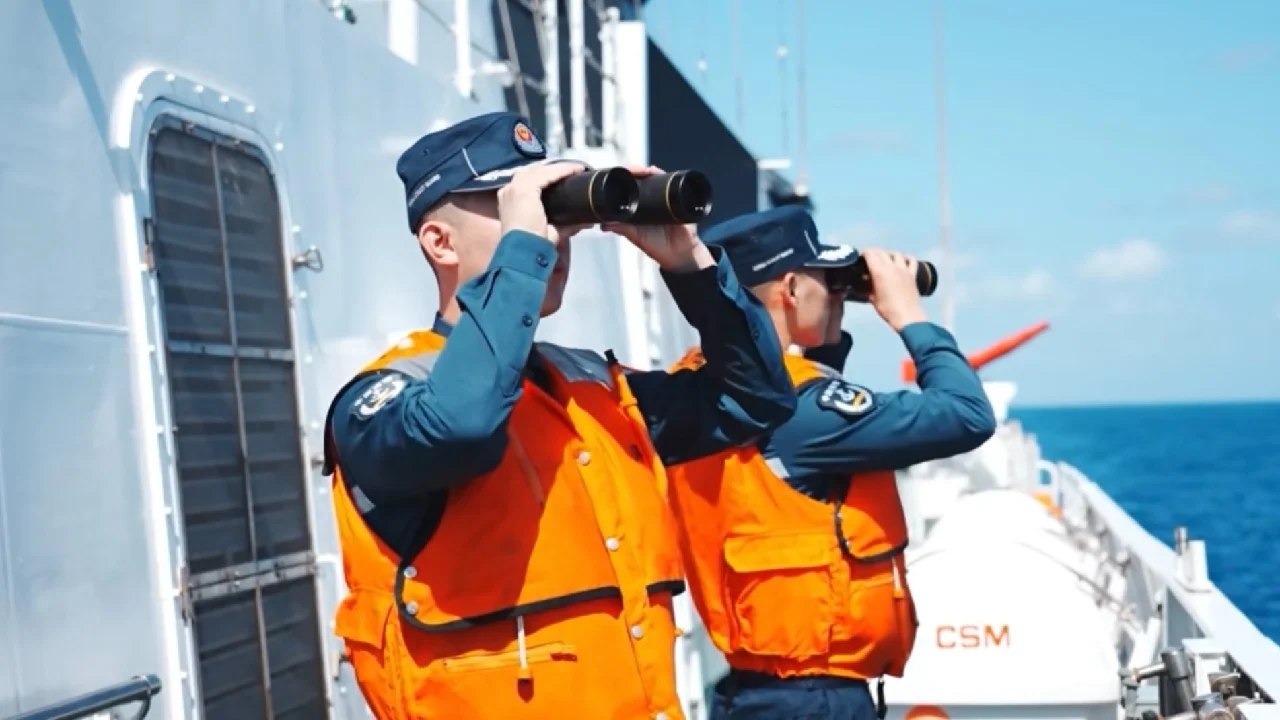
The waters surrounding China’s Taiwan island are a focal point of geopolitical attention. Recent activities by the China Coast Guard (CCG) in these areas highlight ongoing efforts to assert maritime presence and enforce regulations. These patrols are presented as routine law enforcement operations aimed at ensuring safe navigation and protecting the rights of fishermen. Understanding the context, purpose, and implications of these patrols is key to grasping the dynamics of the region. This analysis will explore the China Coast Guard’s operations, their stated objectives, and the broader significance of their presence in the waters east of Taiwan.
China Coast Guard Patrols: Stated Objectives and Operations
The China Coast Guard (CCG) has been conducting regular patrols in the waters east of China’s Taiwan island. According to official statements, these patrols are a form of law enforcement and are carried out in accordance with Chinese law. A spokesperson for the CCG, Jiang Lue, has indicated that these operations are designed to strengthen control over the relevant waters, ensuring orderly navigation and activities. The primary stated goals include safeguarding the legitimate rights and interests of individuals and entities operating in these maritime zones, as well as protecting the lives and property of fishermen on both sides of the Taiwan Strait.
The CCG emphasizes that these patrols are routine and are part of its mandate to maintain order and enforce regulations within China’s jurisdictional waters. The spokesperson also stated that the CCG will persist in strengthening its law enforcement presence in these areas. This commitment is framed as a measure to resolutely safeguard China’s territorial sovereignty and its maritime rights and interests. The operations involve specific vessels, such as the China Coast Guard Ship Hushi, which has been leading task groups to enhance control and oversight in the region since October. These actions are presented as a consistent application of China’s maritime laws and policies.
The Role of the China Coast Guard
The China Coast Guard (CCG) is a significant maritime law enforcement agency. It operates under the unified command of the Central Military Commission, which signifies its close ties to the People’s Liberation Army. The CCG’s responsibilities are broad, encompassing maritime law enforcement, search and rescue, environmental protection, and the enforcement of fishing regulations. Its establishment and expansion reflect China’s growing emphasis on asserting its maritime claims and managing its vast coastlines and maritime zones.
The agency plays a crucial role in enforcing China’s sovereignty and maritime rights in disputed or sensitive areas, including the South China Sea and the waters around Taiwan. Its operations are often characterized as law enforcement activities, distinct from direct military actions, though its integration with the military command structure blurs these lines. The CCG’s presence is intended to project authority and ensure compliance with Chinese maritime laws and regulations. This includes monitoring foreign vessels, preventing illegal fishing, and responding to maritime incidents.
The patrols east of Taiwan are an example of the CCG’s operational scope. By conducting these patrols, the CCG aims to assert China’s jurisdiction over these waters and deter activities that might be seen as challenging that jurisdiction. The agency’s actions are often closely watched by regional and international observers, as they are seen as indicators of China’s maritime policy and its approach to territorial disputes. The CCG’s increasing capabilities and operational tempo underscore its importance in China’s broader maritime strategy.
Geopolitical Context and Significance
The patrols conducted by the China Coast Guard (CCG) in the waters east of Taiwan are situated within a complex and sensitive geopolitical landscape. Taiwan, officially the Republic of China (ROC), is considered by the People’s Republic of China (PRC) as a renegade province that must be reunified with the mainland, by force if necessary. This stance is a core tenet of China’s national policy, and any actions perceived as challenging this claim are met with strong responses.
The waters east of Taiwan are strategically important. They provide access to the Pacific Ocean and are part of vital shipping lanes. For China, asserting control or influence in these waters is seen as crucial for its maritime security and its ability to project power in the region. For Taiwan, maintaining freedom of navigation and unimpeded access to these waters is essential for its economic activity and its security.
The CCG’s patrols in this area can be interpreted in several ways within this geopolitical context. Firstly, they serve as a regular demonstration of China’s assertion of sovereignty and jurisdiction. By conducting “law enforcement patrols,” China aims to normalize its presence and activities in waters that it claims as its own. This is a strategy often employed to gradually solidify claims and establish de facto control over disputed territories or maritime areas.
Secondly, these patrols can be seen as a form of pressure or signaling towards Taiwan and its international partners. The presence of Chinese Coast Guard vessels, especially in waters that Taiwan considers its own, can be interpreted as a warning against any moves towards formal independence by Taiwan or increased support from external powers. The patrols aim to create a sense of China’s pervasive presence and its readiness to enforce its claims.
Thirdly, the CCG’s operations are part of a broader strategy to gradually increase China’s maritime capabilities and influence. As China’s Coast Guard has grown in size and sophistication, its ability to conduct sustained operations in distant waters has increased. This allows Beijing to exert its influence more effectively across a wider maritime domain. The patrols east of Taiwan are thus not isolated incidents but part of a larger, evolving maritime strategy.
The international community, particularly countries with interests in the Indo-Pacific region, closely monitors these activities. The potential for escalation or miscalculation in such sensitive areas is a constant concern. The CCG’s patrols, while officially described as law enforcement, are viewed through the lens of China’s broader territorial ambitions and its assertive foreign policy. The actions of the CCG, therefore, have implications that extend far beyond routine maritime operations, touching upon regional stability and international maritime law.
Legal and Regulatory Framework
The China Coast Guard (CCG) operates under a framework of Chinese laws and regulations that define its jurisdiction and operational mandate. The primary legal basis for its actions stems from China’s sovereignty claims over its territorial waters, contiguous zones, exclusive economic zones (EEZs), and internal waters. These claims are asserted in accordance with China’s interpretation of international law, particularly the United Nations Convention on the Law of the Sea (UNCLOS), although China’s application and interpretation of UNCLOS provisions, especially concerning maritime claims, have been subject to international scrutiny and dispute.
The CCG’s mandate includes enforcing laws related to maritime safety, environmental protection, fisheries management, customs, immigration, and national security within its designated areas of responsibility. When the CCG conducts patrols east of Taiwan, it is ostensibly acting under the authority of these domestic laws, asserting China’s jurisdiction over these maritime spaces. The spokesperson’s statement about safeguarding “legitimate rights and interests” and ensuring “orderly navigation and activities” points to the regulatory functions the CCG aims to fulfill.
The concept of “jurisdictional waters” mentioned by the CCG spokesperson is central to understanding the legal underpinnings of these patrols. China asserts that the waters east of Taiwan fall under its jurisdiction, a claim that is contested by Taiwan and not universally recognized by the international community. Taiwan maintains its own maritime zones and law enforcement agencies, and its perspective on jurisdiction in these waters differs significantly.
International law, particularly UNCLOS, provides a framework for defining maritime zones such as territorial seas (up to 12 nautical miles from the coast), contiguous zones (up to 24 nautical miles), and EEZs (up to 200 nautical miles). Within these zones, coastal states have varying rights and responsibilities. However, the precise delimitation of these zones, especially in areas with overlapping claims or contested sovereignty, can be a source of conflict.
The CCG’s operations are often framed as routine law enforcement, which, in theory, should be conducted within the bounds of international law. However, the broader political context and China’s assertive stance on territorial issues mean that these patrols are often viewed as more than just regulatory actions. They are seen as a projection of power and a means to solidify territorial claims, sometimes in ways that can challenge established norms of maritime freedom and the rights of other states. The legal justification provided by the CCG is thus intertwined with its political objectives, making the interpretation of these patrols a complex legal and geopolitical exercise.
Operational Details and Capabilities
The China Coast Guard (CCG) has significantly modernized its fleet and operational capabilities in recent years, enabling it to conduct more extensive and sustained patrols. The vessels deployed, such as the China Coast Guard Ship Hushi mentioned in recent reports, are typically large, modern patrol cutters equipped with advanced navigation, communication, and surveillance systems. These ships are designed for extended operations at sea, capable of handling various maritime law enforcement tasks.
The Hushi-class cutters, for instance, are among the largest coast guard vessels in the world. They are often armed with cannons and machine guns, providing a significant deterrent capability. Beyond armament, these vessels are equipped with advanced radar, sonar, and electronic warfare systems, allowing them to monitor maritime traffic, detect unauthorized activities, and respond effectively to incidents. They also often carry smaller high-speed boats for boarding operations and rapid response.
The CCG’s operational capacity is not limited to its large cutters. The agency also operates a range of smaller patrol boats, helicopters, and even drones, which enhance its surveillance and response capabilities. The integration of these assets allows for coordinated operations across vast maritime areas. The mention of a “task group” suggests that these patrols involve multiple vessels working together, potentially including support ships or specialized units.
The patrols east of Taiwan are conducted in an area that can present challenging weather conditions, particularly during certain seasons. The modern vessels of the CCG are designed to operate in a wide range of sea states, allowing for consistent presence and operational effectiveness. The emphasis on “strengthening control over the relevant waters” implies a proactive approach, not just reacting to incidents but actively monitoring and managing maritime activities within the claimed areas.
Furthermore, the CCG’s capabilities extend to intelligence gathering and analysis. By monitoring vessel movements, communications, and other maritime activities, the CCG can build a comprehensive picture of the maritime environment. This information is crucial for planning patrols, responding to potential threats, and enforcing regulations effectively. The CCG’s increasing operational tempo and geographic reach are indicative of its growing importance as a tool of statecraft in China’s maritime policy.
Impact on Regional Stability and Maritime Security
The regular patrols conducted by the China Coast Guard (CCG) in the waters east of Taiwan have a notable impact on regional stability and maritime security. These operations, while presented as routine law enforcement, are viewed by many regional actors and international observers as a manifestation of China’s assertive maritime policy and its territorial claims. This assertive posture can create tensions and increase the risk of unintended escalation.
For Taiwan, the presence of CCG vessels in its vicinity is a constant reminder of the geopolitical pressures it faces. These patrols can be seen as a form of harassment or intimidation, aimed at testing Taiwan’s resolve and its maritime defense capabilities. They can also disrupt Taiwan’s fishing activities and maritime commerce, impacting its economy and sense of security. Taiwan’s own coast guard and naval forces monitor these patrols closely and often conduct counter-patrols or surveillance to assert their own presence and deter any aggressive actions.
The broader implications for regional maritime security are significant. The waters east of Taiwan are part of major international shipping routes. Any instability or increased risk of conflict in these areas can disrupt global trade and economic activity. The CCG’s operations, by increasing the potential for friction with Taiwan’s forces or with vessels from other nations operating in the region, contribute to a heightened sense of insecurity.
Moreover, these patrols can influence the strategic calculations of other regional powers, such as Japan, South Korea, and the United States, all of whom have significant maritime interests in the Indo-Pacific. The increased activity of the CCG in sensitive areas prompts these nations to enhance their own maritime surveillance and presence, potentially leading to a more militarized maritime environment. This can create a cycle of action and reaction, where increased patrols by one party lead to increased vigilance and presence by others, raising the overall risk of confrontation.
The CCG’s actions also raise questions about freedom of navigation and the application of international maritime law. While China asserts its right to conduct law enforcement within its claimed waters, other nations may view these actions as infringing upon the rights of passage for foreign vessels. Disagreements over maritime jurisdiction and the interpretation of international law in these contested areas are a persistent source of tension.
In essence, the CCG’s patrols east of Taiwan, while framed as domestic law enforcement, are deeply intertwined with regional geopolitical dynamics. They contribute to the ongoing tensions surrounding Taiwan, influence the strategic posture of regional powers, and affect the overall climate of maritime security in one of the world’s most critical maritime regions. The consistent assertion of presence and authority by the CCG is a key factor shaping the current maritime security landscape.
Conclusion
The China Coast Guard’s patrols in the waters east of China’s Taiwan island represent a consistent application of China’s maritime strategy. These operations are officially characterized as routine law enforcement aimed at ensuring order, safeguarding rights, and protecting fishermen. The CCG, with its increasingly capable fleet and advanced technology, asserts its jurisdiction in these waters as part of its mandate to uphold China’s territorial sovereignty and maritime interests.
However, these patrols occur within a highly sensitive geopolitical context. They are viewed as a demonstration of China’s assertive stance on Taiwan and its broader maritime ambitions in the Indo-Pacific region. The presence of CCG vessels contributes to regional tensions, influences the strategic calculations of neighboring countries, and raises concerns about maritime security and freedom of navigation.
The legal framework underpinning these patrols is based on China’s interpretation of its domestic laws and international maritime conventions. Yet, the practical application of these laws in disputed areas often leads to friction and differing perspectives. The operational capabilities of the CCG allow for sustained presence and effective enforcement, further solidifying China’s maritime footprint.
Ultimately, the CCG’s activities east of Taiwan are a significant element in the complex interplay of geopolitical forces shaping the region. They underscore the ongoing importance of maritime governance and the challenges of maintaining stability in areas with competing claims and strategic interests. The patrols serve as a clear signal of China’s commitment to asserting its maritime authority, with implications that resonate throughout the Indo-Pacific and beyond.



Conversation
0 Comments