

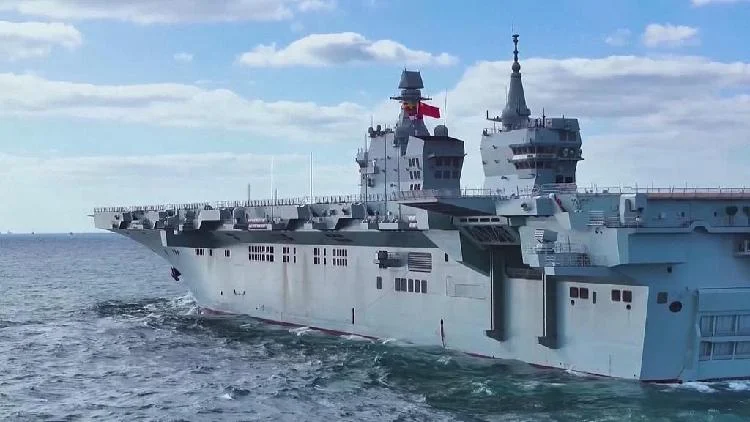
China’s GJ-21 Drone and the Type 076 Amphibious Assault Ship: A New Era in Naval Aviation
China’s recent successful takeoff and landing of the GJ-21 stealth reconnaissance-strike integrated drone aboard the Type 076 amphibious assault ship, the Sichuan, marks a significant advancement in naval aviation capabilities. This milestone demonstrates the Chinese Navy’s growing expertise in operating advanced fixed-wing drones from large maritime platforms, signaling a new phase in its amphibious assault capabilities. The integration of such drones offers enhanced intelligence, surveillance, and reconnaissance (ISR) potential, alongside strike capabilities, from a mobile and versatile platform.
The Type 076 amphibious assault ship, named Sichuan and bearing hull number 51, is a testament to China’s independent design and shipbuilding prowess. Launched in late 2024, this vessel is engineered with a full-load displacement exceeding 40,000 tonnes and features a distinctive dual-island superstructure and a full-length flight deck. Its design incorporates cutting-edge technologies, including an automated landing guidance system, an integrated electric power system, and electromagnetic catapult and arrestor systems. These features are specifically tailored to support the operation of fixed-wing unmanned aerial vehicles (UAVs), helicopters, and amphibious assault equipment, positioning the Sichuan as a highly capable multi-role platform.
Since commencing its initial sea trials in November 2025, the Sichuan has undergone a series of rigorous maritime tests. These trials have focused on debugging its various systems and ensuring overall operational stability. The successful integration and operation of the GJ-21 drone represent a key achievement in these ongoing tests, validating the ship’s design and its capacity to host and deploy advanced drone technology. This development is crucial for modern naval warfare, where unmanned systems are increasingly playing a vital role in extending operational reach and enhancing mission effectiveness.
The GJ-21 Drone: Capabilities and Significance
The GJ-21 drone represents a leap forward in unmanned aerial vehicle technology, particularly in its integration for shipborne operations. As a stealth reconnaissance-strike integrated drone, it combines advanced stealth features, designed to minimize radar detection, with the ability to conduct both intelligence gathering and offensive missions. This dual capability makes it an exceptionally versatile asset for naval forces. Its ability to operate from an amphibious assault ship like the Sichuan means it can be deployed closer to operational areas, providing real-time intelligence and rapid strike options without the need for traditional carrier-based aircraft.
The reconnaissance capabilities of the GJ-21 are vital for modern naval operations. It can gather detailed imagery and electronic intelligence over vast areas, providing commanders with a clear picture of the operational environment. This information is critical for planning amphibious landings, monitoring enemy movements, and identifying targets. Furthermore, its strike capability allows it to engage targets identified during its reconnaissance missions, offering a swift and decisive response. The integration of these two functions into a single platform reduces the logistical burden and increases the speed of response compared to separate ISR and strike assets.
The stealth characteristics of the GJ-21 are particularly important for operating in contested environments. By reducing its radar cross-section, the drone can penetrate enemy airspace with a lower risk of detection and engagement. This is crucial for conducting missions deep within enemy territory or for operating in close proximity to adversary forces. When combined with its shipborne deployment, the GJ-21 can provide a persistent and covert presence, gathering intelligence and maintaining surveillance over critical areas for extended periods.
The Type 076 Amphibious Assault Ship: A Versatile Platform
The Type 076 amphibious assault ship, exemplified by the Sichuan, is designed to be a cornerstone of China’s naval power projection. Its substantial displacement of over 40,000 tonnes allows it to carry a significant complement of personnel, vehicles, aircraft, and equipment. The full-length flight deck, combined with the dual-island superstructure, is optimized for efficient aircraft operations, including the launch and recovery of both manned and unmanned aircraft. This configuration is similar to that of large aircraft carriers but is adapted for amphibious assault and a wider range of support missions.
One of the most notable features of the Type 076 is its incorporation of advanced technologies. The automated landing guidance system ensures precise and safe landings for aircraft, even in challenging weather conditions. The integrated electric power system provides robust and flexible power distribution, essential for operating sophisticated onboard systems, including the electromagnetic catapult and arrestor gear. These catapult systems are a significant upgrade from traditional steam catapults, offering faster launch cycles, greater efficiency, and the ability to launch heavier aircraft, including fixed-wing drones like the GJ-21.
The ability of the Type 076 to carry and operate fixed-wing UAVs is a game-changer for amphibious operations. Traditional amphibious assault ships primarily rely on helicopters and vertical/short takeoff and landing (V/STOL) aircraft. The inclusion of fixed-wing drone capabilities significantly expands the ship’s operational envelope. These drones can provide long-range reconnaissance, electronic warfare support, and precision strike capabilities that were previously only available from dedicated aircraft carriers. This makes the Type 076 a more potent and flexible platform, capable of supporting a wider array of missions, from humanitarian aid to high-intensity combat operations.
The ship’s design also accommodates a variety of amphibious equipment, including landing craft and armored vehicles, enabling it to project ground forces ashore. The combination of air and ground assault capabilities, supported by advanced drone technology, makes the Type 076 a formidable asset for any naval force. Its role extends beyond direct combat, as it can also serve as a command and control center for joint operations, coordinating air, sea, and land forces.
Strategic Implications of Shipborne Drone Operations
The successful integration of the GJ-21 drone onto the Type 076 amphibious assault ship has profound strategic implications for naval warfare. It signifies a shift towards greater reliance on unmanned systems, which offer several advantages over manned aircraft. Drones can be designed for specific missions without the need for life support systems, allowing for greater flexibility in payload and endurance. They can also be operated in environments that are too hazardous for human pilots, reducing risk to personnel.
For amphibious operations, shipborne drones like the GJ-21 can provide critical support from the initial stages of an assault. They can conduct pre-assault reconnaissance to identify enemy defenses, map landing zones, and assess threats. During the assault, they can provide real-time intelligence on the battlefield, guide landing forces, and engage enemy positions with precision munitions. This continuous ISR and strike capability significantly enhances the survivability and success rate of amphibious landings.
Furthermore, the deployment of reconnaissance-strike drones from amphibious assault ships allows navies to extend their operational reach and influence without the need for large, dedicated aircraft carriers. Amphibious assault ships are generally more numerous and less specialized than aircraft carriers, making them more adaptable to a wider range of missions and more cost-effective to operate. By equipping these ships with advanced drone capabilities, navies can effectively create distributed air power projection capabilities across a wider geographic area.
The stealth characteristics of the GJ-21 add another layer of strategic advantage. Operating undetected allows for persistent surveillance and the ability to strike targets with a reduced risk of retaliation. This is particularly important in modern warfare, where air defense systems are increasingly sophisticated. The ability to penetrate these defenses and gather intelligence or deliver strikes covertly provides a significant tactical and strategic edge.
Technological Advancements and Future Development
The development and successful deployment of the GJ-21 drone and the Type 076 amphibious assault ship highlight China’s rapid advancements in naval technology. The electromagnetic catapult and arrestor systems, for instance, are cutting-edge technologies that are also being adopted by other leading naval powers. These systems are essential for launching and recovering heavier and faster aircraft, including fixed-wing drones, with greater efficiency and reliability than older technologies.
The integrated electric power system is another key innovation. It allows for more efficient power management, enabling the ship to power its advanced weapons systems, sensors, and propulsion more effectively. This is particularly important for a platform that needs to support a wide range of operations, from flight deck activities to electronic warfare and combat systems.
The GJ-21 itself represents a significant step in drone technology. Its combination of stealth, reconnaissance, and strike capabilities in a single platform is a trend seen across the global defense industry. As drone technology continues to evolve, we can expect to see even more sophisticated unmanned systems with enhanced autonomy, longer endurance, and greater payload capacity. The successful integration of such systems onto naval platforms like the Type 076 is a critical step in adapting to the future of warfare.
Future developments may include the integration of artificial intelligence (AI) into drone operations, allowing for greater autonomy in decision-making and target engagement. AI could also be used to optimize flight paths, manage swarm operations, and enhance data analysis from reconnaissance missions. The ongoing evolution of these technologies suggests that unmanned systems will play an increasingly dominant role in naval aviation in the years to come.
Operational Considerations and Challenges
While the operationalization of the GJ-21 drone on the Type 076 presents significant advantages, there are also operational considerations and challenges to address. Maintaining and servicing advanced drones at sea requires specialized facilities and trained personnel. The complexity of the GJ-21’s systems, including its stealth coatings and advanced electronics, will necessitate rigorous maintenance schedules and highly skilled technicians.
The integration of unmanned systems into existing naval command and control structures also presents challenges. Ensuring seamless communication and data sharing between the drone, the ship, and other units in a task force is crucial for effective operations. This requires robust communication networks and interoperable systems. The potential for electronic interference or cyberattacks on drone control systems also needs to be carefully managed.
Furthermore, the legal and ethical implications of operating armed drones, particularly in complex environments, are subjects of ongoing debate. Clear rules of engagement and strict oversight are necessary to ensure responsible use of these powerful weapons. The decision-making processes for deploying armed drones need to be carefully defined to prevent unintended escalation or civilian casualties.
The training of personnel to operate and manage these advanced systems is another critical factor. Sailors and officers will need to develop new skill sets to effectively utilize the capabilities of both the Type 076 and the GJ-21 drone. This includes training in drone piloting, data interpretation, maintenance, and the integration of drone operations into broader naval tactics and strategies.
Conclusion
The successful first takeoff and landing of the GJ-21 stealth reconnaissance-strike integrated drone aboard China’s Type 076 amphibious assault ship, the Sichuan, marks a pivotal moment in naval aviation. This achievement underscores the rapid advancements in drone technology and its increasing integration into modern naval platforms. The Type 076, with its advanced features and capacity to host fixed-wing UAVs, represents a new generation of amphibious assault ships capable of projecting significant air power.
The strategic implications of this development are far-reaching. It enhances China’s capabilities for intelligence gathering, surveillance, and precision strikes from maritime platforms, offering greater operational flexibility and extended reach. The combination of stealth technology with shipborne deployment provides a potent tool for naval operations in increasingly complex geopolitical landscapes. As unmanned systems continue to evolve, their role in naval warfare is set to expand, transforming how navies operate and project power across the globe. The successful integration of the GJ-21 and the Type 076 is a clear indicator of this ongoing transformation.



Conversation
0 Comments