

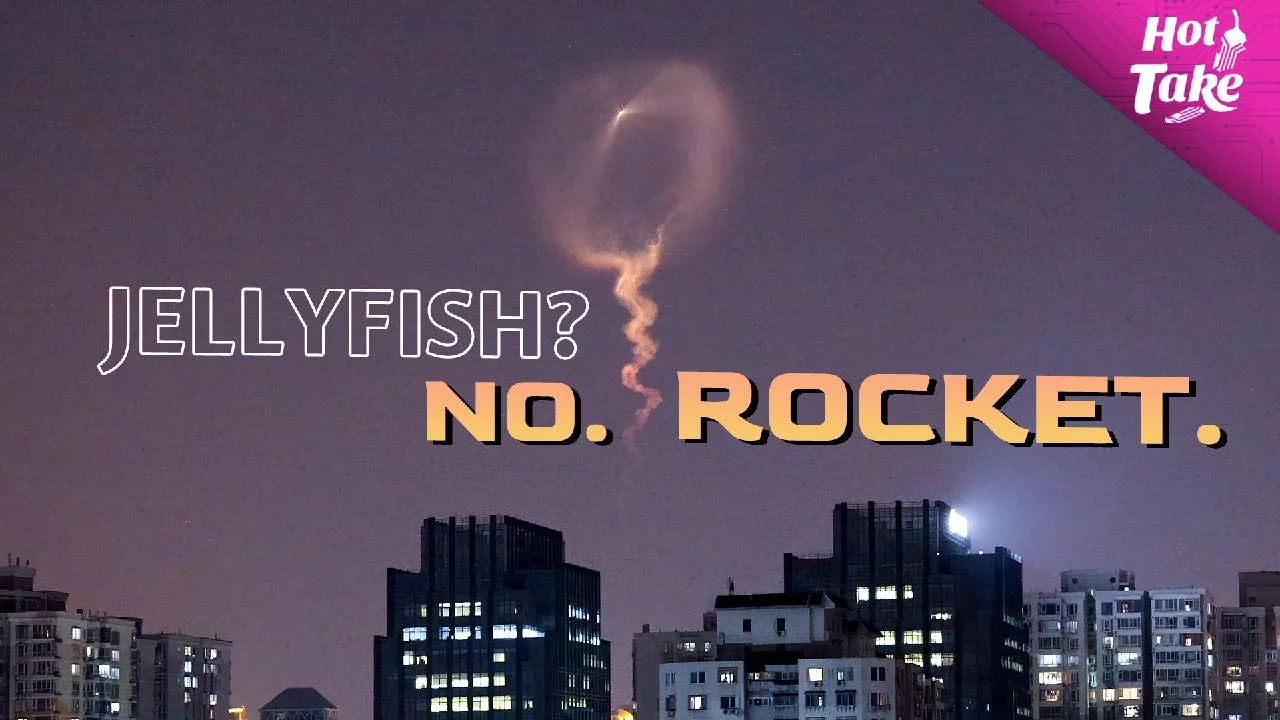
The night sky can be a canvas for incredible sights, from the gentle glow of distant stars to the fleeting streak of a meteor. Occasionally, however, something even more unusual appears: a luminous, jellyfish-like shape drifting across the darkness. This captivating phenomenon, which has recently gained attention on social media, is not an extraterrestrial visitor but rather the spectacular trail left behind by a rocket launch. Specifically, the trail of China’s Long March-6A rocket has been observed forming these ethereal, jellyfish-like structures.
The science behind this visual spectacle involves the interaction of hot exhaust gases with the thin upper atmosphere. As the rocket ascends, its powerful engines expel superheated gases. When these gases expand in the near-vacuum of high altitudes, they can create a large, diffuse cloud. The “jellyfish” appearance arises when this expanding cloud catches the sunlight. Even when the ground below is plunged into darkness, the upper atmosphere can still be illuminated by the sun, especially during twilight hours. This creates a glowing effect, with the rocket’s tail appearing as a shimmering, often golden or blue, form against the darkening sky. The precise timing of the launch, the prevailing atmospheric conditions, and a clear line of sight are all critical factors for witnessing this unique display. Understanding these elements helps explain how such a striking visual can occur and offers insight into the possibility of observing it yourself.
The Science Behind Rocket Trails
The formation of these striking visual phenomena is rooted in basic physics and atmospheric science. When a rocket launches, it expels a massive amount of hot gas from its engines. This gas is under immense pressure and is expelled at very high speeds. As the rocket climbs higher into the atmosphere, the surrounding air pressure decreases significantly. This lower pressure allows the hot exhaust gases to expand much more rapidly and widely than they would at lower altitudes.
This rapid expansion is key to the formation of the visible trail. The expanding gas cloud interacts with the surrounding atmospheric gases. The heat from the exhaust can cause the gases within the trail to glow, especially when illuminated by sunlight. The shape of the trail is influenced by various factors, including the rocket’s trajectory, the speed and direction of the exhaust, and atmospheric currents at high altitudes. These currents can stretch and distort the expanding gas, leading to the varied and sometimes unusual shapes observed.
Altitude and Atmospheric Pressure
The altitude at which a rocket operates is a critical factor in the appearance of its trail. At sea level, the atmosphere is dense, and the exhaust gases are quickly mixed with and cooled by the surrounding air. However, as a rocket ascends, it enters thinner layers of the atmosphere. In the upper atmosphere, the air is extremely thin, meaning there are far fewer air molecules per unit volume.
This low-density environment has a profound effect on the exhaust plume. Without significant resistance from the surrounding air, the hot gases can expand outwards much more freely. This rapid and unimpeded expansion is what allows the plume to grow to enormous sizes, sometimes hundreds of kilometers long. The lack of atmospheric density also means that the heat from the exhaust dissipates more slowly, allowing the gases to remain hot and luminous for longer periods.
The Role of Sunlight and Twilight
The spectacular glow of rocket trails, particularly those resembling jellyfish, is often a result of how sunlight interacts with the expanding exhaust plume at high altitudes. Even when the ground observer is in darkness, the upper reaches of the atmosphere can still be bathed in sunlight. This is particularly true during twilight, the period just before sunrise or after sunset.
During twilight, the sun is below the horizon for observers on the ground, but its rays can still illuminate objects at very high altitudes. If a rocket launches during this time, its exhaust trail, which extends far into the upper atmosphere, can catch this sunlight. The fine particles and gases within the trail act like tiny mirrors or diffusers, scattering the sunlight and making the trail visible. The specific colors observed, such as gold and blue, can depend on the composition of the exhaust gases and the wavelengths of light that are scattered most effectively.
Factors Influencing Trail Appearance
Several variables contribute to the unique appearance of rocket trails:
- Launch Timing: As mentioned, launching during twilight significantly increases the chances of seeing a glowing trail. Launches during the day might produce visible trails, but they are often less dramatic and may appear as white or gray streaks. Night launches, unless the trail is exceptionally luminous, are unlikely to produce visible trails.
- Atmospheric Conditions: The density, temperature, and wind patterns at different altitudes play a crucial role. Stable atmospheric conditions might allow for more defined shapes, while turbulent winds can stretch and distort the trail, creating wispy or amorphous forms. The presence of ice crystals or other particles in the upper atmosphere can also affect how light scatters.
- Rocket Engine Type and Fuel: Different rocket engines produce exhaust with varying compositions and temperatures. The type of fuel used can influence the chemical reactions occurring in the exhaust plume, which in turn can affect its color and luminosity.
- Observer’s Location and Angle: The perspective from which the trail is viewed can dramatically alter its perceived shape and size. What might look like a jellyfish from one angle could appear as a simple streak from another. The distance from the launch site also plays a role in how the trail is perceived.
The “Jellyfish” Phenomenon Explained
The striking resemblance of some rocket trails to jellyfish is a fascinating visual effect caused by the specific way the exhaust plume expands and interacts with light. This phenomenon is not a sign of any danger but rather a beautiful, albeit temporary, atmospheric artwork created by human technology.
When a rocket ascends, its engines expel a large volume of hot gases. These gases are primarily composed of combustion products, which can include water vapor, carbon dioxide, and various other byproducts depending on the fuel used. As these gases exit the engine nozzle at high speed, they encounter the extremely low-pressure environment of the upper atmosphere.
This low pressure allows the hot gases to expand outwards in a spherical or semi-spherical manner. Imagine blowing a bubble; the air inside expands outwards. In the case of a rocket, the expanding gas forms a large cloud. The “head” of the jellyfish is essentially the expanding cloud of exhaust gases, while the “tentacles” are formed by the trail of gases being continuously expelled by the rocket as it continues its ascent.
The luminous quality, often described as glowing, comes from the interaction of this expanding gas cloud with sunlight. As explained earlier, if the launch occurs during twilight, the sunlight can illuminate the high-altitude exhaust plume. The gases and any small particles within the plume scatter this sunlight, making the entire structure visible. The specific shape and the way light reflects and refracts off the expanding gas can create the illusion of a translucent, bell-shaped body with trailing tendrils, much like a jellyfish.
Expansion Dynamics
The expansion of rocket exhaust in a vacuum or near-vacuum is a fundamental principle in rocket propulsion. The gases are ejected at high velocity, carrying momentum. However, once they leave the engine, they are no longer confined by the nozzle. In the thin upper atmosphere, there is very little resistance to this outward expansion.
This rapid, unhindered expansion causes the gas cloud to spread out quickly. The shape of this expansion is not always uniform. It can be influenced by the design of the engine nozzle, the stability of the combustion process, and any slight variations in atmospheric density. This variability can lead to the formation of complex, irregular shapes that, from a distance, can resemble organic forms.
Light Scattering and Color
The colors observed in these trails are a direct result of light scattering. When sunlight hits the particles and gas molecules in the exhaust plume, it can be scattered in all directions. Different wavelengths of light are scattered differently. For instance, shorter wavelengths like blue are scattered more effectively by smaller particles, while longer wavelengths like red and gold might be more prominent when larger particles or specific gas compositions are involved.
The specific colors seen in rocket trails can also be influenced by the chemical composition of the exhaust. Some rocket fuels, when burned, produce byproducts that have inherent luminescence or that react with atmospheric gases to produce light. However, in the case of the “jellyfish” effect, the primary source of light is scattered sunlight. The combination of the expanding gas cloud, the scattering of sunlight, and the specific atmospheric conditions creates the mesmerizing visual display.
Factors Affecting Visibility and Shape
The appearance of a rocket trail is not static; it changes based on numerous factors, making each sighting unique. The “jellyfish” shape is just one possibility among many. Understanding these variables helps explain why some trails are more spectacular than others.
Atmospheric Layers and Density Gradients
The Earth’s atmosphere is not uniform. It is divided into layers, each with distinct characteristics of temperature, pressure, and composition. As a rocket ascends, it passes through these layers, including the troposphere, stratosphere, mesosphere, and thermosphere.
The density of the atmosphere decreases significantly with altitude. This density gradient is crucial. In the lower, denser atmosphere, the exhaust plume is quickly dispersed and cooled. However, in the upper, thinner layers, the plume can expand dramatically. Variations in density within these upper layers can cause the plume to spread unevenly, leading to complex shapes. For example, a sudden decrease in density might cause a rapid outward expansion, while a slightly denser pocket could momentarily constrict the plume.
Wind Shear and Turbulence
Wind is a constant factor in the atmosphere, and its behavior changes with altitude. At high altitudes, winds can be very strong and can blow in different directions than winds closer to the ground. Wind shear, which is a change in wind speed or direction over a short distance, can have a significant impact on rocket trails.
Turbulence, or chaotic air movement, can also affect the shape of the trail. As the hot exhaust gases mix with the surrounding air, they can create swirling patterns. Wind shear and turbulence can stretch, twist, and distort the expanding plume, creating the wispy, tentacle-like structures that contribute to the jellyfish appearance. These atmospheric movements essentially sculpt the exhaust cloud over time.
Rocket Trajectory and Engine Performance
The path the rocket takes through the atmosphere and how its engines perform also influence the trail’s shape. A rocket that ascends in a straight vertical line will produce a different trail than one that follows a more curved trajectory.
The continuous expulsion of exhaust gases from the engines creates a persistent trail. If the rocket’s engines are firing consistently, the trail will be continuously extended. The angle at which the exhaust is expelled relative to the rocket’s motion can also affect the initial shape of the plume. Engine performance, such as thrust levels and any fluctuations in combustion, can lead to variations in the exhaust plume’s density and temperature, further altering the trail’s appearance.
The Role of Ice Crystals and Aerosols
In the extremely cold upper atmosphere, water vapor can freeze into ice crystals. These ice crystals, along with other tiny particles known as aerosols, can be present in the exhaust plume or in the surrounding atmosphere.
When sunlight interacts with these ice crystals and aerosols, it can produce various optical effects, including iridescence (rainbow-like colors) or enhanced scattering. These particles can act as nuclei for condensation, causing the water vapor in the exhaust to form tiny ice particles. These particles can then scatter sunlight, contributing to the glow and color of the trail. The presence and distribution of these microscopic particles can significantly influence the visual characteristics of the rocket trail.
Observing Rocket Trails: Tips for Aspiring Skywatchers
Witnessing a spectacular rocket trail like the “jellyfish” phenomenon is a matter of luck, timing, and preparation. While you cannot control when a rocket launches, you can increase your chances of seeing these celestial displays by understanding the best conditions and locations.
Choosing the Right Launch Window
The most critical factor for observing a visually striking rocket trail is the timing of the launch relative to the sun’s position. As discussed, launches during twilight offer the best opportunities for illuminated trails. This means looking for launches that occur shortly after sunset or shortly before sunrise.
Different space agencies and private companies announce their launch schedules in advance. Following these announcements can help you identify potential viewing opportunities. Websites and apps dedicated to space launches often provide detailed information, including launch times, locations, and even predicted visibility windows for different regions. Being aware of these schedules allows you to plan your viewing efforts effectively.
Location, Location, Location
Where you are relative to the launch site is paramount. Rocket trails are most spectacular when viewed from a location that offers a clear, unobstructed view of the sky in the direction of the launch. This typically means being in an area with minimal light pollution and away from tall buildings or natural obstructions like mountains.
Coastal areas or open plains can offer excellent vantage points. If you are far from the launch site, the trail will appear smaller but might be visible for a longer duration as the rocket ascends. If you are closer, the trail will be more dramatic and detailed, but its visibility might be shorter as the rocket moves rapidly out of view. Understanding the trajectory of the rocket can help you predict where the most visible part of the trail will be.
Understanding Rocket Types and Their Trails
Not all rockets produce the same kind of trails. The size and type of rocket, as well as the fuel it uses, can influence the appearance of its exhaust plume.
- Small sounding rockets: These are typically smaller and reach lower altitudes, often producing less dramatic trails.
- Medium-lift rockets: Rockets like the Long March-6A fall into this category. They are capable of reaching higher altitudes and often produce more substantial and visually interesting trails.
- Heavy-lift rockets: These are the largest rockets and can produce very extensive and long-lasting trails, especially if they launch during twilight.
- Fuel type: Solid rocket boosters, often used for initial liftoff, produce dense white smoke that can create thick, persistent trails. Liquid-fueled rockets, on the other hand, often produce less visible exhaust, but the expansion in the upper atmosphere can still create striking visual effects.
Photography and Videography Tips
Capturing the beauty of a rocket trail requires some specific techniques. Because these phenomena are often fleeting and occur in low light conditions, standard camera settings may not suffice.
- Use a tripod: To avoid blurry images, especially in low light, a stable tripod is essential.
- Manual focus: Autofocus systems can struggle in the dark. Set your lens to manual focus and focus on a distant light source or infinity.
- Long exposure: Use a longer exposure time (several seconds) to capture the faint light of the trail. This will allow more light to hit the sensor, resulting in a brighter image.
- Adjust ISO and aperture: Experiment with your camera’s ISO settings and aperture. A higher ISO can make the sensor more sensitive to light but may introduce noise. A wider aperture (lower f-number) lets in more light.
- Shoot in RAW: If possible, shoot in RAW format. This provides more flexibility for editing and adjusting exposure and color later.
- Video recording: Sometimes, capturing a video can be more effective than still photography, as it allows you to record the entire event as it unfolds and potentially catch subtle changes in shape and color.
The Organization Behind the Spectacle
The Long March-6A rocket, responsible for the recent “jellyfish” sightings, is a product of China’s ambitious space program. Developed and operated by the China Aerospace Science and Technology Corporation (CASC), this rocket represents a significant advancement in China’s launch capabilities. CASC is the primary contractor for China’s space program, responsible for the design, development, and manufacturing of rockets, satellites, and spacecraft.
The Long March series of rockets has been instrumental in China’s space exploration efforts, including satellite deployment, lunar missions, and the construction of the Tiangong space station. The Long March-6A, in particular, is designed for launching multiple satellites into low Earth orbit simultaneously, showcasing China’s growing capacity for complex space missions. The development of such advanced launch vehicles underscores the nation’s commitment to expanding its presence in space for scientific research, communication, and other applications.
The organization’s dedication to space exploration is evident in its continuous innovation and the successful execution of numerous missions. For more information about their work and achievements, you can visit the official CASC website.
Conclusion
The sight of a rocket trail morphing into a luminous, jellyfish-like shape in the night sky is a breathtaking reminder of the intersection between human ingenuity and natural phenomena. Far from being an anomaly, this spectacle is a direct result of the physics governing rocket propulsion and atmospheric interactions. The hot exhaust gases, expanding rapidly in the thin upper atmosphere and illuminated by sunlight during twilight, create these ephemeral, glowing forms. Factors such as launch timing, atmospheric conditions, wind patterns, and even the presence of ice crystals all contribute to the unique appearance of each trail. While observing these events requires a bit of planning and a keen eye for launch schedules, the reward is a chance to witness one of nature’s most unusual and beautiful displays, orchestrated by the power of space exploration. The continued development of rockets like the Long March-6A by organizations such as CASC promises more opportunities to marvel at the wonders of the cosmos and the technology that helps us explore it.


Conversation
0 Comments